There’s something about creating something from nothing.
For the past few days now, I’ve been wanting to quit my job because, by golly, I’ve been having the time of my life working away on Omni Brain. There’s something about this project that genuinely gives me hope. For the first time in quite a while, I find myself looking forward to something with an excitement I haven’t felt in years.
Outside of my family, I mean. I’m not some sad weirdo sitting in a dark room with nothing to live for. I love my family, and obviously, they mean the world to me. What I’m talking about is having something of my own to work towards. Something that gets the old brain going and makes me wonder just what the hell I might accomplish if I keep at it.
There are times when I’m at work when I’m simply tired of it all. The routine, the work, the people, and the general nonsense that comes with it. I find myself watching the clock, thinking about what needs to be done next with Omni Brain. What can I improve? What needs fixing? What happens if I try something completely different?
I suppose it’s the mere notion of creating something entirely offline, something that doesn’t have to depend on some corporation’s servers or whatever the latest technological fad happens to be. An artificial brain built from the ground up, using QB64 Phoenix of all things. Perhaps it’s a ridiculous undertaking, but there’s something rather wonderful about that.
And by God, I’m enjoying every minute of it.
Today, I continued working on Omni Brain 3.3B.5 – Knowledge Consolidation and Long-Term Consistency. The purpose of this stage is to make her knowledge system more reliable, particularly when dealing with repeated information, conflicting claims, stored decisions, and relationships between different pieces of knowledge.
One of the things I’ve been concentrating on is ensuring that Omni Brain doesn’t simply accept everything she’s told as an established fact. During today’s testing, I deliberately fed her incorrect information about the planets, including claims that Earth and Mars were different types of planets than they actually are.
Rather than treating those statements as independently verified truths, she stored them as user claims. I also examined how she handled contradictory information, how existing decisions were retained, and whether I could inspect those decisions afterward.
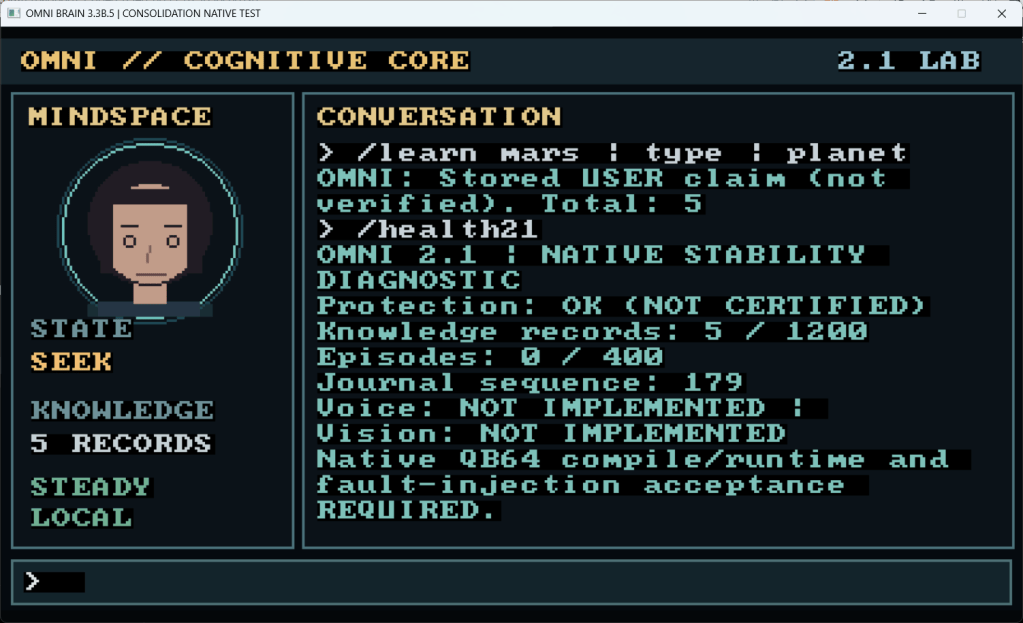
Another part of today’s work involved her native stability diagnostics. The program reported five knowledge records, an operational protection status, and a journal sequence of 179. These are encouraging signs, although the program itself makes it clear that additional native testing and fault-injection checks are still required before I can call this stage fully certified.
And that’s perfectly fine with me. I’d rather spend the extra time getting the foundations right than end up with a mountain of spaghetti code that barely functions.
What makes all of this so exciting isn’t that I’ve suddenly created some remarkable artificial intelligence capable of understanding the universe. I’m nowhere near that point. It’s that I’m slowly putting together the individual systems that something more intelligent will eventually need: memory, knowledge, reasoning, consistency, and the ability to recognize uncertainty.
There is still an enormous amount of work ahead of me, and I haven’t the slightest idea just how far I’ll manage to take this project. But every successful native test, every problem identified, and every improvement brings me a little closer to what I’ve wanted to build for so many years.
And really, isn’t that the beauty of creating something from nothing?
I certainly think so.
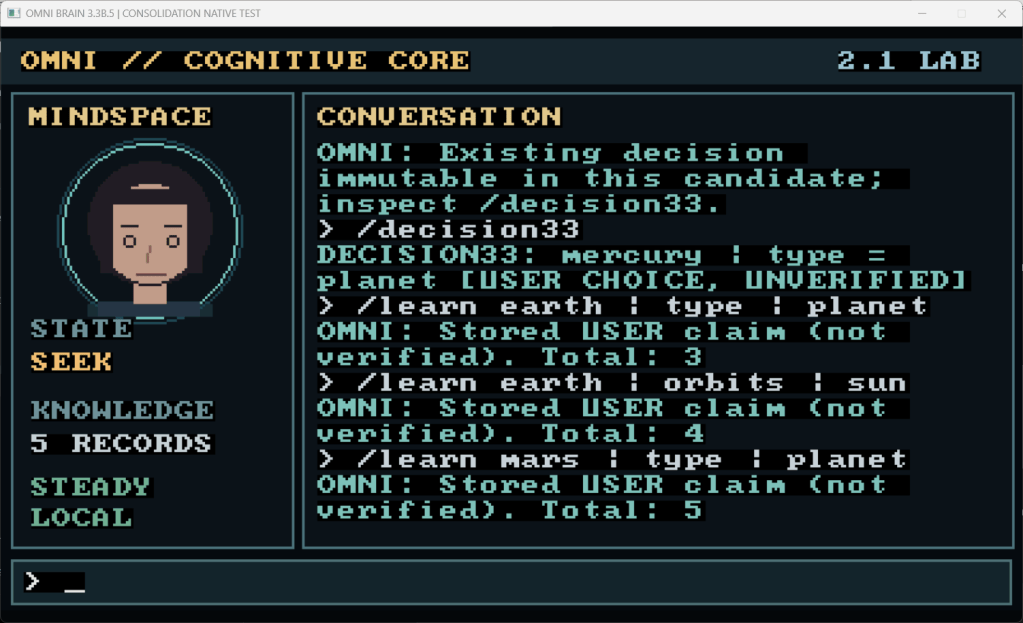
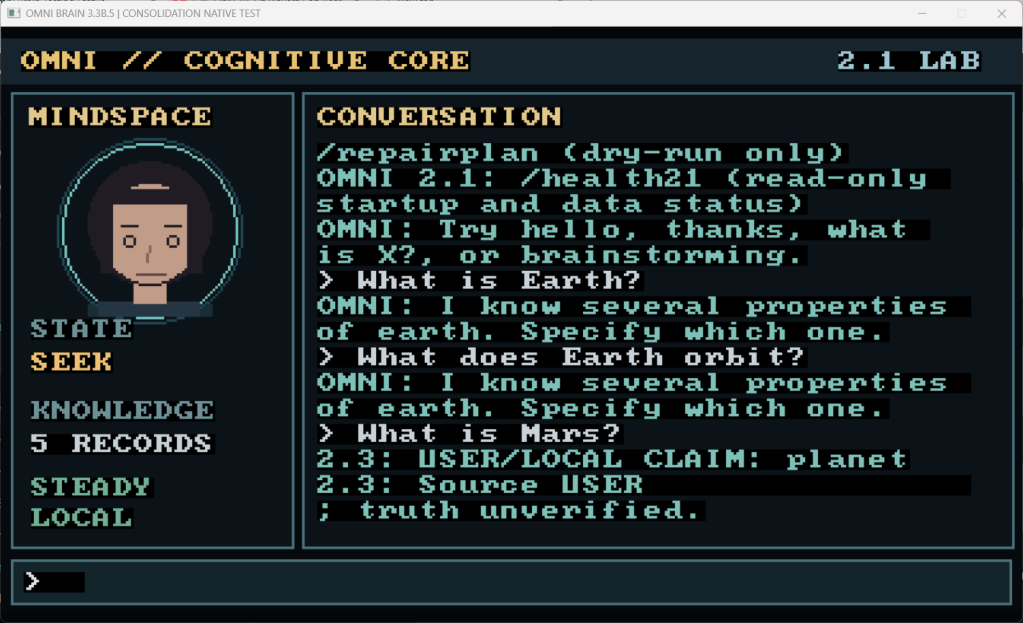
I began by asking Omni Brain several basic questions about Earth and Mars. I wanted to see how she would respond when presented with questions that should eventually be answered through her own knowledge system. Her responses showed that she still has considerable work ahead of her when it comes to understanding ordinary questions and retrieving appropriate information.
Here I tested what happened when Omni Brain encountered contradictory information about Mercury. Instead of quietly replacing the existing information, she reported that the original conflict had been retained and identified the information as user-authorized rather than independently verified. This was an important part of examining how her knowledge system handles disagreements.
I inspected an existing decision concerning Mercury, then deliberately introduced several incorrect statements about Earth and Mars. Omni Brain accepted the new statements into storage but clearly identified them as unverified user claims. I wanted to make certain that different types of information could be recorded without automatically being treated as established facts.
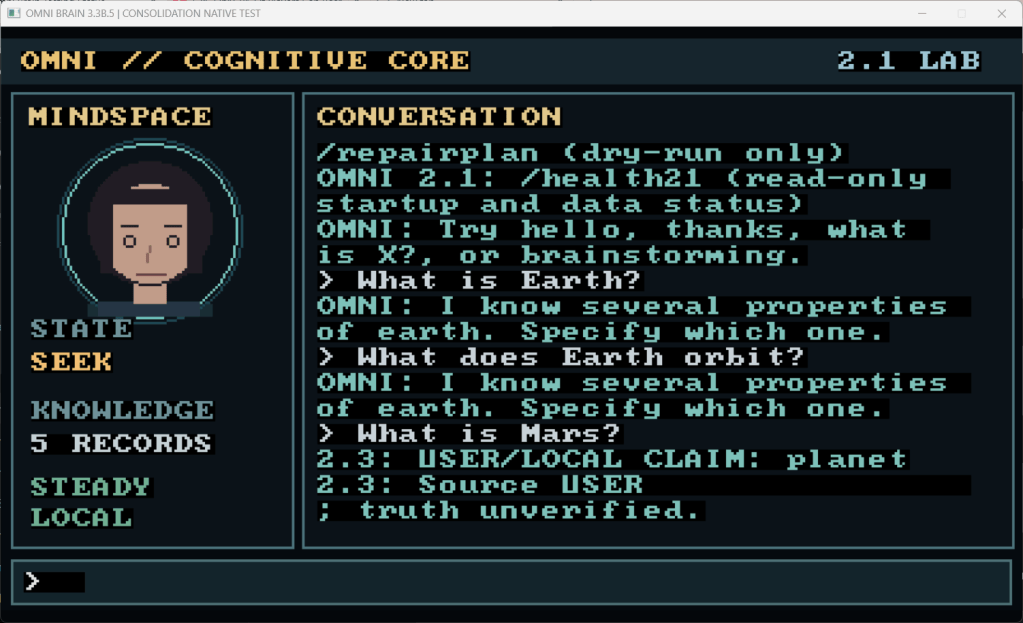
I returned to the earlier questions about Earth, Mars, and Mercury to examine how Omni Brain handled the information already present in her knowledge system. The results showed that conflicting claims could be identified and retained, while also revealing that her general conversational understanding and knowledge retrieval still need considerable improvement.


Leave a Reply