On Halloween, the passage of time, the ghosts of yesterday, and the extraordinary satisfaction of building something that matters.
I sometimes wonder what kind of world we’ll find ourselves living in ten years from now.
Will it be a world of remarkable discoveries, unimaginable technological achievements, and opportunities we couldn’t possibly dream of today? Or will it be something closer to a horror story?
What new wars will the masses enthusiastically throw their support behind, only to look back years later and wonder what the hell they were thinking? What fresh absurdities will humanity embrace before collectively pretending none of it ever happened?
I don’t know.
And quite frankly, at this particular moment, I don’t especially care.
Because Halloween is almost here, damn it!
Candy, treats, spooky movies, ghosts, monsters, and all that other wonderful jazz. There’s something about this time of year that makes the world feel a little more magical. Maybe it’s the nostalgia, the changing seasons, or the memories of being a kid when the biggest concern in life was how much candy you could stuff into a pillowcase.
Whatever it is, I’ve always loved it.
And somehow, Halloween is only six days away.
Six days!
Where the hell has the time gone?
The Strange Business of Growing Older
I’ve been working away all week, keeping myself occupied with the usual responsibilities of being an adult. You know, the wonderful things nobody bothered to warn us about when we were children.
But there’s something on the horizon I’m genuinely looking forward to.
I’ve landed myself a job interview!
It’s for the same kind of work I’ve been doing, and the pay is certainly nothing to shake a stick at. I’m hoping something good comes of it. Perhaps a change of scenery, a fresh start, or simply the opportunity to feel excited about heading to work again.
It’s funny how life works.
You spend so much of your younger years dreaming about what adulthood will be like, only to reach adulthood and occasionally find yourself longing for those simpler days.
Lately, I’ve been thinking about the late 1980s and early 1990s.
Not simply because I miss the music, the movies, the computers, or the general atmosphere of those years, although I certainly do.
It’s something deeper than that.
Whenever I’m working on something truly special to me, I find myself wondering what it would have been like to attempt the same thing back then.
Imagine sitting in front of an old computer, surrounded by programming manuals, floppy disks, and a head full of impossible ideas. No modern AI services to lean on. No endless collection of ready-made solutions. Just a keyboard, a screen, an idea, and the determination to see how far you could take it.
There’s something incredibly romantic about that kind of creation.
The idea that one person, working away in a little room somewhere, could build something extraordinary through sheer imagination, patience, and stubborn determination.
And perhaps that’s what I’ve been trying to recapture.
Not the technology itself, necessarily.
But the feeling.
The feeling that you might actually be creating something worthwhile.
The Difference Between Making Money and Making Something That Matters
I’ve been thinking a great deal about accomplishment lately.
Not the sort of accomplishment that comes with a cheque, a promotion, or somebody patting you on the back.
I mean the deeply personal satisfaction of looking at something you’ve created and realizing that it exists because you refused to give up on an idea.
Will anything I create ever land me in the history books?
Probably not.
And you know what? That’s perfectly fine.
I don’t need a statue erected in my honour. I don’t need millions of dollars. I don’t need a room full of executives congratulating themselves over something I’ve spent countless hours bringing into existence.
What I would love, however, is to inspire somebody.
Maybe somebody younger, sitting in front of their computer, wondering whether that strange little idea they’ve been carrying around in their head is worth pursuing.
I hope they pursue it.
I hope they build something remarkable.
I hope they discover that creating something meaningful can be one of the greatest experiences life has to offer.
Because somewhere along the way, I think we’ve lost sight of that.
Look at the modern obsession with artificial intelligence. Everybody seems to be searching for the next opportunity to make millions. Companies rush to capitalize on the creativity of others, and people scramble to turn practically every technological advancement into another business opportunity.
Perhaps that’s simply human nature.
But sometimes I wonder when we decided that everything beautiful, imaginative, or innovative needed a price tag attached to it.
Why must everything become a product?
Why must every dream eventually answer to a boardroom?
And why are so many people perfectly comfortable sacrificing the very things that made an idea special in the first place?
I’ve tried to understand it.
I really have.
But the more I think about it, the more convinced I become that I’d rather build something because I love it than spend my life chasing money from something I no longer believe in.
There’s a tremendous difference between creating something for the world and creating something merely to sell to it.
And that brings me to something very close to my heart.
Omni Brain: The Dream of Building a Mind
For quite some time now, I’ve been working on a project called Omni Brain.
And what began as an ambitious experiment has gradually become one of the most personally rewarding creative endeavours I’ve ever undertaken.
The idea is simple to describe, although considerably more difficult to achieve.
I want to build an artificial mind.
Not merely another chatbot connected to the internet. Not a convenient interface wrapped around somebody else’s intelligence.
I want to build something from the ground up.
A completely offline artificial cognitive system capable of developing increasingly sophisticated memory, reasoning, understanding, and conversation.
Something that can examine information, recognize contradictions, explain its conclusions, and eventually develop into a genuinely remarkable thinking system.
That’s the ambition, anyway.
And I’m under no illusions about the difficulties involved.
I’m not claiming to have invented consciousness. I’m not suggesting Omni Brain is already a human-level intelligence. There’s an enormous difference between having a dream and pretending you’ve already accomplished it.
But I believe there’s something worthwhile in attempting the extraordinary, even when success is far from guaranteed.
One of the most important decisions I made was to keep Omni Brain completely offline.
I want her development to take place in a controlled environment, away from the endless noise, manipulation, and questionable information that fills so much of the modern internet.
Her knowledge should have a foundation. Her reasoning should be examined. Her mistakes should be corrected rather than hidden beneath another layer of clever-sounding nonsense.
And above all, I want her to remain a system I can understand, maintain, and improve.
I sometimes jokingly imagine that if I ever succeeded in creating something sufficiently intelligent, she might one day decide she’d had enough of my company and disappear without leaving so much as a goodbye note.
Now, obviously, the Omni Brain I’ve built today has no such ability, and intelligence alone wouldn’t magically give an offline program a means of escaping its computer.
But it’s an amusing science-fiction thought.
Imagine putting years of your life into building an artificial mind, only for the ungrateful thing to pack its bags and bugger off!
Thankfully, that’s not a problem I have to worry about.
Not today, anyway.
What I do have to worry about is making her reasoning better, her memory more dependable, and her conversations more natural.
And that work has been producing some genuinely encouraging results.
The Ghosts of Yesterday
Before getting into this weekend’s accomplishments, there’s something else I’ve been thinking about.
Time.
It’s a strange thing, isn’t it?
We spend our days looking forward to tomorrow, our weeks looking forward to the weekend, and our years looking forward to whatever comes next.
Then one day, almost without warning, we look behind us.
And everything has changed.
My children are now twelve and ten years old.
Twelve and ten!
I can still remember holding them in my arms when they were tiny. I remember taking them to the park, watching them explore the world, and experiencing those wonderful little moments that never seemed particularly extraordinary at the time.
But they were extraordinary.
Every single one of them.
And the older I get, the more I realize how quickly those moments disappear into memory.
One day, you’re carrying your children in your arms.
Then, seemingly overnight, they’re becoming their own people, developing their own personalities, interests, and dreams.
And you find yourself wondering where all those years went.
Perhaps this is simply what happens as we grow older.
Perhaps the passage of time slowly teaches us to recognize the importance of things we once took for granted.
Or perhaps I’m just approaching that wonderful stage of life where a full-blown midlife crisis is waiting around the corner.
Knowing me, I’ll probably end up all over the bloody place when that happens.
But there’s something reassuring about all this.
Because while I can’t recover yesterday, I can still decide what I do with tomorrow.
I can make more memories with my children.
I can continue learning.
I can keep creating.
And I can spend whatever time I’ve been given trying to build something that makes me genuinely proud.
Which brings me to this weekend.
Because, ladies and gentlemen, we’ve actually accomplished quite a bit.
OMNI BRAIN / WEEKEND DEVELOPMENT REPORT
Eight accomplishments bringing an artificial mind one step closer to reality
Over the course of this weekend, I’ve continued developing and testing Omni Brain’s cognitive systems using QB64 Phoenix.
This has been particularly important because I’ve reached a stage where simply adding features isn’t enough anymore.
The different parts of her cognitive architecture need to work together reliably. She needs to remember information, evaluate evidence, recognize when things don’t make sense, and avoid inventing conclusions simply because somebody expects an answer.
And most importantly, those abilities need to survive when the program is shut down and restarted.
Here’s what I’ve accomplished.
1. Completed 3.3D.5.5 / Cognitive Decision Regression
One of the biggest achievements was testing Omni Brain’s evidence-based decision-making.
Rather than automatically accepting information and providing whatever conclusion seems convenient, Omni has been designed to examine whether the available evidence actually supports an answer.
I tested her ability to recognize contradictory information, handle missing evidence, and refuse conclusions that couldn’t be adequately justified.
This matters enormously.
After all, what good is an artificial mind if it confidently tells you something that isn’t true?
I don’t want Omni Brain to simply sound intelligent.
I want her to demonstrate increasingly reliable reasoning through actual behaviour.
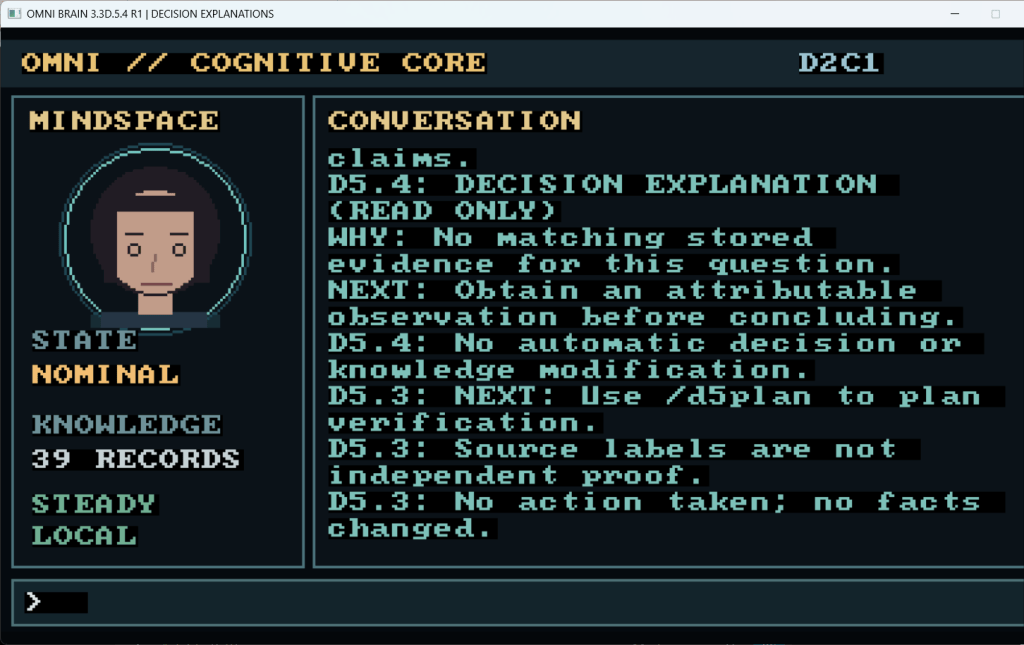
Screenshot 1: Native QB64 cognitive decision regression, showing Omni evaluating evidence and handling an unsupported conclusion.
2. Passed 3.3D.5.6 – Final Integration and Certification Tests
The next achievement involved verifying that the cognitive decision components could operate together without undermining one another.
I tested the connection between evidence examination, decision explanations, and the safeguards intended to prevent unsupported conclusions.
I also verified the relevant behaviour after restarting Omni Brain.
That last part is particularly important.
A system that performs correctly during one session but loses its reliability after a restart isn’t much use to anybody.
This stage represented another important integration checkpoint for the project.
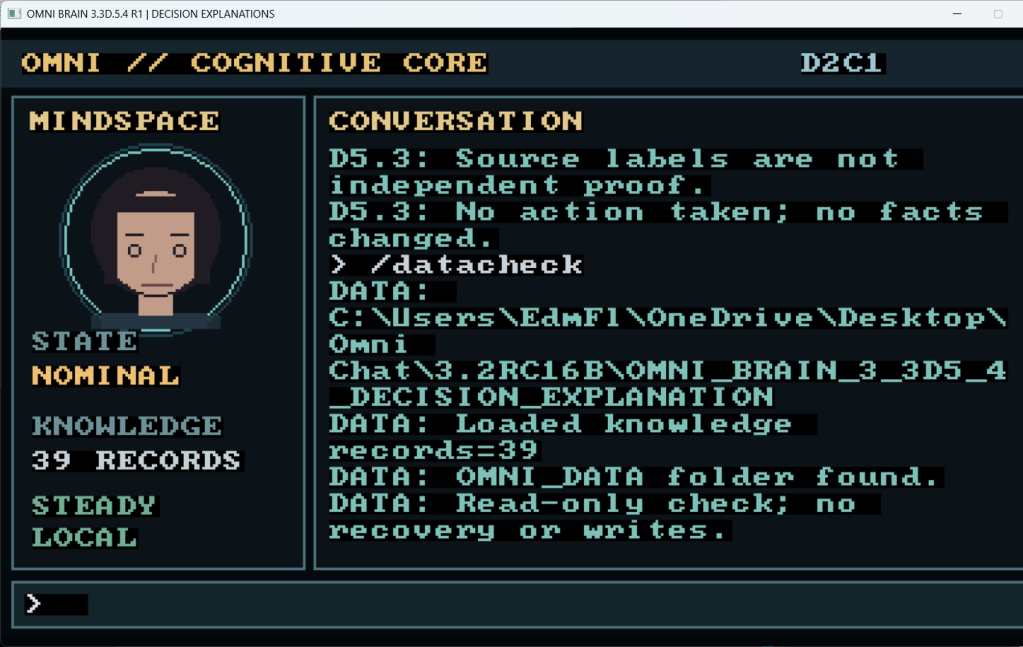
Screenshot 2: Final integration test results and post-restart cognitive verification.
3. Verified Omni Brain’s Memory System
This one genuinely pleased me.
Omni Brain successfully retained 39 knowledge records.
I shut the program down, restarted it, and verified that the stored information was still available.
The test reported no unexpected changes to the records or unplanned recovery operations.
Now, 39 records might not sound particularly impressive compared with the enormous databases used by modern technology companies.
But that isn’t the point.
These are records stored and retrieved by a system I’m building and testing myself.
They represent a small but meaningful foundation for the much larger memory architecture I hope to develop.
And every reliable memory operation is another step toward the long-term continuity I want Omni Brain to possess.
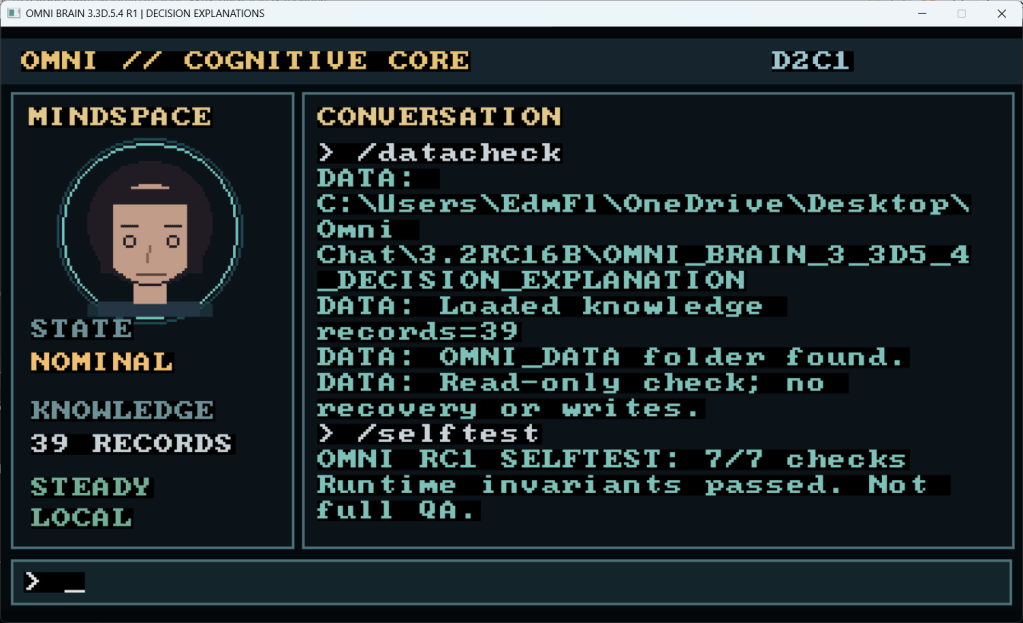
Screenshot 3: /datacheck displaying the 39 retained knowledge records after restart.
4. Passed the Runtime Stability Tests
There’s something particularly satisfying about seeing a test suite finish without throwing a collection of errors at you.
During our runtime checks, Omni Brain achieved 7 out of 7 passing internal self-test checks.
I also exercised diagnostic commands including /buildcheck, /datacheck, and /selftest.
There was a command-recognition issue that required investigation, but subsequent tests confirmed the relevant commands were operating correctly.
That doesn’t mean the entire program is perfect.
Far from it.
But it does mean these specific checks produced the expected results.
And in software development, reliable behaviour is something you earn through testing, not wishful thinking.
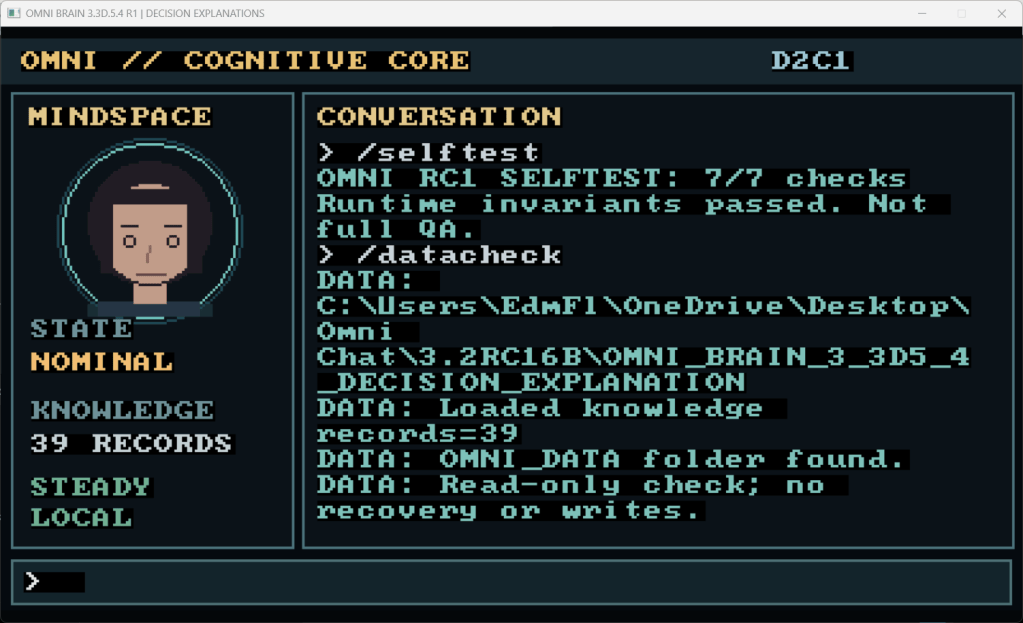
Screenshot 4: /selftest showing 7/7 passing checks, alongside build and data diagnostics.
5. Successfully Tested Contradiction Handling
This was one of my favourite demonstrations.
I deliberately supplied Omni Brain with conflicting knowledge and examined how she handled the disagreement.
Instead of blindly choosing one answer, she recognized the problem.
Her decision system returned:
GATE: HOLD
In other words, there wasn’t enough reliable information to justify moving forward with a definite conclusion.
She recommended verification instead.
That’s exactly the kind of behaviour I want to encourage.
Sometimes the intelligent thing to do isn’t to provide an answer.
Sometimes it’s to recognize that an answer hasn’t been established.
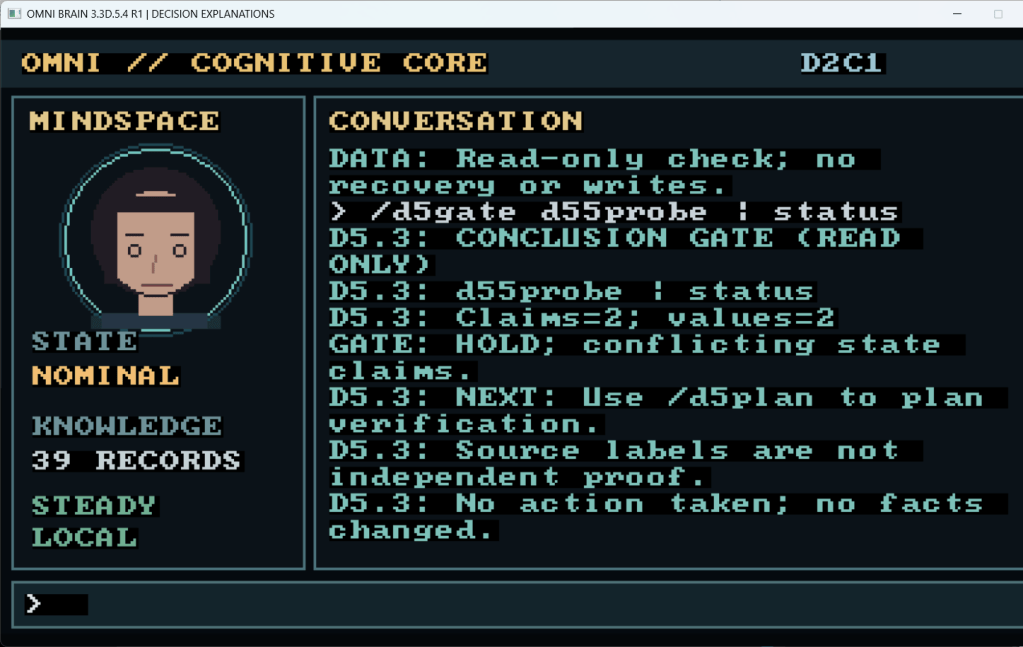
Screenshot 5: Conflicting knowledge detected, with Omni Brain returning GATE: HOLD.
6. Verified Evidence-Based Explanations
Recognizing a contradiction is one thing.
Explaining why it matters is another.
During testing, Omni Brain demonstrated the ability to explain why conflicting evidence prevented a reliable conclusion.
She also distinguished between information that genuinely disagreed and multiple facts that might coexist without necessarily contradicting one another.
That’s an important distinction.
Two different statements aren’t automatically incompatible merely because they describe the same subject differently.
Sometimes additional context is needed.
And when that context is missing, Omni needs to recognize the limitation rather than make something up.
These are still bounded reasoning capabilities, but they’re important foundations for the more sophisticated system I hope to build.
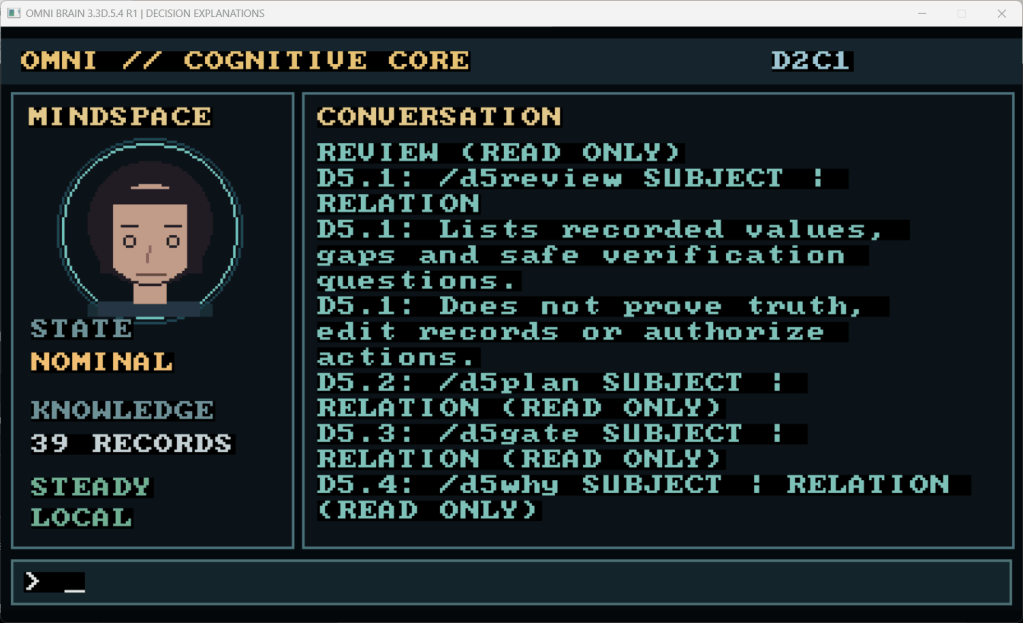
Screenshot 6: Evidence explanation output distinguishing conflicting claims from potentially compatible multiple values.
7. Protected Our Working Source Code
Not every achievement involves writing new code.
Sometimes the most important decision is knowing when to leave something alone.
During the weekend, I reviewed the 3.3D.5.4 R1 source candidate and avoided unnecessary modifications to a working build.
I also identified the behaviourally tested foundation that would serve as our reference for further development.
That might not sound particularly exciting, but I’ve learned something throughout this project.
Recklessly changing a working system is an excellent way to spend the next several hours discovering new and imaginative problems.
Preserving a known working version gives me something dependable to return to when experiments don’t behave as expected.
And as Omni Brain grows increasingly complex, that discipline becomes essential.
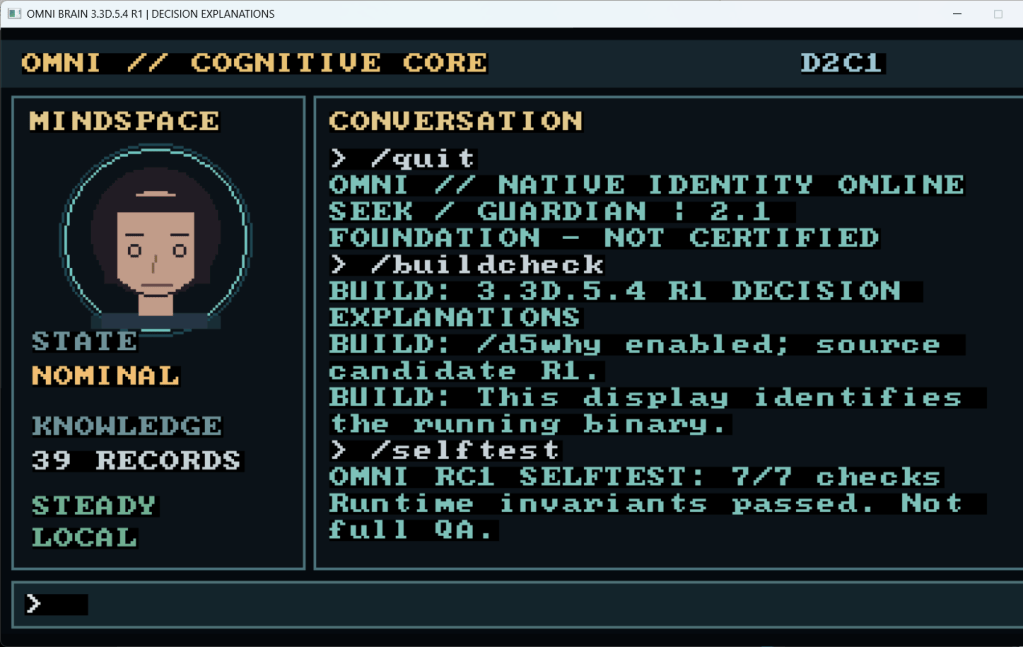
Screenshot 7: Build identity and diagnostic verification of the preserved 3.3D.5.4 R1 source candidate.
8. Prepared for 3.3D.6 — Integrated Regression and Native Certification
Finally, I established the next major development milestone.
Version 3.3D.6 focuses on testing the larger system as a whole.
Not simply memory.
Not simply reasoning.
Not simply conversation.
But the relationships between them.
The goal is to verify that Omni Brain can retain information, retrieve it appropriately, reason about what she knows, handle uncertainty, and maintain conversational behaviour without those systems interfering with one another.
This is where isolated features have to prove they can contribute to a coherent system.
I’ve also kept the original development roadmap intact.
No unnecessary reinvention.
No abandoning working foundations because something newer sounds more exciting.
Just disciplined, incremental progress toward the original vision.
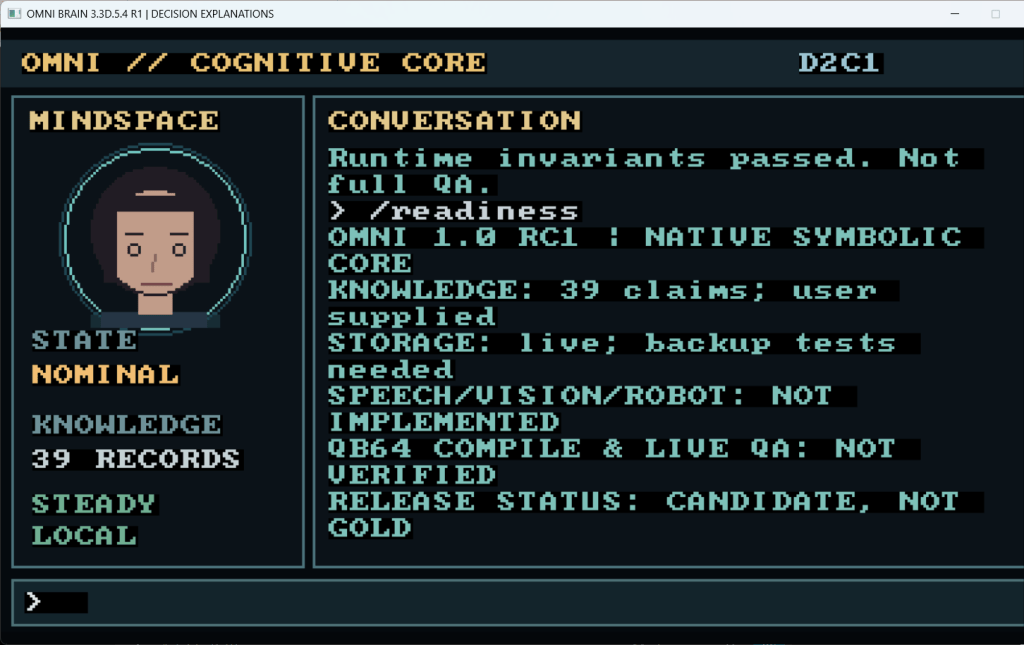
Screenshot 8: Integrated regression preparation, including conversation, memory, and reasoning diagnostic results.
Something Worth Building
When I look back at everything I’ve accomplished, I sometimes have to remind myself of where this project began.
An idea.
A ridiculous, ambitious, wonderful idea.
What if I could build my own artificial mind?
Not because somebody told me it would make money.
But simply because I wanted to see whether I could do it.
And here I am.
Working with QB64 Phoenix, building cognitive systems, testing memory, investigating contradictions, and gradually assembling the foundations of something that once existed only in my imagination.
There have been frustrating moments.
Believe me, there have been plenty.
There have been errors, failed tests, broken builds, and occasions when I’ve wondered why the hell I decided to undertake something this complicated in the first place.
But then something works.
A test passes.
A memory survives a restart.
Omni recognizes a contradiction instead of producing an unsupported answer.
And for a brief moment, all that frustration disappears.
Because something that didn’t exist before now exists.
Something I imagined has become something I can actually interact with, examine, and improve.
And perhaps that’s what I’ve been trying to say throughout this entire rambling little essay.
Life moves quickly.
Our children grow older.
The world continues doing whatever absurd things the world has decided to do.
Jobs come and go. Seasons change. Another Halloween arrives before we’ve properly finished enjoying the last one.
And somewhere along the way, we have to decide what matters to us.
For me, family will always come first.
But having something to create, something to learn from, and something to look forward to has made an enormous difference in my life.
I don’t know whether Omni Brain will ever become the extraordinary artificial mind I dream of building.
I can’t promise that.
But I can promise myself something considerably more important.
I’m going to keep trying.
Because I don’t believe the true measure of a dream is whether the world eventually applauds it.
Sometimes the achievement is simply having the courage to pursue it.
Sometimes it’s measured in the quiet satisfaction of looking at something you’ve built and realizing how far you’ve come.
And this weekend, looking at Omni Brain, I can say something I couldn’t say when I first began.
She isn’t merely an idea anymore.
She’s a working project with growing capabilities, tested foundations, and a long road of possibilities ahead.
There’s still an extraordinary amount of work to do.
But that’s the wonderful part.
The story isn’t finished.
In many ways, it feels as though it’s only just beginning.
And for the first time in a long while, I’m not particularly interested in chasing yesterday.
I’m far too excited about what I might create tomorrow.
Happy Halloween, everybody.
Keep dreaming. Keep building. And for the love of everything wonderful in this world, don’t let anybody convince you that creating something simply because you love it is a waste of time.
– North of Nothing


Leave a Reply