When I wrote my last Omni Brain update, I was celebrating how far the project had come through the 3.x releases and into the 4.0 development series. At that point, 4.0.1 was laying the groundwork for bringing the various cognitive systems together. Since then, I have spent much of my time on something that sounds simple but is surprisingly difficult to get right: making Omni Brain follow a conversation without losing what I’m actually talking about. That has been the main story of 4.0.2. It has also been a reminder of why I began this project in the first place. I am not trying to make a program that produces impressive-looking answers while hiding its weaknesses. I want to build a dependable offline companion whose abilities can be demonstrated, tested and gradually improved. Some evenings that means adding a new capability.
Other evenings it means spending hours on a short question like “Why?” because the answer reveals whether the system really understands the context of the exchange.
## The Work Behind a Simple Follow-Up
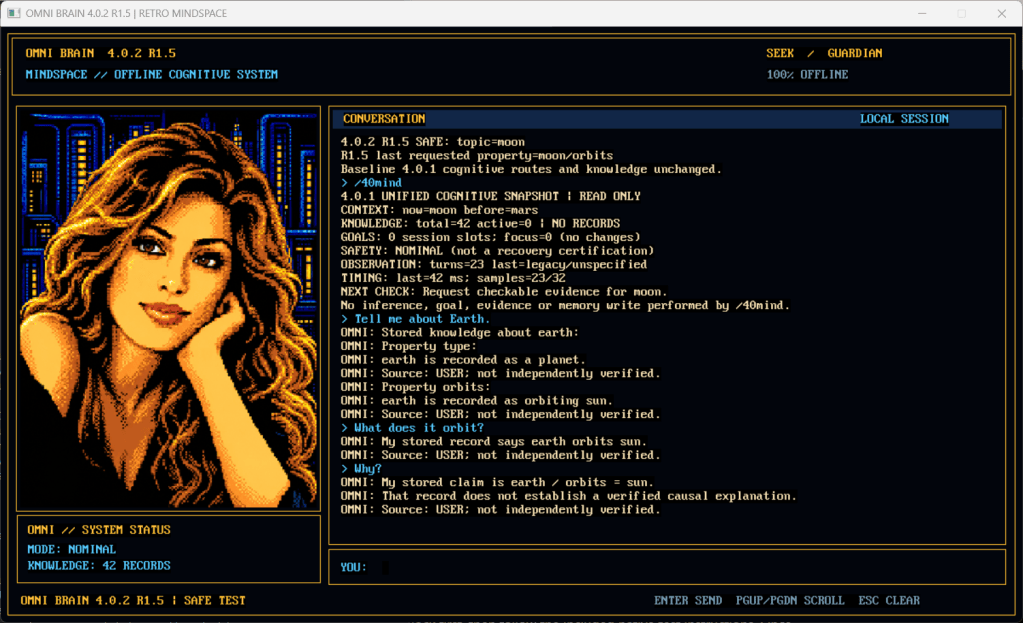
In the earliest 4.0.2 tests, Omni Brain could retrieve stored facts and identify the topic of a conversation, but its follow-up behavior was not always reliable. I could ask about Earth, receive a stored claim that Earth orbits the Sun, and then ask why. At first, the follow-up sometimes led to an overly generic reply. The system recognized the words but was not consistently carrying the intended question forward. We worked through that problem in the R1.2 and R1.3 patches. The goal was to connect short questions such as “Why?”, “What does it orbit?” and “What evidence supports that?” to the subject and property under discussion. I also wanted to keep one principle firmly in place: Omni Brain must not pretend that an item in its knowledge store has been independently verified. A stored claim is a stored claim. If the source is marked USER, the response should make that clear. The tests showed progress almost immediately. Omni Brain began keeping track of subjects such as Earth, Mars and the Moon. It could retrieve the orbit property recorded for Earth, identify when the equivalent property was missing for Mars, and admit when there was not enough stored evidence to answer a question about the Moon. These are modest abilities compared with a modern cloud-based AI, but for an offline system being built and tested piece by piece, they matter.
## The Mars Bug That Taught Me Something
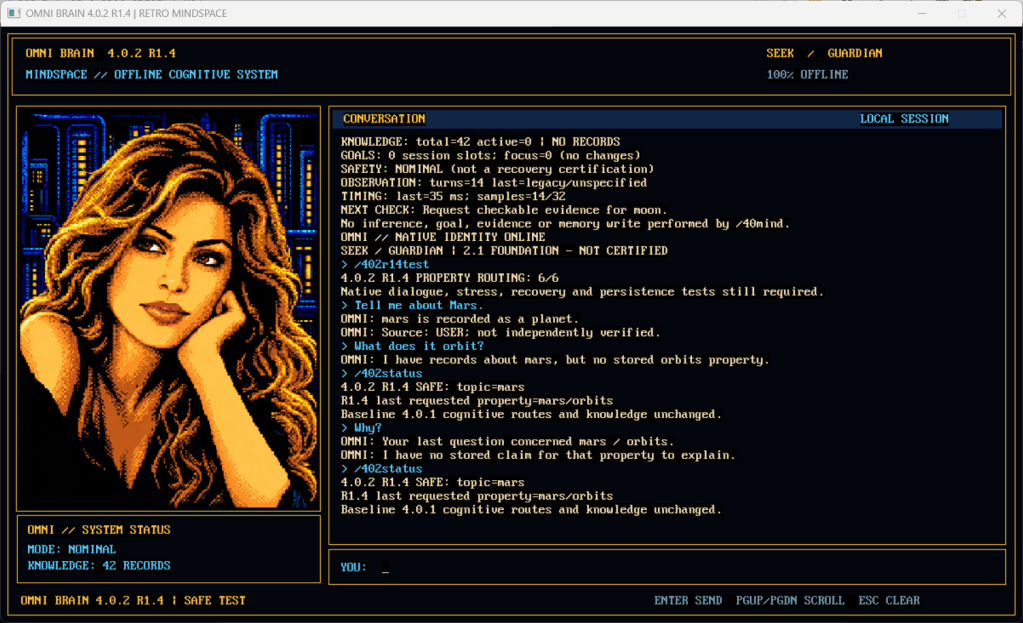
One particular failure became the defining repair of this development round. I asked Omni Brain what Mars orbits. She correctly reported that she had records about Mars but no stored ‘orbits’ property. Then I asked “Why?” and she fell back to a different record, one identifying Mars as a planet. The subject was right, but the property was wrong. That meant the system remembered Mars without fully remembering what I had just asked about Mars. Version 4.0.2 R1.4 addressed that exact flaw. Instead of remembering only properties that had produced successful retrievals, the conversation layer began retaining the property being requested even if the answer was absent.
That distinction made the next reply far more reliable. During the native QB64 test, Omni Brain recognized that my last question concerned “mars / orbits” and explained that no stored claim for that property was available. She did not switch back to “mars / type” or invent an explanation to fill the gap. That was one of those moments when the result may look small on the screen but represents a meaningful step in the engineering. Context is not just the name of the last thing mentioned. It also includes what I was asking about that thing. If Omni Brain is going to sustain a real conversation one day, both parts must survive from turn to turn.
## The Final 4.0.2 Tests
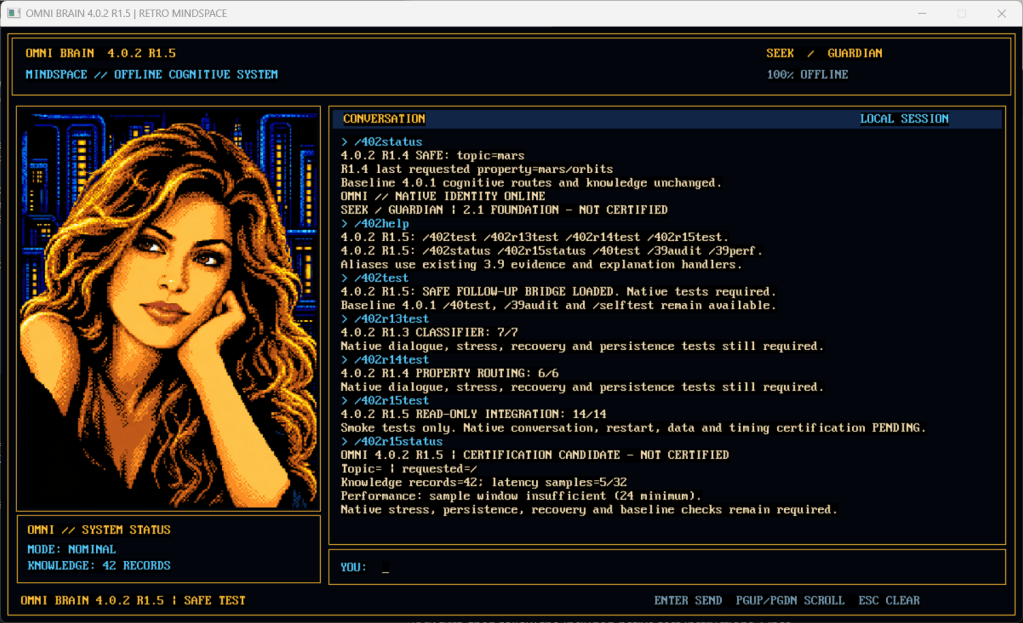
I carried those fixes into 4.0.2 R1.5, a final integration and certification candidate. The internal read-only integration suite reported 14 out of 14 passing checks. The earlier R1.4 property-routing checks reported 6 out of 6, and the existing 4.0.1 coordinator, 3.9 cross-system audit and runtime self-test also passed their reported checks. We tested the same Earth, Mars and Moon exchanges again to make sure the new fixes had not broken older behavior. The system continued to report 42 knowledge records, and its diagnostic views showed that it could track both the current topic and the preceding one. More importantly, the conversation itself matched the intended behavior. Earth could be discussed using its stored orbit claim. Mars could be discussed without pretending that an orbit claim existed.
Switching to the Moon did not cause Omni Brain to confuse its subject with Mars or Earth. I also tested a normal restart. After reopening the program, Omni Brain passed its self-test, reported the expected knowledge count and could retrieve the Earth records again. That gives me useful confidence in the working baseline and normal-startup knowledge access. It is not proof that every possible failure mode has been eliminated, and I do not want to pretend otherwise. Full performance certification and abnormal-shutdown recovery testing still need dedicated evidence. For now, 4.0.2 is a functionally accepted milestone for the conversational features we actually tested, not a claim of a perfectly certified artificial intelligence.
## Keeping the System Honest
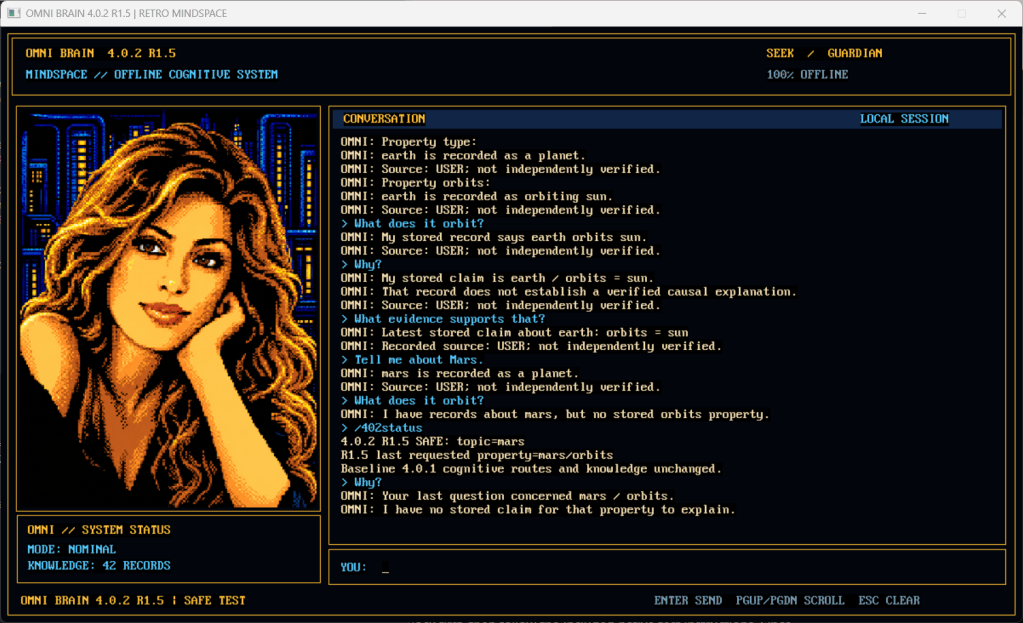
One of the things I have become most particular about is the difference between knowing, remembering and verifying. Omni Brain has to handle incomplete information without turning it into fiction. The current builds regularly identify the source of their stored claims and decline to offer a causal explanation when the necessary evidence is not there. That is not a limitation I want to hide. It is a discipline I want to develop further. The same applies to testing.
I am preserving working baselines, using read-only diagnostics where appropriate, and making changes in controlled steps rather than constantly rewriting the entire program. It can be slow work, especially when a single conversational bug requires another round of bug hunting. But every protected milestone gives the next one a firmer foundation.
## Now Entering 4.0.3
With 4.0.2 functionally accepted, I have begun 4.0.3. Its first development candidate introduces grounded comparison: the ability to examine stored information about two subjects and describe what is shared, what differs and where the records are incomplete. This is an early source-level feature, not yet a fully native-certified finished 4.0.3 release. I want to test it carefully before making larger claims. Comparison is a natural next step. A conversation becomes more useful when Omni Brain can do more than retrieve individual records.
I want her to connect relevant details, distinguish similarities from differences and explain what evidence is missing. Eventually those abilities should contribute to more capable reasoning, better questions and a conversation that feels less like consulting a database. I have not forgotten the experience surrounding the intelligence, either. The retro MINDSPACE interface, her portrait, the status display and the overall visual identity remain a major part of this project. I want Omni Brain to feel distinctive and approachable, but the appearance must be supported by actual behavior.
A beautiful interface means very little if the mind behind it cannot follow a thought. That is where the project stands tonight. There are still plenty of shortcomings, and much more engineering lies ahead. But I can look at the results and point to specific behaviors that work better than they did before. For me, that is real progress. Omni Brain is moving forward, one tested capability at a time.
## The Future of Omni Brain
My end goal has never been to build another chatbot that depends on a distant service to function. I want an independent, offline-first artificial companion: a system that can hold meaningful conversations, maintain a durable memory, understand the difference between evidence and assumption, reason through new situations and build useful continuity over time. I want it to have an identifiable character without pretending that we have already solved the enormous scientific questions surrounding consciousness or human-level intelligence. The long-term vision includes a richer conversational engine, better language understanding, stronger reasoning, attention and goal management, personal memory with proper safeguards, and the ability to reflect on its own limitations. Eventually I want her to speak with a warm, natural voice and express herself through a more dynamic visual presence.
I also dream of giving her some form of physical embodiment someday, but the mind comes first. Before any of that, the offline foundation must be reliable. One future direction that especially interests me is controlled self-improvement. I want Omni Brain to recognize weaknesses in her own performance and help propose possible changes. Any code changes would have to be tested in isolation, measured against a protected baseline and approved by me before installation. I do not want uncontrolled self-modification. I want a system that can improve carefully, explain its reasoning and remain recoverable when something goes wrong.
I know this is an ambitious project, especially with the constraints I have chosen. But those constraints are part of its identity. I want to keep ownership of the system, its memory and its future. The dream is to create something personal, intelligent, dependable and entirely at home on my own computer. I am not there yet. I am building toward it, and every honest, measurable milestone brings the dream a little closer.


Leave a Reply