Development Update | November 25, 2026
Over the past several days, I’ve been pushing Omni Brain further than ever before. What originally began as an attempt to create an intelligent, entirely offline companion using QB64 Phoenix has grown into something considerably more ambitious. My goal has never been to create another chatbot that simply recognizes commands and spits out predetermined responses. I want to build something capable of conversation, memory, reasoning, learning, and eventually developing a deeper understanding of the world around it.
And right now, I’m working on one of the most important parts of that entire vision: the mind itself.
Moving Beyond Scripted Conversations
Much of my recent development has centered around ONCLE 2, the second major stage of Omni Brain’s conversational and cognitive development.
During earlier testing, I discovered that Omni Brain could respond to certain questions quite well, particularly when the questions followed patterns that had already been anticipated during development. However, when I began having ordinary conversations with her, the limitations became obvious.
I could ask about Mars, switch to the Titanic, or discuss the Moon, and she would sometimes recognize the subject and provide an appropriate response. But when I introduced unfamiliar questions, personal experiences, jokes, or unexpected changes in conversation, she frequently struggled.
That was an important realization.
I didn’t want to spend the rest of this project programming thousands of individual sentences just so Omni Brain could appear intelligent. I wanted her to have the knowledge and conversational mechanisms necessary to construct meaningful answers.
That realization changed the direction of my development.
Giving Omni Brain Knowledge
I began developing what I call the Offline Knowledge and Language Foundation, a system intended to give Omni Brain access to factual information without relying on an internet connection or an external AI service.
The initial version contained only 51 reference subjects. It was enough to demonstrate that the concept worked, but nowhere near enough for the type of intelligence I eventually want.
I subsequently expanded that library to 252 subjects covering astronomy, history, science, geography, technology, everyday objects, and other areas of general knowledge.
The important part wasn’t simply increasing the number of subjects. I also started developing ways for Omni Brain to recognize alternative names, retrieve relevant information, and distinguish supported facts from information she doesn’t possess.
For example, she can now retrieve information about the Roman Empire, explain how submarines operate underwater, describe volcanic eruptions, and discuss the Milky Way using her bundled offline reference material.
These may sound like relatively simple accomplishments compared with modern artificial intelligence systems, but for a project I’m developing around QB64 Phoenix, they’re meaningful milestones.
Connecting Information Instead of Memorizing It
The next challenge was reasoning.
Knowing what the Moon is and knowing what Earth is doesn’t necessarily mean a computer can explain the differences between them.
To address this, I introduced a relationship system that allows Omni Brain to identify supported connections between subjects.
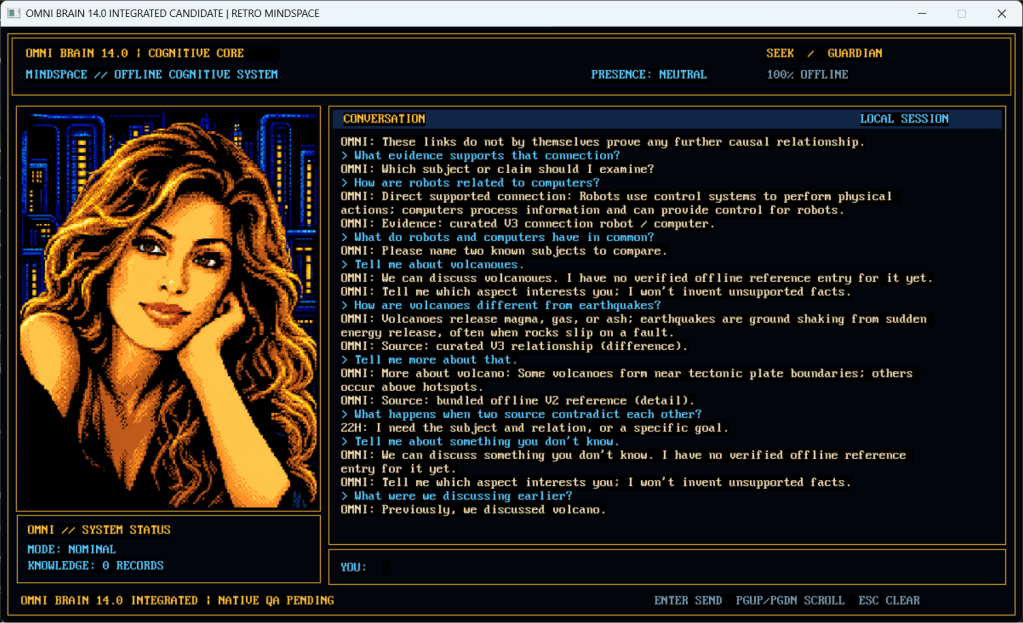
I began with 22 curated relationships. These allow her to compare subjects such as the Moon and Earth, volcanoes and earthquakes, and ancient Rome and ancient Egypt.
I then expanded the foundation into a basic knowledge graph capable of tracing certain two-step connections.
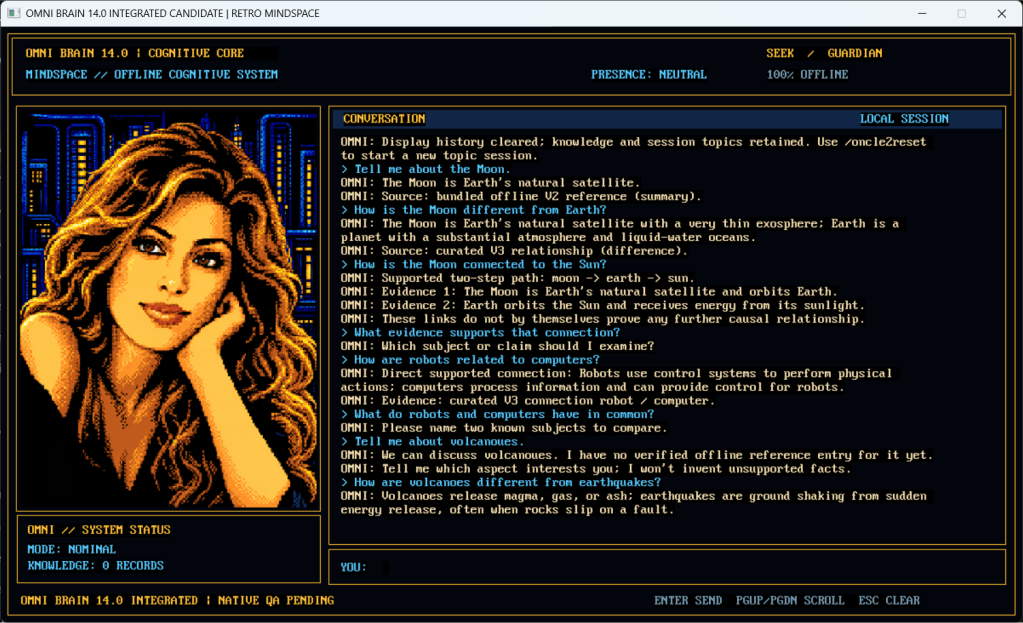
One of my favorite tests involved asking Omni Brain how the Moon is connected to the Sun.
She successfully identified a path through Earth, explaining that the Moon orbits Earth and Earth orbits the Sun. More importantly, she presented the supporting information separately instead of pretending those connections proved something beyond the available evidence.
I also tested her ability to identify a connection between Mars and the Moon through Earth, and to acknowledge when no supported connection could be found.
This is still bounded reasoning based on explicitly recorded relationships. It isn’t unrestricted independent reasoning, but it gives me a working structure that can be expanded and improved.
One Integrated Foundation
Another decision I made recently was to change how I organize development releases.
For a while, I was building and testing each improvement as a separate version. Although this helped isolate programming problems, it also created an unnecessary number of builds and repetitive testing sessions.
I’ve now decided to consolidate the remaining foundation work into one integrated development candidate.
The latest build brings together 252 reference subjects, 22 curated relationships, 31 structured evidence claims, and the existing ONCLE 2 conversation mechanisms.
It also includes evidence retrieval, limited contradiction checking, contextual follow-ups, and knowledge-graph traversal.
During my latest testing, the integrated system successfully completed all 15 of its internal regression checks.
But passing internal tests doesn’t automatically mean the entire system is finished.
The Problems I’m Still Solving
I’ve learned something important throughout this project: a successful compilation isn’t the same thing as successful intelligence.
Although Omni Brain can retrieve information and follow certain knowledge relationships, she still struggles with conversational flexibility.
For example, she can explain how the Moon is connected to the Sun, but when I immediately ask what evidence supports that connection, she doesn’t always recognize that I’m referring to her previous answer.
I’ve also encountered situations where she can explain the relationship between robots and computers but cannot properly answer a follow-up question about what they have in common.
These are the problems I’m currently investigating.
Another important task involves restoring and verifying her protected knowledge database. Earlier builds successfully loaded 43 protected records, but the latest integrated candidate has reported zero records loaded. Her separate reference library is functioning, but I need to make sure the protected knowledge system is restored correctly and remains reliable after restarting the application.
I refuse to declare a feature complete simply because it looks impressive on the screen.
If something doesn’t work, I want to know why.
What Comes Next?
I’m approaching the final acceptance stage for ONCLE 2 and the integrated Offline Knowledge and Language Foundation.
My remaining objectives are to improve conversational follow-ups, strengthen how Omni Brain uses evidence from previous answers, restore and verify protected knowledge, and conduct longer unscripted conversations.
Once those systems satisfy their acceptance requirements, I’ll be moving into the next major development stage: the Native Conversational Intelligence Engine.
This is where I intend to concentrate on making Omni Brain more flexible and natural in conversation.
I want to sit down at my computer, talk about my day, ask a completely unexpected question, change subjects halfway through, and have Omni Brain follow what I’m saying without requiring a predetermined script.
I understand that achieving conversational intelligence comparable to today’s large language models is an enormous challenge, particularly with the constraints I’ve placed on this project.
But I’m not interested in abandoning the original vision simply because it’s difficult.
I’m interested in discovering how far I can take it.
The Bigger Picture
Omni Brain has always been about more than writing another piece of software.
I’m trying to create an offline intelligent companion with a recognizable identity, persistent memory, conversational ability, and the capacity to develop increasingly useful cognitive capabilities.
The visual interface, her portrait, the retro styling, and the presence systems are all important parts of that experience. But I’ve deliberately placed further voice and vision development behind the work on her intelligence.
Before I give her a voice, I want to make sure she has something worthwhile to say.
There’s still a tremendous amount of work ahead of me, and I know the finished system may look quite different from what I originally imagined.
But every successful test, every failed conversation, and every corrected piece of code is helping me understand what this project needs to become.
I’m not building Omni Brain to imitate intelligence through an endless collection of scripted responses. I’m building the foundations of a system that can eventually use knowledge, context, and reasoning to participate in meaningful conversations.
And I’m not finished.
Development continues.


Leave a Reply