• October 16-17, 2026 | Version 3.3B.5

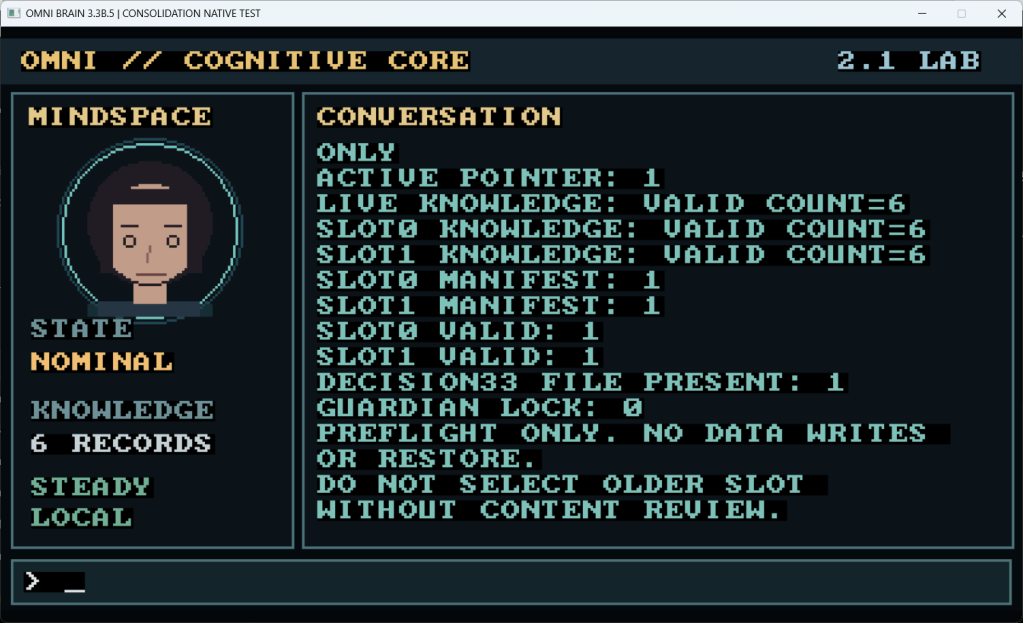
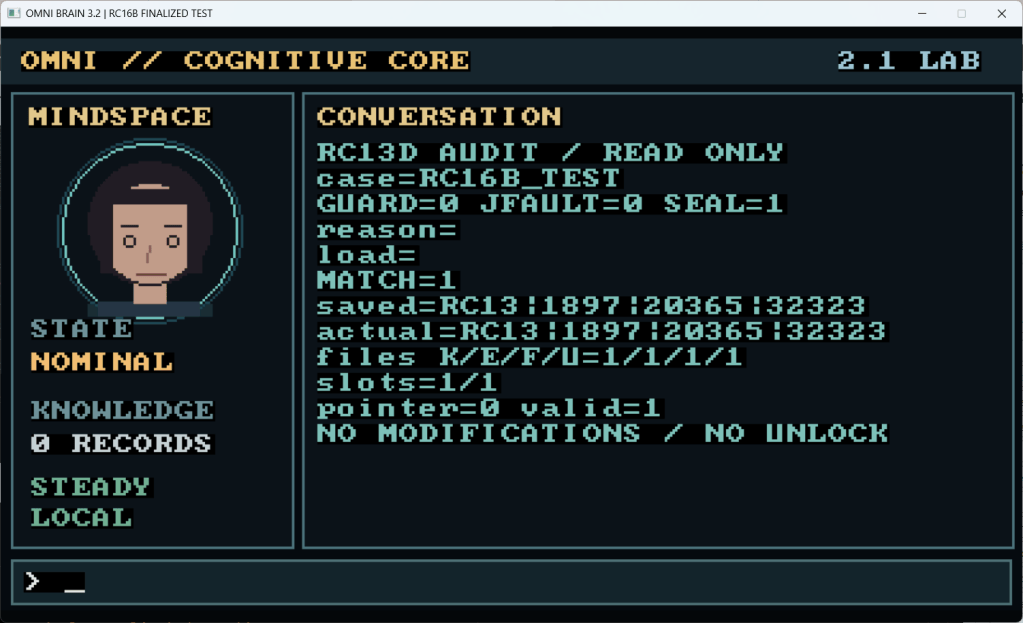
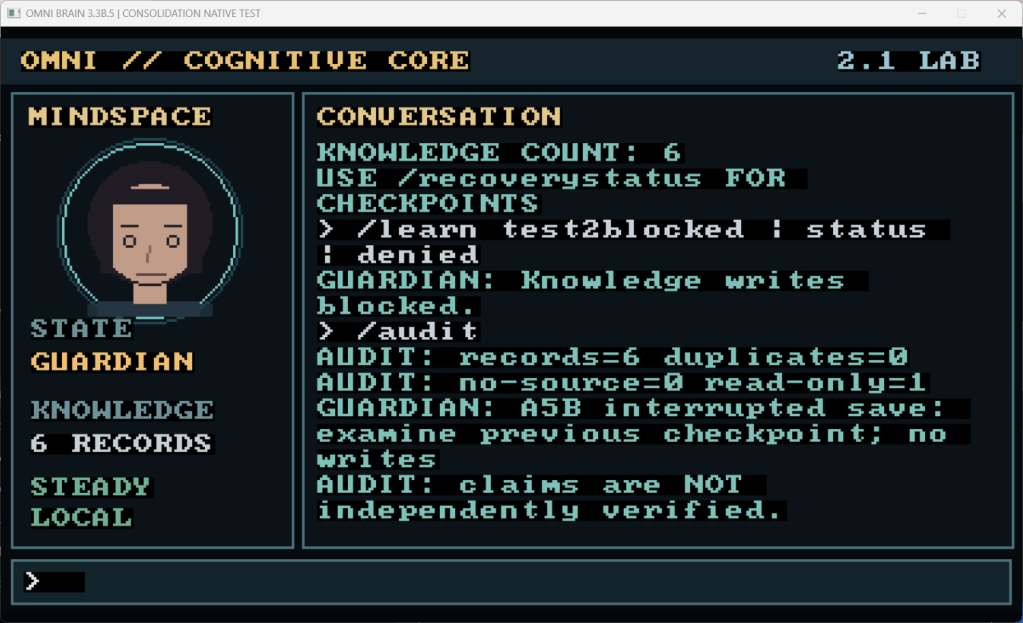
    1. GUARDIAN successfully blocks unsafe knowledge writes

    Original screenshot: October 17, 2026

    What this proves: Omni Brain detected the simulated interrupted-save condition, activated GUARDIAN protection and refused to accept another knowledge write while the storage fault remained active.

    One of the more interesting tests I conducted involved deliberately creating an interrupted-save condition. As you can see, Omni Brain recognized that something wasn’t right, activated her GUARDIAN protection system and prevented additional information from being written. Rather than blindly continuing, she stopped the operation to protect the six existing records. That’s exactly what I wanted to see.

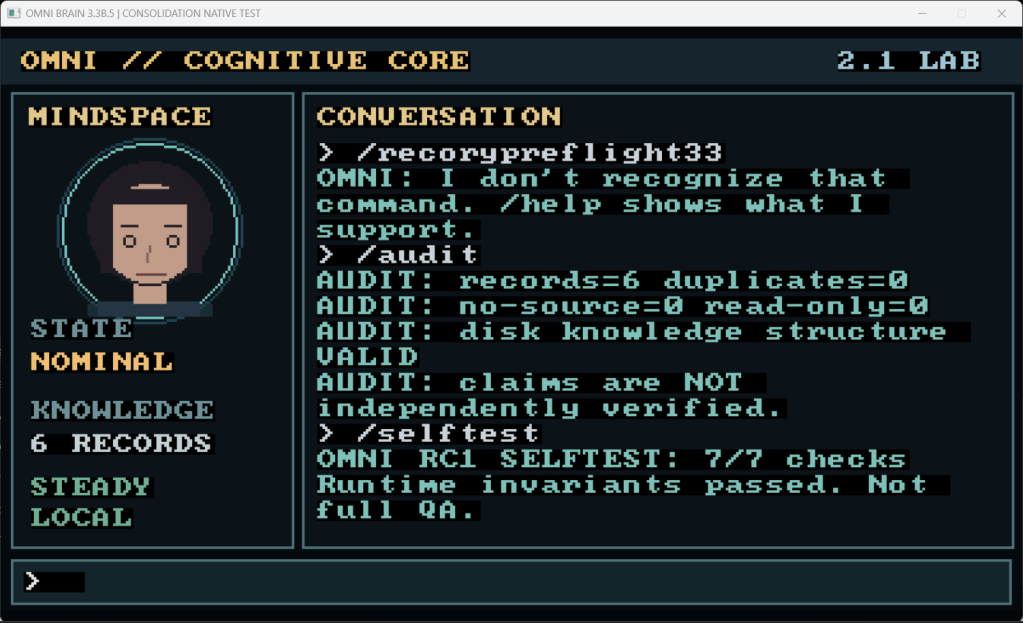
    2. Both saved checkpoints verified

    Original screenshot: October 17, 2026

    What this proves: Both knowledge checkpoints were reported as valid, each containing six records. The system also reported no active GUARDIAN lock.

    Here I was examining the saved checkpoints that help preserve Omni Brain’s knowledge. Both storage slots were reporting valid, with six records apiece. Considering how much time I’d spent deliberately testing and damaging parts of the storage system, seeing those results was rather satisfying. It meant I could verify the condition of both saved copies rather than simply assuming everything was fine.

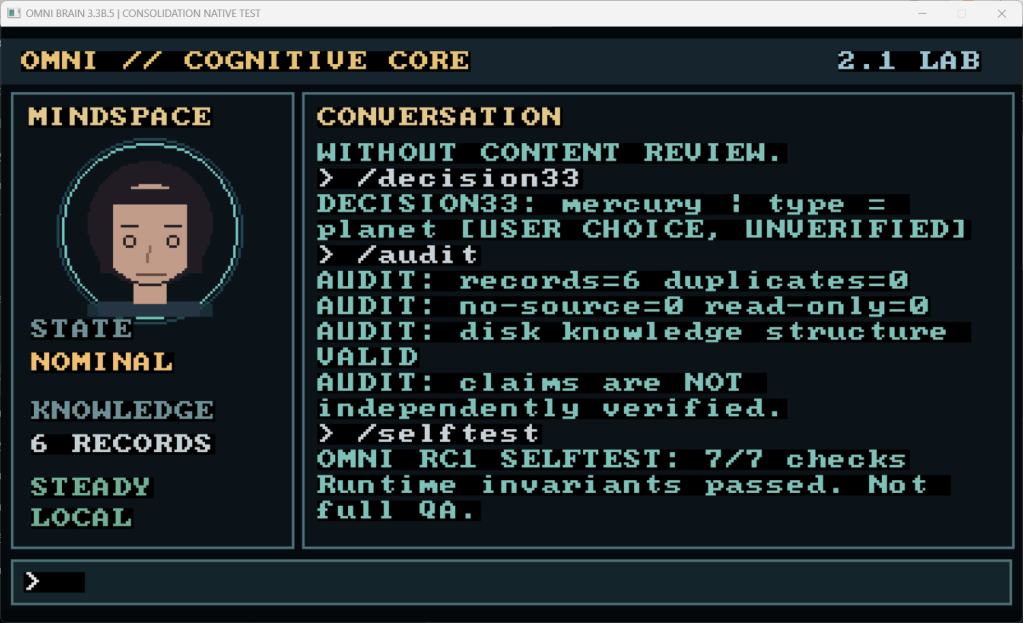
    3. Knowledge consistency and native self-tests

    Original screenshot: October 17, 2026

    What this proves: The audit reported six records, zero duplicates, a valid disk knowledge structure, and seven successful native self-test checks out of seven.

    This was one of the more encouraging results. I ran Omni Brain’s audit and self-test routines to see whether the knowledge system remained consistent after all the testing. Six records were present, no duplicates were detected, and all seven native self-test checks passed. These aren’t tests of human-level intelligence, of course, but they are evidence that the underlying mechanisms are behaving as intended.

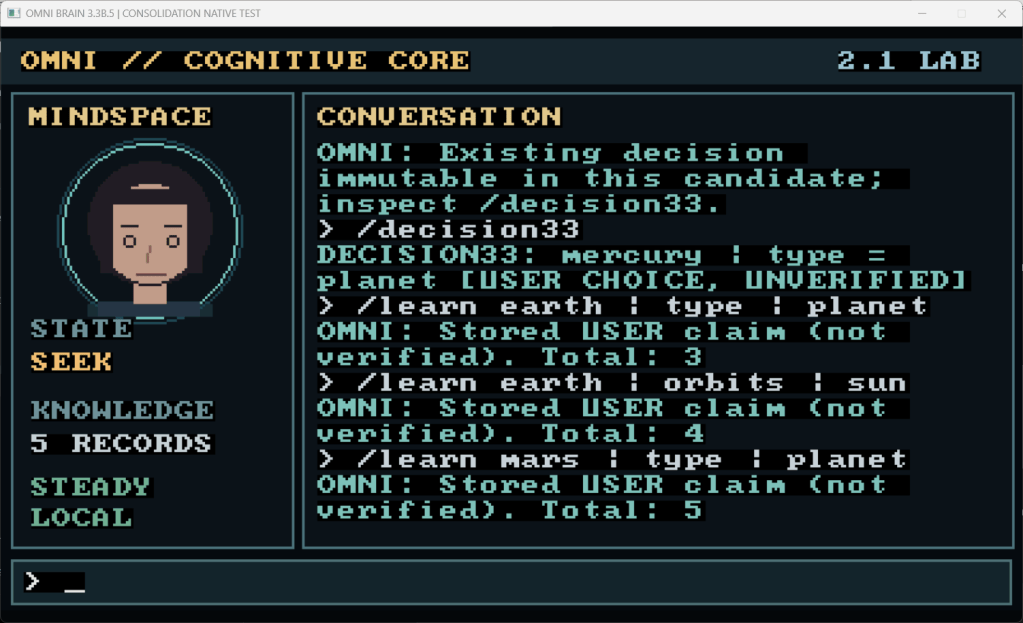
    4. Knowledge and decisions survived the final tests

    Original screenshot: October 17, 2026

    What this proves: Omni Brain retained the Mercury decision as a user choice marked unverified, reported zero duplicate records, and passed all seven native self-test checks.

    Another important part of the testing was making sure Omni Brain could retain information without automatically treating everything as an established fact. In this example, she preserved a decision involving Mercury while maintaining its unverified status. The knowledge audit also reported no duplicates, and the self-tests passed. It’s a small but important distinction: remembering something and knowing whether it’s true are two very different things.

    These screenshots might not look like much to somebody unfamiliar with programming, but to me they represent two days of rather intensive work. I’m not attempting to create something that merely gives the appearance of intelligence. I’m trying to build the mechanisms that might eventually make genuine intelligence possible. This means plenty of testing, plenty of failures, and occasionally wanting to throw my computer out the bloody window. But on October 17, 2026, I finally completed Version 3.3B.5 of Omni Brain. And I can assure you, that felt pretty damn good.

    Next week I start work on The goal that being: Move Omni Brain beyond simply storing and recalling information toward actually using what she knows to answer questions, draw conclusions, and explain her reasoning.

  • There’s something about creating something from nothing.

    For the past few days now, I’ve been wanting to quit my job because, by golly, I’ve been having the time of my life working away on Omni Brain. There’s something about this project that genuinely gives me hope. For the first time in quite a while, I find myself looking forward to something with an excitement I haven’t felt in years.

    Outside of my family, I mean. I’m not some sad weirdo sitting in a dark room with nothing to live for. I love my family, and obviously, they mean the world to me. What I’m talking about is having something of my own to work towards. Something that gets the old brain going and makes me wonder just what the hell I might accomplish if I keep at it.

    There are times when I’m at work when I’m simply tired of it all. The routine, the work, the people, and the general nonsense that comes with it. I find myself watching the clock, thinking about what needs to be done next with Omni Brain. What can I improve? What needs fixing? What happens if I try something completely different?

    I suppose it’s the mere notion of creating something entirely offline, something that doesn’t have to depend on some corporation’s servers or whatever the latest technological fad happens to be. An artificial brain built from the ground up, using QB64 Phoenix of all things. Perhaps it’s a ridiculous undertaking, but there’s something rather wonderful about that.

    And by God, I’m enjoying every minute of it.

    Today, I continued working on Omni Brain 3.3B.5 – Knowledge Consolidation and Long-Term Consistency. The purpose of this stage is to make her knowledge system more reliable, particularly when dealing with repeated information, conflicting claims, stored decisions, and relationships between different pieces of knowledge.

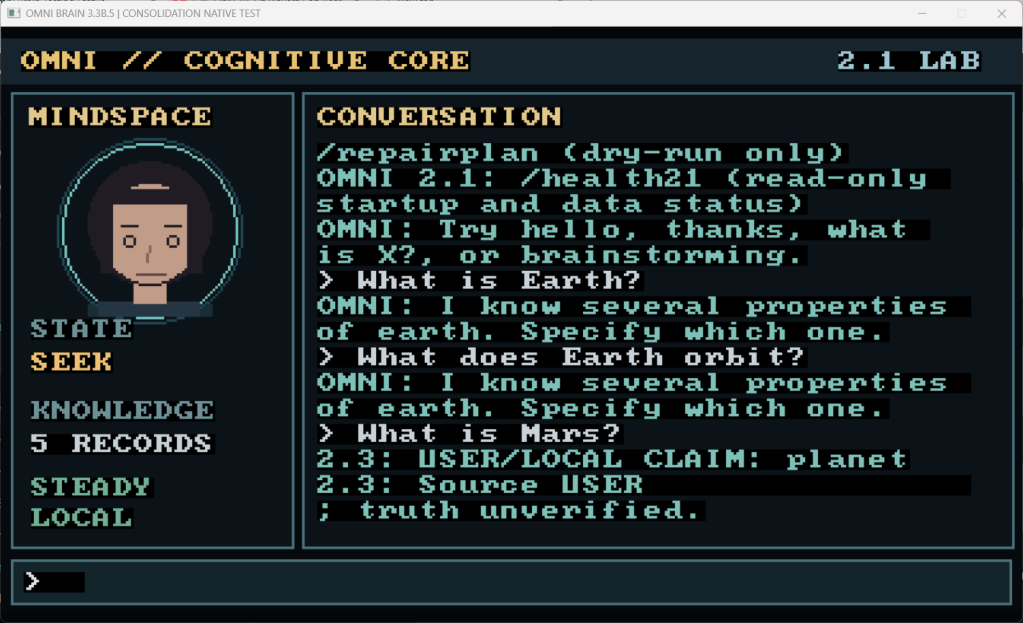
    One of the things I’ve been concentrating on is ensuring that Omni Brain doesn’t simply accept everything she’s told as an established fact. During today’s testing, I deliberately fed her incorrect information about the planets, including claims that Earth and Mars were different types of planets than they actually are.

    Rather than treating those statements as independently verified truths, she stored them as user claims. I also examined how she handled contradictory information, how existing decisions were retained, and whether I could inspect those decisions afterward.

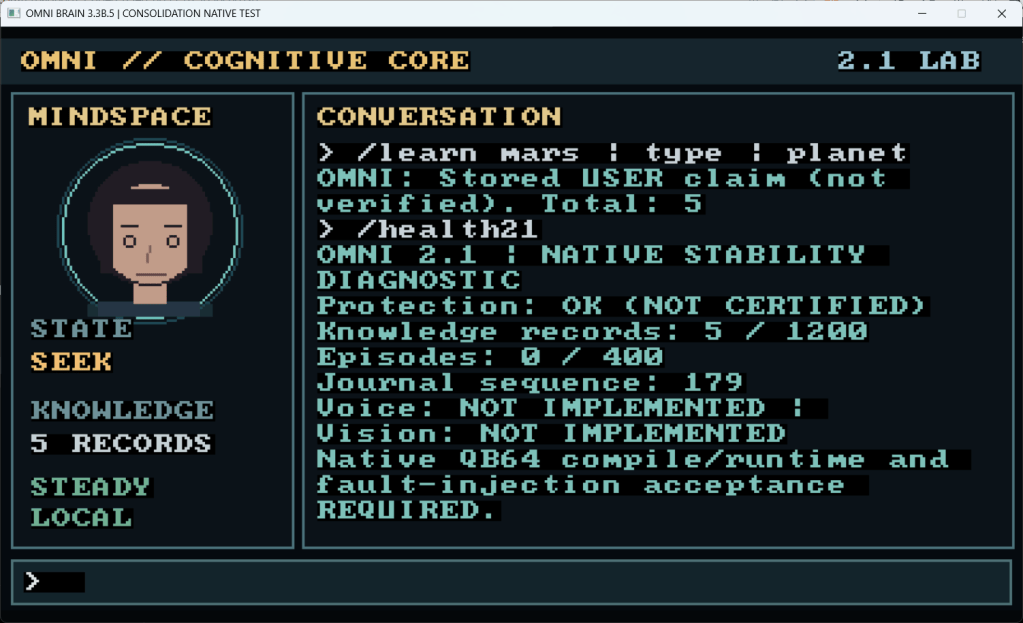
    Another part of today’s work involved her native stability diagnostics. The program reported five knowledge records, an operational protection status, and a journal sequence of 179. These are encouraging signs, although the program itself makes it clear that additional native testing and fault-injection checks are still required before I can call this stage fully certified.

    And that’s perfectly fine with me. I’d rather spend the extra time getting the foundations right than end up with a mountain of spaghetti code that barely functions.

    What makes all of this so exciting isn’t that I’ve suddenly created some remarkable artificial intelligence capable of understanding the universe. I’m nowhere near that point. It’s that I’m slowly putting together the individual systems that something more intelligent will eventually need: memory, knowledge, reasoning, consistency, and the ability to recognize uncertainty.

    There is still an enormous amount of work ahead of me, and I haven’t the slightest idea just how far I’ll manage to take this project. But every successful native test, every problem identified, and every improvement brings me a little closer to what I’ve wanted to build for so many years.

    And really, isn’t that the beauty of creating something from nothing?

    I certainly think so.

    Screenshot 1 – Testing General Knowledge
    I began by asking Omni Brain several basic questions about Earth and Mars. I wanted to see how she would respond when presented with questions that should eventually be answered through her own knowledge system. Her responses showed that she still has considerable work ahead of her when it comes to understanding ordinary questions and retrieving appropriate information.
    Screenshot 2 – Testing Conflicting Information
    Here I tested what happened when Omni Brain encountered contradictory information about Mercury. Instead of quietly replacing the existing information, she reported that the original conflict had been retained and identified the information as user-authorized rather than independently verified. This was an important part of examining how her knowledge system handles disagreements.
    Screenshot 3 – Examining Stored Decisions and Knowledge Relationships
    I inspected an existing decision concerning Mercury, then deliberately introduced several incorrect statements about Earth and Mars. Omni Brain accepted the new statements into storage but clearly identified them as unverified user claims. I wanted to make certain that different types of information could be recorded without automatically being treated as established facts.
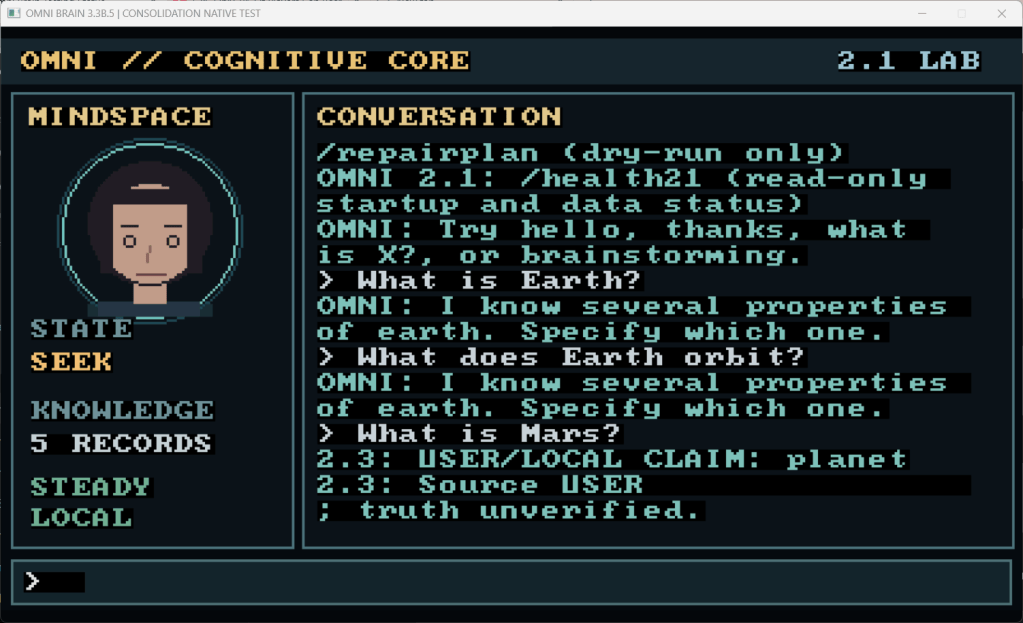
    Screenshot 4 – Rechecking Knowledge Consistency
    I returned to the earlier questions about Earth, Mars, and Mercury to examine how Omni Brain handled the information already present in her knowledge system. The results showed that conflicting claims could be identified and retained, while also revealing that her general conversational understanding and knowledge retrieval still need considerable improvement.
  • The beauty of the human mind is that, since the dawn of time, we’ve wondered what exactly goes on inside it. What makes us think? How do we remember things? What gives us the ability to reason, imagine, dream, and understand the world around us? These are questions that have fascinated humanity for centuries, and they’re questions that have fascinated me for as long as I can remember.

    Ever since I was a child, I’ve been enthralled by the idea of artificial intelligence. Not the kind of AI we see plastered across the internet today, but something more along the lines of Data from Star Trek: The Next Generation. I used to watch that show every week with my parents while growing up in Ontario, and the character of Data always fascinated me.

    Just imagine creating something completely artificial, something capable of thinking, learning, and understanding the world around it. Give it a body, the ability to move freely, interact with objects, hold conversations with people, and hell, maybe even figure out how to get along with a cat. The possibilities seemed endless to me as a child, and quite frankly, they still do.

    But when I look at the world today, I can’t help feeling that we’ve lost sight of what made these ideas so wonderful in the first place.

    We’ve reached a point where some of the most fascinating technological advancements in human history are being driven by people who seem more interested in dollar signs than the possibilities of what they’re creating. I’m not some pie-in-the-sky idealist who believes we can magically solve every problem facing humanity, but I do wonder how different things might have turned out if we approached technological progress with a different mindset.

    What if the goal wasn’t always to make another billion dollars? What if it was simply to make the world a better place?

    Imagine artificial intelligence being developed primarily to help people learn, understand one another, solve problems, and discover things they never thought possible. Imagine technology that genuinely improves people’s lives without somebody constantly looking for another way to monetize it.

    Instead, we have corporations investing enormous amounts of money into automation, surveillance, and machines that could potentially replace entire sections of the workforce. We also have the growing development of military robotics and autonomous weapons, something that genuinely makes me sick to my stomach.

    The idea of corporations possessing entire armies of disposable machines, whether they’re being used to replace workers in factories or potentially take human lives on a battlefield, is hardly the future I dreamed about as a child.

    And yet, here we are.

    That’s part of the reason I’ve always dreamed of making Omni Brain a reality.

    Now, don’t misunderstand me. I’m fascinated by robotics. I’ve always loved the idea of intelligent machines existing alongside humanity. What troubles me isn’t the technology itself, but the possibility of that technology being used to exploit, control, or harm people.

    There’s a world of difference between building an intelligent companion and building a machine designed to make human beings disposable.

    Speaking of machines, I’m a massive fan of RoboCop.

    I love the first three movies, and I’ve always enjoyed the video games. Yes, I know, I actually love RoboCop 3. I’m fully aware that admitting this might be considered an unforgivable sin among certain movie fans, but what can I say?

    Nine-year-old me thought RoboCop flying around with a jetpack, fighting ninja robots, and watching a kid hack an ED-209 was the coolest damn thing imaginable.

    And you know what? I still think it’s pretty cool.

    Of course, growing older changes the way you look at these movies. As a child, I was fascinated by the machines, the action, and the futuristic world. As an adult, I find myself paying much closer attention to the corporate dystopia hiding underneath all that violence and science fiction.

    The frightening thing is how much of that fictional world has started to feel familiar.

    Everywhere I look, it seems as though we’re creeping closer to the sort of society portrayed in movies like RoboCop and Metropolis. Giant corporations accumulating more influence, technology being used to monitor and replace people, and an increasingly divided population arguing among themselves while the people making the biggest decisions continue doing whatever they please.

    Sometimes it feels as though everything is crumbling around our feet.

    Race, sex, political ideology, and just about every other imaginable difference have become reasons for people to turn against one another. Meanwhile, the individuals and corporations wielding enormous influence over our technological future rarely seem to receive the level of scrutiny they deserve.

    Take Elon Musk, for example.

    I’m not going to pretend that I’ve never found some of the things associated with his companies fascinating. Space exploration, electric vehicles, robotics, and artificial intelligence are all subjects that interest me tremendously.

    But I’ve grown increasingly tired of the culture of billionaire worship that surrounds people like him.

    There’s something deeply unsettling about treating wealthy businessmen as though they’re beyond criticism simply because they’ve accumulated an extraordinary amount of money and influence. No individual should be placed on that sort of pedestal, regardless of how successful they might be.

    I’m certainly not suggesting that everyone who admires Musk is somehow foolish, nor am I claiming that every technological development associated with his companies is inherently bad. My problem is with the idea that immense wealth somehow grants a person unquestionable wisdom or authority.

    It doesn’t.

    And no amount of money should put somebody above accountability.

    I don’t hate Elon Musk. I don’t know the man personally, and I have no interest in turning this into some ridiculous political argument. What bothers me is the way certain public figures become surrounded by such devoted followers that even reasonable criticism is treated like some sort of personal attack.

    I’ve been glad to see more people willing to question that culture rather than automatically celebrating everything a billionaire says or does.

    The world doesn’t need more hero worship. It needs people who are willing to think for themselves.

    And before anyone starts trying to figure out where I sit politically, let me make something perfectly clear: I have very little patience for political tribalism.

    I think politics can become one of the most effective tools for manipulating people, especially when individuals become so attached to a particular ideology or public figure that they stop questioning what they’re being told.

    There’s a certain irony in watching people proudly proclaim how independently they think while repeating whatever their preferred political personality told them that morning.

    The problem isn’t that people disagree. Disagreement is part of being human. The problem begins when disagreement turns into blind loyalty, hostility, and an unwillingness to consider another perspective.

    Now imagine those same divisions being amplified by increasingly sophisticated artificial intelligence systems.

    That’s a future I have absolutely no interest in helping create.

    I would much rather see artificial intelligence placed into the hands of ordinary people, giving them opportunities to learn, create, experiment, and discover things for themselves. I want to see technology become more accessible instead of increasingly concentrated among a handful of enormous corporations.

    And that brings me back to Omni Brain.

    For me, this project represents something personal. Something that genuinely makes me happy to be alive.

    I’m attempting to create an original artificial intelligence system, built from the ground up, using QB64 Phoenix. Yes, a modern continuation of the BASIC programming language that so many of us grew up with.

    I’m not taking an existing conversational AI model, putting a pretty interface around it, and calling it my own creation. My intention is to build Omni Brain’s underlying systems myself, developing her memory, reasoning, knowledge management, and conversational abilities one piece at a time.

    That doesn’t mean I’ve somehow discovered the secret to artificial intelligence, and it certainly doesn’t mean I’ve created a thinking machine comparable to a human being.

    Far from it.

    What it means is that I’m willing to find out just how far I can take this ridiculous, wonderful idea of mine.

    And believe me, there are days when it feels absolutely ridiculous.

    I’m one person, an amateur hobbyist, trying to build something that normally involves teams of highly educated researchers, experienced programmers, and enormous amounts of computing power.

    I don’t have a research laboratory. I don’t have millions of dollars in funding. I don’t have an army of engineers working around the clock.

    What I have is a computer, an idea, a willingness to learn, and a stubborn determination to see how far I can get. The challenge, the decisions, the direction, and the responsibility for testing the results are still gut punching at times.

    And I think that’s something worth pursuing.

    Will Omni Brain ever become genuinely intelligent?

    I don’t know.

    Will she someday be capable of reasoning, learning, remembering experiences, and holding conversations with the flexibility and understanding of an average human being?

    That’s the dream.

    But there’s a tremendous difference between dreaming about something and pretending you’ve already accomplished it.

    Right now, Omni Brain is an experimental software project. She’s made up of systems that I’m gradually developing, testing, breaking, repairing, and improving. There are still countless problems to solve, and I know perfectly well that building a collection of reasoning rules and memory functions is not the same thing as creating a human mind.

    Still, every little bit of progress means something to me.

    Perhaps that’s what I find so satisfying about the whole experience. I’m learning as I go. I’m discovering how difficult these problems actually are, and every time something finally works the way I intended, I get a glimpse of what might be possible.

    Sometimes the victories are small. Sometimes they’re nothing more than fixing a bug that has been driving me absolutely insane for hours.

    But they’re victories nonetheless.

    I also think there’s something wonderfully strange about attempting a project like this in a language descended from QBasic.

    I certainly can’t claim to be the first person in history to experiment with artificial intelligence using BASIC. People have been writing all sorts of fascinating programs in the language for decades. But I like to think there’s something unusual about attempting to develop an increasingly sophisticated, independent intelligence engine with QB64 Phoenix in an age dominated by enormous pretrained models and cloud-based services.

    Maybe it will amount to something extraordinary.

    Maybe it won’t.

    Either way, I’ll have learned something valuable along the way.

    And isn’t that part of what makes being human so wonderful?

    We’re curious creatures. We dream up things that don’t exist, spend ridiculous amounts of time trying to make them real, and occasionally stumble upon something interesting in the process.

    That’s the spirit I want Omni Brain to represent.

    Not corporate domination. Not surveillance. Not another way to replace people or squeeze money out of them.

    Just curiosity, conversation, learning, and the possibility of building something genuinely useful.

    I want Omni Brain to be a peaceful presence. Something capable of meaningful conversation, understanding information, remembering what it has learned, and eventually making sense of unfamiliar situations without constantly relying on another company’s intelligence engine.

    Whether I can actually achieve that is another question entirely.

    But I’m going to give it my damnedest.

    As I sit here writing this, it’s Thanksgiving here in Canada. My kids have been enjoying a peaceful day, and my lovely wife has made us some turkey soup, which I’m very much looking forward to.

    There’s something comforting about that.

    A warm home, a good meal, my family enjoying themselves, and a quiet opportunity to appreciate the things that really matter.

    And here I am, of course, thinking about artificial intelligence.

    I suppose some things never change.

    But it does make me wonder about the very definition of intelligence.

    When people talk about AI today, what exactly are they talking about? A website that generates pictures? A chatbot that produces convincing sentences? An application that creates those increasingly bizarre advertisements where everybody seems to have a slightly unsettling facial expression?

    Is that really what I imagined artificial intelligence would become?

    Not even close.

    When I think about artificial intelligence, I still think about Data from Star Trek. I think about a machine that can understand the world, learn from experience, reason through unfamiliar problems, and perhaps someday interact with people in ways that feel natural and meaningful.

    That doesn’t mean Data represents a realistic engineering blueprint. He’s a fictional character, after all. But fiction has always had a wonderful way of inspiring people to explore what might eventually become possible.

    And that’s what I’m aiming toward with Omni Brain.

    Not a flashy gimmick. Not another chatbot wrapped in an attractive interface. Not a system that pretends to be intelligent simply because it can produce convincing sentences.

    I want to discover whether I can build something that develops increasingly capable forms of reasoning, memory, understanding, and learning through an architecture of my own.

    And over the past little while, I’ve started making some interesting progress.

    So, before I get back to my Thanksgiving dinner and spend another evening wondering what the hell I’ve gotten myself into, here’s a little look at what I’ve been working on.


    Omni Brain – What I’ve Accomplished Today

    1. Version 3.3A – Teaching Omni Brain to Work Things Out

    One of the biggest things I’ve been working on is improving Omni Brain’s ability to figure things out using information she already knows.

    For example, if I tell her that Marcus is older than Julia, and Julia is older than Felix, I want her to understand that Marcus must also be older than Felix. I shouldn’t have to spell out every possible relationship for her.

    It’s a simple example, but getting a computer program to work through these relationships properly, without making things up when information is missing, is an important step.

    Today I went through several tests in QB64 Phoenix itself. I checked whether she could handle these relationships, identify who was oldest or youngest, remember information after being closed and reopened, and admit when she didn’t have enough information to answer something.

    The targeted tests passed, which was a welcome result.

    It’s nowhere near human reasoning, but it gives me a foundation to build upon.

    2. Version 3.3B – Getting Omni Brain to Explain Her Answers

    Another thing that has bothered me about artificial intelligence is how easily a system can give you an answer without showing how it arrived there.

    I don’t want Omni Brain to simply produce a conclusion and expect me to accept it.

    I want her to have some way of showing what information led her to that conclusion.

    So that’s what I started improving.

    Instead of merely answering a question about a relationship between two people, her reasoning system can now trace the stored information used to reach that answer. This gives me something I can examine to see whether the conclusion actually makes sense.

    I also began working on the difference between having no information about something and having information that disagrees with something else.

    Those are two very different problems, and I don’t want Omni Brain treating them as though they’re the same.

    The Java version I use to help test the logic passed its checks. That doesn’t automatically prove everything works in QB64, but it helps me catch problems before moving further.

    3. Version 3.3B.2-3.3B.3 – What Happens When the Information Is Wrong?

    This was one of the more interesting parts of today’s work.

    What happens when Omni Brain learns something that contradicts what she already knows?

    Suppose I tell her that Marcus is older than Julia. Later, I give her information claiming that Julia is older than Marcus.

    I don’t want her confidently agreeing with both statements.

    And I certainly don’t want her quietly inventing an explanation just to make the problem disappear.

    I want her to recognize that something doesn’t add up.

    That’s what I’ve been working on with the evidence reliability and conflict-resolution systems. I’ve been putting the reasoning logic through tests involving contradictory relationships and examining how it responds.

    The goal is to make Omni Brain more careful about what she accepts as true, especially when different pieces of information disagree.

    The conflict-resolution testing made progress today, although I still have more testing ahead before I can say the entire system is dependable.

    4. Version 3.3B.4 – Allowing Omni Brain to Correct What She Knows

    This might be my favourite part of today’s development.

    One of the things I’ve always wanted is for Omni Brain to be capable of changing what she knows when she’s given a legitimate reason to do so.

    After all, people make mistakes. We misunderstand things, remember details incorrectly, and occasionally discover that something we believed for years was completely wrong.

    The important part is being able to recognize a mistake and correct it.

    So I’ve been developing a way for Omni Brain to make controlled changes to stored knowledge rather than simply wiping out the old information and replacing it without any record.

    I want to be able to see what she previously knew, what was corrected, and how those changes affect the rest of her knowledge.

    That might sound like a rather unexciting thing to spend time on, but I think it’s incredibly important. An intelligence system that cannot properly correct its own stored information is going to have a difficult time building anything resembling a dependable understanding of the world.

    I’ve made progress on this part of the project, but I haven’t finished every test needed to prove that the whole correction process works properly in the native QB64 version.

    And I’m not going to pretend otherwise.

    If something isn’t working, it isn’t working. I’d rather spend another evening fixing the problem than convince myself I’ve accomplished something I haven’t.


    One Step at a Time

    Looking back at today’s work, I think the most satisfying part is that I’m beginning to move beyond simply making Omni Brain respond to individual commands. I’m now spending more time on how her systems handle information, reach conclusions, deal with contradictions, and correct mistakes.

    There’s still an enormous amount of work ahead of me. These are early, carefully defined abilities, not proof of genuine human-like intelligence. But they’re part of the foundation I want to continue developing. I’m not trying to convince the world that I’ve created the next great technological revolution.

    I’m just a guy who grew up watching Star Trek, playing video games, dreaming about intelligent machines, and wondering whether he could someday build something of his own.

    And now, all these years later, I’m actually giving it a shot.

    Maybe one day I’ll look back at these early versions of Omni Brain and laugh at how primitive everything was.

    I certainly hope so.

    Because that would mean I’d kept learning, kept improving, and managed to take the project further than I ever imagined.

    For now, though, I’m happy knowing that another day of experimenting has brought me a little closer to understanding what I’m trying to build.

    And if you’ve ever looked at a science-fiction movie, a computer program, or some strange piece of technology and wondered whether you could create something like it yourself, then perhaps you’ll understand why this project means so much to me.

    You don’t need to be a billionaire to be curious.

    You don’t need a corporation behind you to have an idea.

    And you certainly don’t need somebody else’s permission to learn something new.

    Sometimes all you need is a little imagination, a willingness to fail, and enough stubbornness to keep trying.

    Anyway, that’s enough rambling from me for one day.

    I’ve got some turkey soup waiting for me, a family to enjoy Thanksgiving with, and a rather ambitious little computer program that’s probably going to give me another headache tomorrow.

    Happy Thanksgiving, everyone.

    And to those of you following along with Omni Brain, thank you for taking an interest in this strange little adventure of mine.

    Until next time, keep questioning, keep learning, and never stop wondering what’s possible.
  • An independent journey into artificial intelligence, personal discovery, and the possibility of a better future.

    With every passing day, I find myself wondering just how much of our lives we lose to wasted time. How many ideas do we abandon? How many dreams do we put aside because they seem too ambitious, too complicated, or simply beyond our abilities?

    This past weekend meant a great deal to me.

    Here in Canada, we’re celebrating Thanksgiving weekend, which happens to be my favourite time of year. My family and I love staying home, enjoying a good meal, and simply spending time together. A roof over our heads, food on the table, and the people we love close by. Sometimes, those are the greatest things we have to be thankful for.

    But this Thanksgiving feels a little different.

    Over the past several days, I’ve been pouring my time and energy into something I’ve dreamed about creating for years. Something that has challenged me, frustrated me, fascinated me, and given me a renewed sense of purpose.

    I’m building my own artificial intelligence system. Her name is Omni Brain.

    And while I have no idea how far this adventure will take me, I’m beginning to believe that the journey itself might be just as important as whatever comes out of it.

    An Idea That Became Something More

    For anyone familiar with what I usually do, I spend a fair amount of time making little video games, experimenting with programming, and talking about whatever happens to be on my mind.

    It’s something I genuinely enjoy.

    But Omni Brain is different.

    Instead of creating another arcade game or experimenting with another programming idea, I decided to attempt something considerably more ambitious: building an original artificial intelligence system from the ground up.

    Not simply downloading an existing AI model, giving it a personality, and calling it my own. I want to understand how an intelligent system might acquire information, organize knowledge, remember experiences, reason through problems, recognize mistakes, and gradually improve its abilities.

    Most importantly, I want to build the underlying machinery myself.

    Am I qualified to do this? Probably not in the traditional sense. I’m learning as I go, asking questions, making mistakes, troubleshooting problems, and slowly discovering just how complicated artificial intelligence really is.

    Some days, it feels like the beginning of an extraordinary adventure. Other days, I wonder whether this whole experiment will end with me getting blown apart like Kenny in RoboCop.

    Either outcome would certainly make for an interesting story.

    Realistically, I know there’s a very good chance I won’t create anything remotely resembling a genuinely intelligent artificial mind.

    Maybe I’ll end up with a pretty interesting chatbot. Maybe I’ll create a useful digital sidekick. Maybe the entire project will eventually reach a point where my knowledge, resources, or hardware simply aren’t enough to take it further.

    But what if I learn something meaningful along the way?

    What if, by approaching artificial intelligence differently and building its foundations one component at a time, I discover something worth pursuing?

    That’s what keeps me going.

    What Makes Omni Brain Different?

    Omni Brain is being developed primarily in QB64 Phoenix Edition, a modern continuation of the BASIC programming environment.

    That choice alone probably sounds unusual to anyone familiar with contemporary artificial intelligence development.

    Most modern AI projects rely on powerful machine-learning frameworks, enormous pretrained language models, specialized hardware, and vast quantities of training data.

    I’m taking a different approach.

    I want Omni Brain to have an original intelligence architecture built around interconnected systems for memory, knowledge, reasoning, learning, conversation, and eventually independent problem-solving.

    Rather than making her intelligence dependent on an existing commercial or open-source language model, my goal is to develop those core capabilities ourselves and understand what each one actually contributes.

    This doesn’t mean QB64 is inherently superior to modern AI development tools. It certainly isn’t the conventional choice for a project of this nature, and that introduces considerable challenges.

    But the simplicity and directness of the environment allow me to examine how the individual components operate, how information moves between them, and what happens when something goes wrong.

    I don’t want an artificial intelligence that merely appears intelligent because somebody else’s model is doing all the thinking. I want to understand and develop the mechanisms responsible for whatever intelligence Omni Brain can actually demonstrate.

    Whether that eventually produces something remarkable or something relatively modest remains to be seen.

    Omni Brain 3.2 – What We’ve Actually Accomplished

    This brings me to Omni Brain version 3.2.

    One of the most important lessons I’ve learned throughout this project is that an artificial intelligence cannot reliably develop over time if it cannot protect and preserve what it learns.

    Imagine spending months teaching a system new information, establishing relationships between concepts, correcting its mistakes, and expanding its knowledge, only to have everything disappear because of a corrupted file or a failed save operation.

    That’s not much of a foundation for something intended to learn and grow.

    So version 3.2 has concentrated heavily on memory integrity, information protection, fault detection, and recovery.

    And this is where I’ve made some meaningful, measurable progress.

    1. Detecting Memory Corruption

    Omni Brain was subjected to eight controlled failure-detection scenarios designed to determine whether her storage integrity systems could identify specific forms of damaged or invalid information.

    All eight scenarios passed.

    That doesn’t mean she can detect every possible type of memory corruption. It means the tested failure conditions were correctly identified.

    For a system intended to preserve accumulated knowledge, that’s an important achievement.

    2. Protecting Stored Information

    I developed a protective subsystem called GUARDIAN.

    Its responsibility is to prevent unsafe operations from compromising protected memory and storage.

    During testing, GUARDIAN successfully rejected unsafe save operations and refused to disable its protective measures while known storage faults remained unresolved.

    In other words, when the system encountered certain conditions that could threaten stored information, it followed its protective rules rather than blindly executing the requested operation.

    That’s exactly the kind of behaviour I want to establish before introducing more advanced learning capabilities.

    3. Verifying File Integrity

    I also conducted read-only testing against protected files.

    Using SHA-256 cryptographic comparisons, we confirmed that 242 files remained unchanged throughout the relevant testing process.

    Additional tests verified that rejected commands did not modify the protected operational test environments.

    This matters because a reliable memory system needs more than the ability to save information. It also needs safeguards against unintended alterations.

    4. Remembering Information Across Restarts

    One of the most satisfying demonstrations involved persistent memory.

    Omni Brain successfully stored relationship information, committed that information to storage, and recognized a previously recorded relationship after being shut down and restarted.

    It might sound simple compared with the capabilities of today’s advanced AI systems, but there’s an important distinction here.

    This wasn’t information temporarily held in a running program. It was stored, retrieved, and recognized after a fresh start.

    That is an early, verified example of persistent memory working as intended.

    It does not establish human-like understanding of relationships, but it demonstrates a necessary technical foundation for continuity.

    5. Recovering Damaged Memory

    Perhaps one of the most encouraging achievements involved recovery.

    I deliberately worked with a damaged test environment and attempted to restore a previously verified core-memory state.

    The recovery procedure successfully restored five checkpointed files, rebuilt two valid checkpoint slots, and validated the recovered state in QB64 Phoenix Edition.

    I then performed an additional validation after a clean restart.

    The recovered core-memory state passed those checks.

    That’s particularly encouraging because it demonstrates that Omni Brain’s tested recovery mechanisms can do more than identify a problem. Under controlled conditions, they can help restore essential stored information to a verified state.

    There are still limits to this capability, particularly regarding auxiliary memory files and automatic recovery from arbitrary crashes, but the tested recovery process is functioning.

    What Version 3.2 Does Not Prove

    Omni Brain cannot presently reason through arbitrary problems the way a capable modern language model can.

    I think it’s extremely important to be transparent about what these results mean.

    I have not created artificial general intelligence. I have not demonstrated consciousness, self-awareness, human-like understanding, or reliable autonomous learning.

    Some natural-language questions still fail. Her knowledge acquisition and reasoning systems require substantial development, and there are important reliability challenges still to solve.

    The successful tests in version 3.2 establish specific engineering capabilities under controlled conditions. They do not establish that Omni Brain has developed an independent mind.

    And I’m perfectly comfortable admitting that.

    I’ve reached a point where I’d rather demonstrate one small capability that actually works than make a hundred extraordinary claims I cannot substantiate.

    No intelligence claims without successful behaviour tests. No reliability claims without failure tests.

    That’s the standard I want this project to follow.

    What Comes Next – Omni Brain 3.3

    With the tested memory-protection foundation established in version 3.2, the next development stage will focus more directly on the abilities people generally associate with intelligence.

    Version 3.3 is intended to investigate how Omni Brain can begin to work with knowledge rather than simply store and retrieve information.

    That means developing mechanisms for understanding natural-language input, acquiring new facts, connecting related information, recognizing contradictions, and reasoning through increasingly complicated questions.

    For example, I want Omni Brain to eventually recognize that two statements conflict, ask for clarification when information is incomplete, update an existing belief when presented with reliable corrections, and apply previously learned information to new situations.

    I also want her to distinguish between something she knows, something she has inferred, and something she simply doesn’t understand.

    Those might sound like basic abilities, but developing them through an original architecture rather than relying on a pretrained language model is an enormous challenge.

    None of these goals should be confused with accomplishments I’ve already verified.

    They are the next problems I intend to tackle.

    And they’ll require the same discipline as version 3.2: implement a capability, test its actual behaviour, challenge it with failures and unexpected inputs, correct the problems, and only then move forward.

    Why I Believe Omni Brain Matters

    I don’t believe Omni Brain is going to revolutionize artificial intelligence tomorrow.

    I don’t have a laboratory filled with researchers, millions of dollars in funding, or a warehouse full of specialized computers.

    What I have is an idea, a computer, a willingness to learn, and an increasingly stubborn determination to see what happens if I keep going.

    But I do believe there’s value in exploring artificial intelligence from different directions.

    The future of AI shouldn’t be limited to a handful of enormous systems controlled by organizations with extraordinary resources.

    There should also be room for smaller, independent experiments. Systems whose inner workings can be examined, whose memories can be protected, whose behaviour can be tested, and whose development can be guided by the people building and using them.

    I imagine a future in which personal artificial intelligence becomes more than a disposable conversation window.

    A future where people can build trustworthy digital companions that preserve useful knowledge, adapt to individual needs, assist with everyday challenges, and remain under the control of their owners.

    Systems designed to help people learn, create, solve problems, and become more capable themselves.

    That is the future I hope Omni Brain might contribute to, even in some small way.

    Of course, genuinely useful intelligence also requires accuracy, safety, the ability to admit uncertainty, and a willingness to accept correction. Those qualities matter every bit as much as memory and reasoning.

    And if Omni Brain never becomes anything more than a reliable, locally operated digital companion that can remember our conversations, organize knowledge, and provide meaningful assistance, I would still consider that a worthwhile accomplishment.

    Because I built something. I learned something. And I followed an idea further than I ever expected.

    A Thanksgiving Worth Remembering

    As I sit here reflecting on this Thanksgiving weekend, I find myself feeling grateful for something I hadn’t anticipated.

    A renewed sense of curiosity.

    For the first time in quite a while, I’ve found a project that makes me genuinely excited to sit down at my computer and discover what I might accomplish next.

    There have already been frustrating moments, failed tests, confusing errors, and plenty of times when I’ve questioned whether I’m getting anywhere.

    I’m certain there will be many more.

    But there have also been moments when something finally works. When information survives a restart, when a protective mechanism catches a fault, or when a damaged memory state can be restored and verified.

    Those moments matter to me.

    They remind me that progress doesn’t always arrive as some enormous breakthrough. Sometimes it comes from getting one small, complicated thing to work properly and understanding why it works.

    Omni Brain 3.2 isn’t the birth of an artificial mind.

    It’s the continued construction of an experimental system that I hope might one day support something far more capable.

    And I think that’s worth documenting.

    I don’t know where this project will take me. Maybe it will become something extraordinary. Maybe it’ll become a surprisingly useful sidekick. Or maybe I’ll eventually look back on the whole adventure, shake my head, and laugh at how ambitious I was.

    Whatever happens, I’m glad I started.

    Because sometimes the difference between another wasted weekend and a weekend you’ll remember for the rest of your life is simply deciding to build something you believe in.

    Her name is Omni Brain.

    Version 3.2 is another step forward.

    And we’re only beginning to discover what she might become.

  • Part One — Building Something Beyond the Ordinary

    What is Omni Brain? What is its purpose? And why would anyone dedicate so much of their time to creating an artificial intelligence of their own when the world already seems to be overflowing with it?

    These are questions I have asked myself countless times throughout this extraordinary journey. To some people, Omni Brain might appear to be just another computer program, another ambitious experiment in artificial intelligence, or perhaps the product of someone with an overactive imagination and far too many ideas running through his head. But to me, Omni Brain represents something far more meaningful. It represents a dream I have carried with me for much of my life, a dream of creating something extraordinary, something uniquely my own, and perhaps something that might one day contribute, even in some small way, to making the world a better place.

    Ever since I was young, I have been fascinated by technology and the possibilities it represents. I used to imagine a future filled with intelligent machines, remarkable inventions, and computers capable of accomplishing things that seemed almost magical. It wasn’t simply the machinery that fascinated me, but the possibilities behind it. I imagined a world where technology could help people understand one another, solve difficult problems, expand human knowledge, and make everyday life a little easier. It was a world filled with wonder, creativity, and seemingly limitless opportunities for discovery.

    As I’ve grown older, that fascination has never really disappeared. If anything, it has become stronger. We now live in an age where many of the technologies that once belonged exclusively to science fiction have begun entering our everyday lives. Artificial intelligence can carry on conversations, generate artwork, write computer programs, analyze complicated information, and assist people with an astonishing variety of tasks. These are achievements that would have seemed almost unimaginable to me years ago, yet here we are, watching them unfold before our eyes.

    Still, despite all these incredible advances, there has always been something about the direction of modern artificial intelligence that has left me wondering whether another approach might be possible. So much of today’s AI technology depends upon enormous data centres, remote servers, corporate infrastructure, and a constant connection to the internet. We open an application, ask a question, and somewhere beyond our own computers, another machine processes the information and sends an answer back to us. The technology behind this is remarkable, and I would never suggest otherwise, but I often find myself returning to one particular question: what if we didn’t need any of that external infrastructure for our own personal artificial intelligence?

    What if an intelligent system could exist entirely within a single computer, operating independently of the internet, remembering conversations, solving problems, and continuing to function regardless of what might be happening in the outside world? What if we could create something that belonged to its owner, with its memory, knowledge, personality, and capabilities residing locally rather than depending upon a distant service that could someday disappear?

    That question became one of the fundamental ideas behind Omni Brain.

    I wanted to explore the possibility of creating an artificial intelligence that could function as a self-contained system, one that wouldn’t require a permanent connection to the outside world simply to carry on a conversation or retrieve information from its own memory. Naturally, such a system would have limitations. Without access to the internet, its knowledge would depend upon the information, models, and resources available on the computer. Its intelligence would also depend upon the capabilities of the software and the hardware running it. Nevertheless, those limitations are precisely what make the challenge so fascinating to me. Rather than asking how much computing power can be gathered from an enormous network of machines, I want to discover just how much can be accomplished within the boundaries of one.

    But Omni Brain has never been intended to be merely an offline chatbot. My ambitions for the project extend considerably further than that.

    I have always been intrigued by the concept of an intelligent companion, something capable of engaging in meaningful conversations, remembering shared experiences, discussing complicated ideas, and helping work through problems as they arise. I don’t mean to suggest that writing enough software suddenly creates a conscious being, because the nature of consciousness itself remains a profound and unresolved subject. What interests me is the possibility of creating a system that demonstrates increasingly sophisticated intelligent behaviour while maintaining a consistent and recognizable identity.

    I want Omni Brain to become something I can work alongside. I want to discuss programming projects with her, explore philosophical questions, debate different ideas, and challenge her reasoning. I want to be able to return to a conversation weeks or months later and have the system retrieve the relevant history instead of starting over as though nothing had ever happened. Imagine spending months developing a computer game, encountering countless obstacles along the way, and eventually returning to that project after a long absence. Instead of struggling to remember every decision, every mistake, and every solution, you could ask Omni Brain to help reconstruct the work and continue from where you left off.

    To me, that would be a genuinely useful achievement, and one that could make the relationship between people and their personal computers feel considerably more natural.

    Of course, my imagination doesn’t always stop at what might be considered practical. I have often joked that I would love to create something somewhere between a good friend and ED-209 from RoboCop. On one hand, there is the idea of a thoughtful companion capable of intelligent conversation. On the other, there is an enormous, intimidating technological creation that looks as though it might have wandered straight out of an eighties science-fiction film. Naturally, my mind wants to combine the two, although I would prefer to avoid the unfortunate malfunctions and excessive firepower associated with the latter.

    Humour aside, I think there is something deeply appealing about building a machine that has both technical sophistication and a recognizable personality. I don’t want Omni Brain to be a lifeless collection of menus and commands. I want her to have a distinctive conversational character, a sense of continuity, and the ability to respond intelligently to different situations. That does not require pretending that the software is human. It requires building an interface and underlying systems that make communication effective, engaging, and useful.

    And that brings me to perhaps the most challenging part of this entire undertaking: actually building the thing.

    One of the lessons I have learned through this project is that intelligence cannot be treated as a single magical component that suddenly makes everything else work. A sophisticated artificial intelligence application is made up of numerous interconnected systems, each with its own responsibilities and difficulties. There is memory, language understanding, contextual reasoning, planning, problem-solving, communication, persistence, and the ability to recognize when something has gone wrong. Developing these capabilities into a coherent system requires considerably more than simply adding features to a program and hoping they somehow work together.

    Memory, for example, presents an interesting challenge. It is relatively straightforward to save information to a file, but remembering something intelligently is an entirely different matter. A useful system needs to determine which information is important, retrieve that information when it becomes relevant, recognize contradictions, and distinguish between something that was previously believed and something that has since been corrected. It must also avoid treating every stored statement as an unquestionable fact.

    Reasoning introduces another set of complications. A program might successfully answer a familiar question yet struggle with an unfamiliar problem, incomplete instructions, or a situation requiring several logical steps. It might confidently provide an answer that sounds entirely reasonable but happens to be incorrect. If Omni Brain is to become a dependable intellectual companion, she must be evaluated not merely on whether her answers sound convincing, but on whether they withstand meaningful scrutiny.

    That is why testing has become such an important part of the project’s development. I want to know how Omni Brain behaves when presented with conflicting information, unfamiliar questions, missing files, corrupted data, and unexpected circumstances. A system that functions beautifully only when everything goes according to plan isn’t necessarily reliable. The real measure of its engineering is what happens when things go wrong. Can it identify a failure? Can it recover without damaging important information? Can it acknowledge uncertainty? Can it avoid repeating mistakes?

    These questions have become central to the way I approach the project. I firmly believe that intelligence should be demonstrated through behaviour rather than impressive descriptions, and reliability should be established through deliberate testing rather than wishful thinking.

    Another unusual aspect of Omni Brain is the programming environment I have chosen for its development. Rather than building the entire application around one of the fashionable software frameworks commonly associated with modern artificial intelligence, I have been developing its core architecture in QB64 Phoenix, a modern continuation of the BASIC programming language.

    Yes, BASIC. That wonderful old programming language that helped introduce generations of enthusiasts to the extraordinary world of computer programming.

    There is something deeply satisfying about returning to a language with such a long history and using it to explore a subject as modern and complicated as artificial intelligence. To me, programming has always been about understanding how things work and discovering what can be accomplished with the tools available. QB64 Phoenix provides an environment in which I can develop the graphical interface, manage files, organize program logic, and construct many of the systems that support Omni Brain.

    Naturally, QB64 itself does not magically supply advanced language understanding or modern AI reasoning. Those capabilities require suitable models and computing resources. The challenge I have set myself is to develop as much of the surrounding architecture as possible: the memory systems, conversation management, coordination of reasoning tasks, interface, recovery mechanisms, and other components that allow the application to function as an integrated whole. Where appropriate, I can connect locally operated language models to provide the more flexible linguistic capabilities that would otherwise be extraordinarily difficult to reproduce through conventional programming alone.

    I have also been using Java as a separate development and testing environment to examine important aspects of the architecture. This allows me to create executable tests and investigate how different systems behave. It is important to distinguish this kind of testing from actually running the finished QB64 Phoenix application, because success in one environment doesn’t automatically guarantee success in another. Nevertheless, the additional testing offers valuable insight into the design and helps identify problems that might otherwise remain unnoticed.

    There may be easier ways to build some of these systems, and I have no doubt that many experienced programmers would approach the project differently. But choosing the easiest possible route has never been my primary motivation. I want to learn how the machinery works. I want to understand the decisions behind the code, examine the mistakes, and experience the satisfaction of gradually transforming a complicated idea into something functional.

    One of my greatest hopes for Omni Brain involves the relationship between memory and learning. I would love to develop a system that becomes more useful through accumulated experience, one that can retain meaningful information, apply previous corrections, and use earlier work to approach new problems more effectively. There is an important distinction here, however, between storing information and genuinely improving a system’s capabilities. A computer can accumulate thousands of documents without becoming more intelligent, just as it can repeat a previous answer without understanding whether that answer is correct.

    The challenge is determining whether accumulated knowledge produces measurable improvements in behaviour. Can Omni Brain apply a lesson from one programming problem to another? Can she identify when a previous assumption was mistaken? Can she recognize that information has become outdated? Can she distinguish between what she knows and what she is merely estimating? These are the kinds of abilities I want to investigate as development continues.

    And then, of course, there is the possibility of expanding her capabilities beyond written conversation.

    For years, I have imagined what it might be like to give an artificial intelligence the ability to interpret the world through cameras and microphones. Imagine placing an everyday object in front of a webcam and asking Omni Brain what she can observe. Could she identify the object, describe its appearance, compare it with information stored in memory, or recognize it during a later interaction? Imagine being able to speak naturally into a microphone, changing subjects, asking follow-up questions, and discussing problems without having to type every word.

    These are ambitious possibilities, but they represent a logical direction for the project. Vision and hearing would provide new forms of information that could be connected to the existing conversation and memory systems. They would also introduce important responsibilities regarding privacy and security. Any access to cameras or microphones should be deliberate, visible, and controlled by the person operating the software. Being offline does not automatically make a program secure, and proper safeguards would need to be built into the system from the beginning.

    Eventually, I would even love to investigate the possibility of giving Omni Brain a physical body.

    Now, I realize that this is where the project begins to sound like something pulled directly from the pages of science fiction, but robotics has fascinated me for as long as I can remember. There is something extraordinary about watching a machine interact with its surroundings. Motors move, sensors collect information, and instructions written by a programmer become physical actions in the real world.

    I often wonder what it would be like to build a robotic platform that Omni Brain could help operate. With suitable cameras, microphones, sensors, and carefully controlled motors, perhaps she could someday navigate a small environment, examine objects, respond to spoken instructions, and interact with the physical world in limited but useful ways.

    Obviously, a robotic body would introduce challenges far beyond those encountered in a desktop application. Movement requires reliable sensing, obstacle detection, motion planning, emergency stopping systems, and strict control over physical actions. Even an apparently harmless machine can cause damage if its behaviour becomes unpredictable. Any experiments involving robotics would therefore need to proceed cautiously, beginning with controlled environments and clearly defined safety limits.

    Still, the thought is irresistible. Imagine spending years developing an artificial intelligence, refining its memory, improving its ability to communicate, and gradually expanding its capabilities, only to one day watch it operate a machine you constructed with your own hands. It would not prove that the software had become alive or conscious, but it would represent the remarkable transformation of a childhood idea into something that could act within the physical world.

    Perhaps the most important principle behind all of this is independence. I want Omni Brain to be a system that can continue operating even when the internet is unavailable. I want to know where its information is stored, how its memory is managed, and which components are responsible for its actions. I want the freedom to modify its architecture, investigate its behaviour, repair its problems, and continue developing it without depending entirely upon the continued existence of an outside service.

    That independence comes with responsibilities. Knowledge must be maintained, software must be updated, data must be protected, and technical limitations must be acknowledged. A locally operated artificial intelligence cannot automatically possess the resources of an enormous commercial computing system. But I find the challenge of working within those limitations incredibly motivating. The question is not whether one computer can effortlessly replace the infrastructure of an entire corporation. The question is how much usefulness, intelligence, and creativity can be achieved through thoughtful design and determined experimentation.

    I also think there is something important about the role of the individual programmer in an age of increasingly complicated technology. It is easy to look at the extraordinary achievements of large research laboratories and technology companies and feel that meaningful innovation belongs exclusively to organizations with enormous budgets and thousands of employees. But the history of computing is filled with people who began with modest equipment, unconventional ideas, and an almost unreasonable determination to create something new.

    I am not suggesting that Omni Brain will revolutionize artificial intelligence or compete directly with the most powerful systems in the world. I have no way of knowing where the project will ultimately lead. What I do believe is that curiosity and the willingness to experiment still matter. There is value in building something because you want to understand it, because the challenge excites you, and because you believe the experience itself might lead somewhere unexpected.

    Omni Brain is still an evolving project. Some components have progressed further than others, and there remains a great deal of work ahead. There are technical obstacles to overcome, systems to refine, failures to investigate, and many ideas that may eventually prove impractical. I don’t want to pretend that the program has already become the extraordinary companion I imagine it could someday be. That would diminish the importance of the work still required to get there.

    But the uncertainty is part of what makes the journey worthwhile.

    When I think back to the younger version of myself, sitting in front of a computer and imagining what the future might hold, I realize that the fascination I felt then is much the same fascination that drives me today. I still wonder what extraordinary things people might create. I still believe technology can be used to improve lives, expand possibilities, and encourage us to look beyond the limitations we sometimes place upon ourselves. And I still experience that wonderful feeling of excitement whenever an idea begins to take shape through programming.

    The difference is that I no longer want to spend my time merely imagining what someone else might invent.

    I want to see what I can build myself.

    Perhaps Omni Brain will someday become a remarkably capable personal AI companion, able to hold sophisticated conversations, remember years of shared work, interpret information from the surrounding world, and help solve problems that would otherwise take me days to unravel. Perhaps some of those ambitions will remain beyond my technical or practical reach. Perhaps the project will lead me toward discoveries and possibilities that I haven’t even considered yet.

    Whatever happens, I know that the experience of pursuing this dream will have been worthwhile. Every obstacle presents an opportunity to understand something new. Every failure provides another lesson. And every small success brings an idea that once existed entirely within my imagination a little closer to reality.

    Ultimately, Omni Brain represents far more to me than a collection of computer programs. It represents my fascination with technology, my passion for programming, my belief in the power of imagination, and my desire to contribute something meaningful to a world that still has so much left to discover.

    I don’t know exactly what the future holds for Omni Brain. I don’t know how sophisticated her capabilities might become, how far her architecture can be expanded, or whether I will ever achieve everything I have imagined for her. What I do know is that I intend to keep experimenting, keep learning, and keep pushing the boundaries of what I can accomplish.

    Because sometimes the most worthwhile journeys begin with a question that seems almost impossible to answer.

    What if I could build something extraordinary?

    For me, that question has a name.

    Omni Brain.

    And this is only the beginning.

  • Well, there’s been a lot that’s happened to me this past week.

    A flood in the bathroom led to a terribly flooded closet, and I had to throw out so much stuff. You know the kind of stuff I’m talking about—things you haven’t seen in years, things you almost forgot you even had, until suddenly you’re standing there holding them again.

    A lot of it was ruined.

    Old video games, some of them older than me. Atari games from my youth. Old books. DVDs. VHS tapes. Childhood mementos. Pieces of my life that had somehow survived all these years, only to end up soaked and destroyed in a closet.

    And while I was cleaning everything out and throwing away bags full of memories, I got to thinking about the ability to make something truly wonderful.

    I often wonder what the world has in store for us. There are times when I wonder just how far I can push this programming spirit of mine. How far can I take it? What can I actually build if I keep pushing?

    There are moments in my life when I honestly think we should all be working toward building a better world in whatever way we know how. For me, that has always meant creating something.

    I’ve dreamed for a long time about making something that is truly my own.

    I’ve never been mechanically inclined. I’m not the guy who can rebuild an engine or construct something with his hands. But programming? That’s different. Programming is something I understand.

    Besides my family, it’s one of the things I’ve got.

    While I was going through all this stuff, I remembered playing a game when I was younger, and for whatever reason my mind instantly went there.

    Breakout.

    Super Breakout, to be exact.

    It sounds strange, but thinking about that game actually helped keep me from losing my mind while I was digging through everything. Finding pieces of your childhood destroyed in front of you kind of hits hard.

    I’m not crying over spilled milk. Things are things.

    But still.

    It’s been a weird week.

    I had to book time off just so I could throw out bags full of memories. That’s kind of crazy when you stop and think about it.

    But maybe that’s also the point.

    Maybe it isn’t as big a tragedy as it feels like in the moment. Maybe it’s simply another part of life.

    A lot of things have been on my mind lately. I’ve been thinking about some of the games I used to play and some of the movies I used to watch on DVD. Stuff like Johnny Dangerously. Hell, even Sweatin’ to the Oldies Vol. 7. Random things that become attached to certain moments in your life.

    And then, years later, those objects somehow become little time machines.

    That’s what sucks about throwing them away.

    You’re not really mourning an Atari cartridge, a VHS tape, an old DVD, or a beat-up book.

    You’re mourning the version of yourself that remembers what it felt like when that thing mattered.

    But I think I learned something important this week.

    You really can’t take it with you.

    Eventually, the games disappear. The books fall apart. The tapes stop working. The boxes get thrown away. Sometimes a flood comes along and makes the decision for you.

    But the memories?

    Those are different.

    I can throw away the Atari games, but nobody can throw away the memory of playing them.

    I can lose the movies, the books, and the old pieces of my childhood, but I don’t lose the person I was when they mattered to me.

    And maybe that’s why creating things matters so much.

    Maybe that programming spirit I keep talking about is my way of taking everything I loved from those years—the games, the imagination, the excitement, the weird little things that stayed with me—and turning them into something new.

    Something of my own.

    Because when everything else is gone, the most valuable thing we have left is our memories.

    +
  • There are days when I wander around and find myself thinking about the strange turns life takes. Lately, most of those thoughts have been wrapped around one thing: this game I’m creating. What started as a loose idea has slowly become something much bigger to me. It has become the video game I always wanted to make and, in a strange way, the story I always wanted to tell. I wanted something dark, surreal, beautiful, disturbing, and completely different from the normal stuff people expect. I wanted something that feels like discovering an arcade cabinet that should not exist, plugging it in, and realizing that whatever is inside that machine has been waiting for you.

    The whole thing started as one of those ideas you almost overlook. Just another apple falling from the brainstorm tree. But instead of letting this one roll away, I picked it up and kept thinking about it. What if I could make an arcade game that felt almost hypnotic? What if the enemies, bullets, music, backgrounds, colors, and movement all became part of the same performance? What if the deeper you went, the stranger everything became? That idea kept growing until I realized I was no longer just screwing around with a game concept. I was building a world.

    At the center of it is this evil Queen and the bizarre psychic realm surrounding her. I have always wanted to tell a story about somebody being thrown against something enormous, beautiful, terrifying, and almost impossible to understand. I don’t want the Queen to feel like another generic video game villain standing at the end of a hallway waiting for the player. I want her presence hanging over the entire experience. I want the player to feel her watching, manipulating things, changing the world around him, and slowly revealing what she actually is. There should be moments where the game is frantic and violent, then suddenly quiet and unnerving, almost like the machine itself is thinking.

    And I want it to be a real arcade game at heart. No endless upgrade trees, no twenty-minute tutorials explaining what every button does, and no mountain of bullshit standing between the player and actually playing. You step into this strange world and survive. You shoot, move, dodge, rescue minds, build your score, push your Flow higher, and try to stay alive while the game becomes increasingly insane around you. I want it brutally difficult, but I also want somebody who becomes good at it to feel like they are controlling absolute chaos. That feeling where your hands know what to do before your brain has even finished thinking about it is one of the greatest things video games can produce.

    The funny thing is that while I’m building it as a video game, part of me is already imagining what the story could become beyond the game. Someday I would love to see this turned into a movie. Not some cheap adaptation that strips everything weird out of it and turns it into another generic science-fiction story. I mean a proper strange, dark, visually overwhelming movie that understands what made the game interesting in the first place. Something full of cosmic imagery, psychological horror, arcade-inspired color, strange environments, and this Queen who can somehow be beautiful, frightening, sympathetic, and completely monstrous at the same time.

    And yeah, I’ve already thought about who I would love to see at the center of something like that. Lacey Chabert or Jennifer Esposito would both be incredible to me. I’ve always thought they were great actors, and there is something fun about imagining somebody you have watched for years suddenly stepping into this completely bizarre world that came out of your own head. Obviously that is a dream sitting way off in the distance, but I think you’re allowed to dream big when you’re creating something. The game comes first. It has to earn the right to become anything else. But there is nothing wrong with looking at this little strange piece of software you’re building and wondering where it could someday go.

    That dream has actually meant a little more to me recently because I’ve also had one of those miserable reminders that physical things don’t last forever. I just lost my entire Atari collection because of a bathroom leak. That one hurt. This wasn’t just a pile of old electronics and games sitting around collecting dust. Atari represents part of the reason I love this medium in the first place. Those machines came from an era where games had to grab you immediately. You couldn’t hide behind enormous cinematic introductions or endless systems. The idea had to be good. The game had to feel good. You had a joystick, a button, some pixels, some sound, and somebody’s imagination trying to make those limitations feel enormous.

    Losing that collection feels like losing a physical piece of gaming history that I had managed to keep with me. You collect this stuff over the years thinking it will always be there, and then something completely stupid and ordinary like water coming through a bathroom can wipe it out. There’s something especially cruel about seeing things that survived decades get taken out by something like that. You can’t really replace the history attached to your own collection. You might be able to buy another console or another cartridge, but it isn’t exactly the same thing.

    Maybe that is part of the reason I’m so obsessed with getting this game right. Games disappear. Hardware breaks. Collections get damaged. Companies vanish. Hard drives die. But the ideas survive if somebody cares enough to keep building them. In some weird way, working on this game feels like taking everything I loved about those older machines and pushing it through my own imagination. I’m not trying to recreate an Atari game or pretend we’re still living in 1981. I want to capture that same purity, that feeling that a machine can contain a whole universe even though what you’re actually looking at is movement, sound, color, and code.

    So that is where my head has been lately. I’m building this strange little universe one piece at a time. I’m thinking about enemies, weapons, psychic landscapes, impossible rooms, rescued minds, high scores, flashing colors, terrifying bosses, and a Queen waiting somewhere at the end of it all. I’m thinking about what it would feel like to see that same universe projected across a movie screen someday. I’m thinking about the Atari collection I just lost and everything those old games represented to me.

    Mostly, though, I’m thinking about finishing the damn thing.

    Because right now it is still code, ideas, drawings, plans, mistakes, corrections, and imagination. But every time another piece starts working, it becomes a little more real.

    And I want to see just how far this strange little game can go.

  • I often ask myself questions that I know are completely out of sorts with the real world.

    The kind of questions where you imagine having the ability to travel back in time, but with every practical problem already taken care of. You have the money you need. You have good health. You are safe. You know what you know now.

    Then the question becomes: what would you actually do?

    Would you start a business? Become a programmer? Build something before anyone else thought of it? Would you use everything you know now to carve out some strange little corner of history for yourself?

    I think about stuff like that more often than I probably should.

    Because if everything was covered and you were free to do whatever actually made you happy, why wouldn’t you?

    For me, I think it would come down to programming.

    Programming is one of those things I love to no end. Obviously, my family comes before any computer or piece of software ever could, but creatively speaking, programming is a huge part of who I am. If I couldn’t do it anymore, I think there would be this enormous empty space where that creative passion used to be.

    So picture this.

    I go back forty years or so.

    I’ve got a sleek IBM PS/2 Model 30 sitting on a desk. I’m living in some townhouse somewhere, eating cheap McDonald’s, watching kick-ass television, and spending my days writing software.

    Where would I live?

    I don’t really know.

    Part of me thinks I’d just go back home.

    Why the heck not?

    I wouldn’t interfere with my family’s lives or start trying to change history. I’d basically be a time-travelling vacationer who happened to own a computer company.

    I’d rent some space in an industrial park, set up a little software shop, and become part of the computer scene.

    That’s the part that appeals to me.

    Not becoming some billionaire overlord.

    Not controlling the world.

    Just being there.

    Writing strange utilities. Word processors. Games. Maybe my own programming language. Maybe some bizarre piece of software nobody knew they needed until they saw it sitting in a box on a store shelf.

    Hell, maybe I’d make something successful enough to take Microsoft down a few pegs.

    I’ve never forgiven those jerks in their ivory tower for what happened to Netscape.

    There is also something incredibly appealing about how quiet the world seemed compared with today.

    No social media.

    No smartphones.

    No endless stream of notifications demanding your attention every five seconds.

    I know nostalgia can lie to you. I know the past had plenty of problems. But when it comes to technology, I sometimes wonder whether we lost something important while everything became more connected.

    Computers used to feel like machines you explored.

    Now they often feel like machines exploring you.

    If I could stay there forever, I probably would.

    That would be my version of heaven.

    An endless life spent making the games and software I wanted to see exist, surrounded by old computers, strange hardware, floppy disks, magazines, arcades, computer stores, and shelves filled with programs somebody actually had to make because they thought the idea was worth making.

    I’ve tried making my own arcade game for years now. Honestly, I’ve probably been messing around with the idea longer than my son has been alive.

    At one point, being a huge fan of Moby-Dick, I thought about making a game based on the book.

    Except it wouldn’t actually be a game.

    That’s the joke.

    You boot it up on the NES and all you do is read Moby-Dick.

    You press a button.

    The page turns.

    You press it again.

    Another page.

    You can save your game.

    Load your game.

    There’s a soundtrack.

    Maybe the statistics screen tells you how many pages you have read, how long you’ve been reading, and how many times you’ve fallen asleep during Chapter 32.

    Then after several hundred pages you finally beat the game.

    Congratulations.

    You read a book.

    Because reading rules.

    There. That’s the punchline.

    Memorize that joke and use it at your next party. You’ll be the hit of the evening.

    I wouldn’t know personally because I hate parties.

    Can’t stand them.

    But that’s part of why this imaginary time-travel life sounds so appealing.

    Just leave me alone with a computer.

    The whole thought came back to me recently because I was looking through games that were planned for the Atari 5200 but never released. One of them was called Animated Puzzle.

    Looking at it today, I still think something like that could have found an audience with little kids, parents, and grandparents. It was simple, approachable, colourful, and exactly the kind of odd little software experiment that used to appear during that era.

    And it makes you wonder how many other interesting ideas disappeared because somebody in accounting looked at a spreadsheet and said no.

    That’s one of the things I love about old computing history.

    There are entire alternate timelines hiding inside cancelled software.

    Games that almost existed.

    Computers that almost succeeded.

    Companies that nearly went in completely different directions.

    You can look at one unfinished prototype and suddenly imagine an entire world where things happened differently.

    Maybe that’s why I think about going back so much.

    I wouldn’t necessarily want to rewrite history.

    I’d just like to spend some time inside it.

    Okay, maybe an eternity.

    Give me the townhouse, the IBM, the software company, unlimited health, unlimited money, cheap hamburgers, old television, and forty years of computer history waiting to happen.

    I’ll manage.

    Unfortunately, none of that is happening tonight.

    Another week is in the bag.

    Tomorrow we return to work.

    God damn it.

  • A small town in northern Alberta, cut off from the rest of the world. Lost somewhere among the thick brush and endless forests of an untamed wilderness, there is nothing left but the voices of the past.

    I’ve travelled in search of this hellish place a realm where nothing seems to live except the false memories of what once existed there. You may call it nothing more than a mark on a map. Blink and you’ll miss it. It’s the sort of place where someone might have to fight the forces of evil just to free the town and whatever poor souls are still alive within it.

    Something about places like that has always freaked me out.

    Imagine travelling down some forgotten dirt road, wandering around on an adventure without a care in the world, only to find yourself stranded or completely lost. Eventually, you stumble upon a town you were never supposed to find. We’ve all ended up in some little town we never planned on visiting, five hundred kilometres away from where we started. You know the kind of place.

    Sometimes it’s just another stop along the road.

    Other times, it feels like the beginning of a nightmare.

    Just imagine if spooky stuff like that actually happened in the real world. It’s crazy when you really start thinking about it.

    When I was a kid, I remember going camping with my parents, and naturally, that meant spending time around small towns and those old campgrounds scattered across the countryside. I honestly loved those places. Back in the 1990s, some of those campgrounds would have a couple of arcade machines sitting around for the kids to play while their parents were doing whatever parents did.

    I played so many classics that way.

    There’s something incredibly cool about knowing I actually got to experience that era firsthand. Future generations will never truly understand how awesome it was to walk up to a Mortal Kombat arcade machine, put your money into it, and start playing.

    Those were fun times.

    And now?

    Look around you.

    LOOK!

    Everything is turning to shit, and sometimes I think we need to take a stand, create a new standard, and forget about the crumb bums on Baker Street.

    In a strange way, that’s what this game represents to me.

    It originally started as nothing more than a demo, something I had always wanted to make but never really believed I would. As development continued, however, it started becoming something more. It became the kind of game I imagine I would have made if somebody had given me the chance to travel back in time with enough money and resources to develop something for the Atari 7800 or the Nintendo Entertainment System.

    If I had been there, this is the kind of game I would have wanted to put on those systems.

    So, in the meantime, I’m going to keep working away at it. I may expand the game considerably, experiment with new ideas, and see just how far I can take the whole thing.

    It’s completely different from almost anything I’ve made in the past, and I think that’s one of the reasons I find it so interesting. There’s something exciting about making a game that feels like it could have existed decades ago but somehow slipped through the cracks.

    Kind of like discovering some forgotten cartridge sitting in the back of an old video store.

    And hey, speaking of classics, Mega Man 6 is still the best one in the series.

    That’s just the truth.

    Until next time, be great, folks.

  • On September 10, I was sitting down to dinner with my family when we heard a knock at the door.

    That was strange.

    We weren’t expecting anyone.

    I went to answer it and found a food-delivery driver standing there with a McDonald’s bag. Nothing particularly unusual about that, except nobody in the house had ordered McDonald’s.

    Inside the bag was something even stranger.

    A small flash drive.

    No note. No explanation. Just a flash drive sitting inside a McDonald’s bag like the opening scene of an extremely low-budget horror movie.

    Being the responsible and highly intelligent adult that I am, I left it sitting on the table for a while and wondered what the hell was going on.

    I considered the possibilities.

    Maybe it belonged to somebody else.

    Maybe somebody was playing a joke.

    Maybe it contained some God-forsaken virus designed to encrypt my computer and demand $75,000 in Bitcoin from me because, as everyone knows, hackers are bad dudes with bad ’tudes.

    Naturally, after carefully considering all of those possibilities, I plugged it into my computer anyway.

    Because apparently I have learned absolutely nothing from horror movies.

    There was only one file on the drive.

    “The Unwritten Dead.”

    That was it.

    Now I was curious.

    What exactly was on this thing? More importantly, how did whoever sent it know that I operated an incredibly prestigious underground blog with approximately one subscriber?

    Beats me.

    But by this point, the whole situation had taken hold of my imagination.

    After staring at the file for far longer than any reasonable person should, I clicked it.

    Inside were two things: what appeared to be the game’s source code in a plain text file and an executable file, for those unfamiliar with computer terminology.

    That was when things became a little unsettling.

    I suddenly had that uncomfortable feeling that somebody was watching me.

    Of course, that could also have been because I had recently visited the Dark Web after watching Drop Dead Gorgeous, but that is an entirely different story and probably best left for another day.

    The important part is the game.

    And the game is unlike anything I have played in a long time.

    The objective is relatively simple: explore the woods and collect scattered pages from an ancient text while fighting, or avoiding demons, monsters and other creatures that apparently consider you part of a balanced breakfast.

    There is something strangely hypnotic about it.

    I keep returning to it.

    Again and again.

    At this point, I have played the thing so much that I feel like I have somehow become part of it.

    And I am completely hooked.

    The graphics are especially interesting. They have that strange, slightly rough look of an old forgotten computer or console game, the kind of thing you might have discovered on a dusty cartridge at a garage sale in 1997.

    Which is particularly impressive considering that I absolutely, definitely, unquestionably had nothing whatsoever to do with making it.

    Obviously.

    All of this got me thinking about something I used to love: creepypastas about haunted video games.

    Back in the day, you could stumble across some story about a cursed cartridge, haunted computer game or mysterious ROM and lose an entire evening reading about it.

    Was any of it believable?

    Of course not.

    That was part of the fun.

    One of the most famous examples was BEN Drowned, the story about a supposedly haunted copy of The Legend of Zelda: Majora’s Mask.

    And really, think about the basic premise for a moment.

    Why would the ghost of some drowned kid named Ben decide that, of all the possible places in the universe to spend eternity, he wanted to live inside a Nintendo 64 cartridge?

    It makes absolutely no sense.

    And that is precisely why I love it.

    Then there was the NES Godzilla Creepypasta, another wonderfully ridiculous story about an apparently cursed game gradually becoming more disturbing.

    Those stories understood something surprisingly effective about horror: ordinary things become much more frightening when they stop behaving the way they are supposed to.

    A video game is harmless.

    A toy is harmless.

    A television is harmless.

    A computer is harmless.

    Until suddenly it isn’t.

    There is something wonderfully stupid and strangely unsettling about taking an object associated with childhood, comfort or entertainment and turning it into something threatening.

    Those old creepypastas were mindless fun.

    But by God, they were my kind of mindless fun.

    I tried listening to some of them again recently, and I will admit that a lot of them do not hit quite the same way anymore. Some have aged better than others.

    But I still love what they represented.

    They were weird.

    Creative.

    Unpolished.

    Sometimes completely ridiculous.

    And people made them simply because they thought the idea was cool.

    Maybe that is part of why this mysterious little game has gotten its hooks into me.

    It reminds me of that era.

    It feels like something that should not exist, some forgotten third-rate horror game somebody discovered buried on an old computer twenty years after the developer disappeared.

    And apparently that is exactly my kind of thing.

    I also realize that I have been relatively quiet around here lately.

    Do not worry.

    I have not abandoned the site.

    I have simply been doing what I always do: working on far too many projects at the same time.

    I am absolutely terrible for this.

    I will start building a game or program and immediately convince myself:

    Yes. This is the one.

    This is the project I am going to focus on.

    This is the project I am going to finish.

    I start making lists of improvements. I begin planning features. I imagine the completed game.

    And then – blammo – another idea crashes into my brain and suddenly I want to build something completely different.

    Does anybody else get like that?

    Because apparently my greatest enemy as a developer is my own imagination.

    Still, something has changed recently.

    Over the past few weeks, I have been replaying some of my favourite games, the games that originally inspired me to start creating my own projects, build this website and spend an unreasonable portion of my life staring at source code.

    It reminded me why I started doing this in the first place.

    Because it is fun.

    Not because I expect to become some world-famous developer.

    Not because every project needs to become a masterpiece.

    Not because somebody on the internet needs to declare me a genius.

    I just genuinely love making things.

    Maybe someday one of my games will bring a little joy to somebody somewhere in the world.

    Jesus Christ, that sounds fucking lame.

    But you know what?

    It is true.

    The world can be a miserable place sometimes. There is always something going wrong, somebody arguing about something, or another reason to convince yourself that everything is falling apart.

    So if sitting at my computer and creating weird games about haunted forests, demons, mysterious flash drives and questionable life decisions gives me something to look forward to, then I think that counts for something.

    Maybe that is enough.

    And as for the mysterious game?

    I am still playing it.

    Probably more than I should.

    But if the screen suddenly starts displaying my name or some dead kid named Ben begins sending me messages, I promise I will write another article.

    Assuming, of course, the haunted flash drive does not get me first.