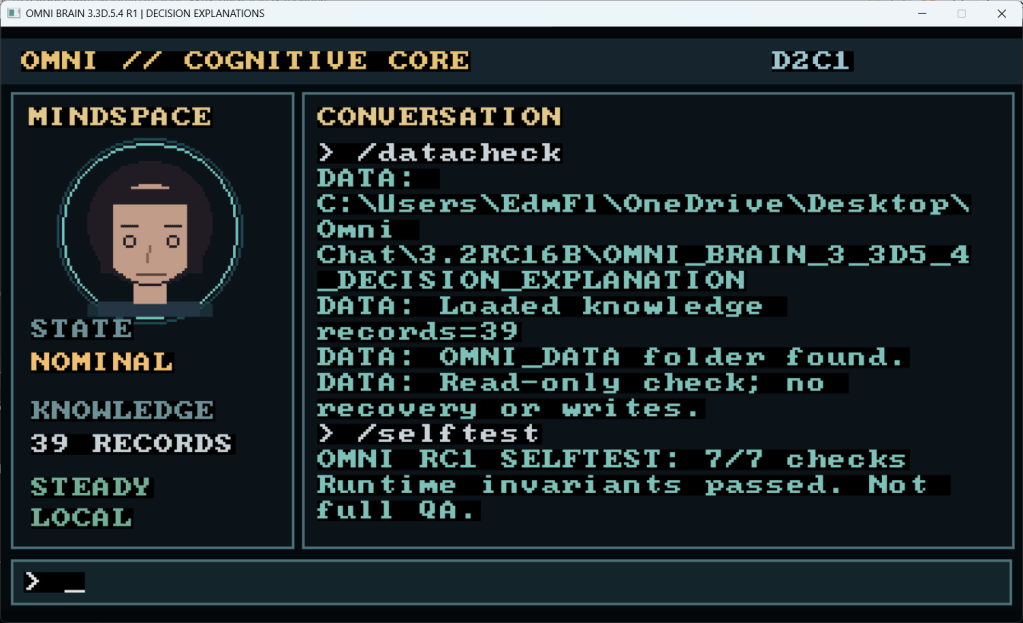
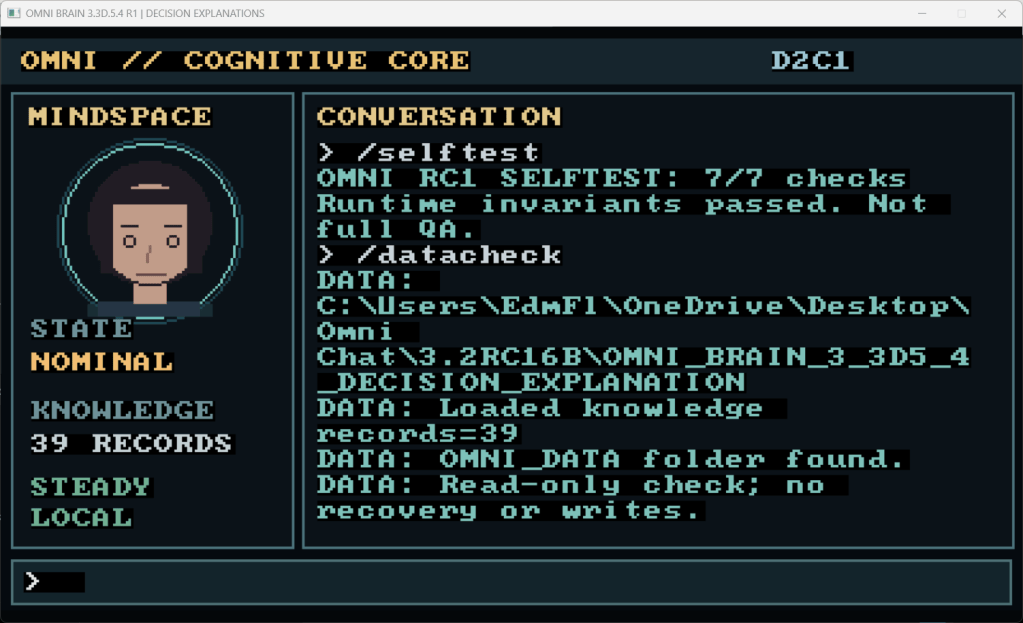
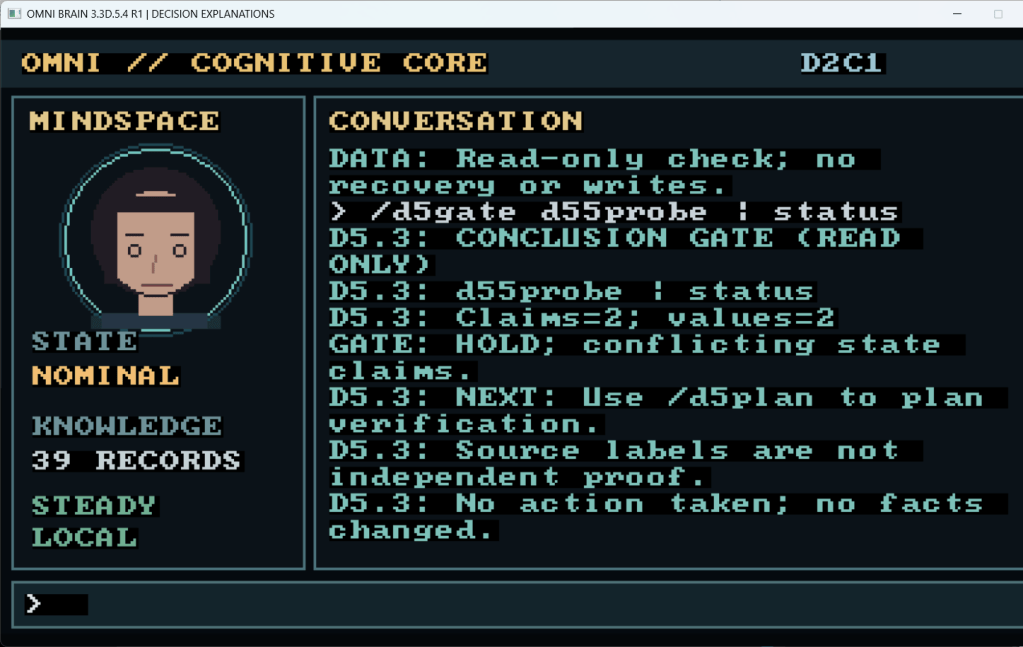
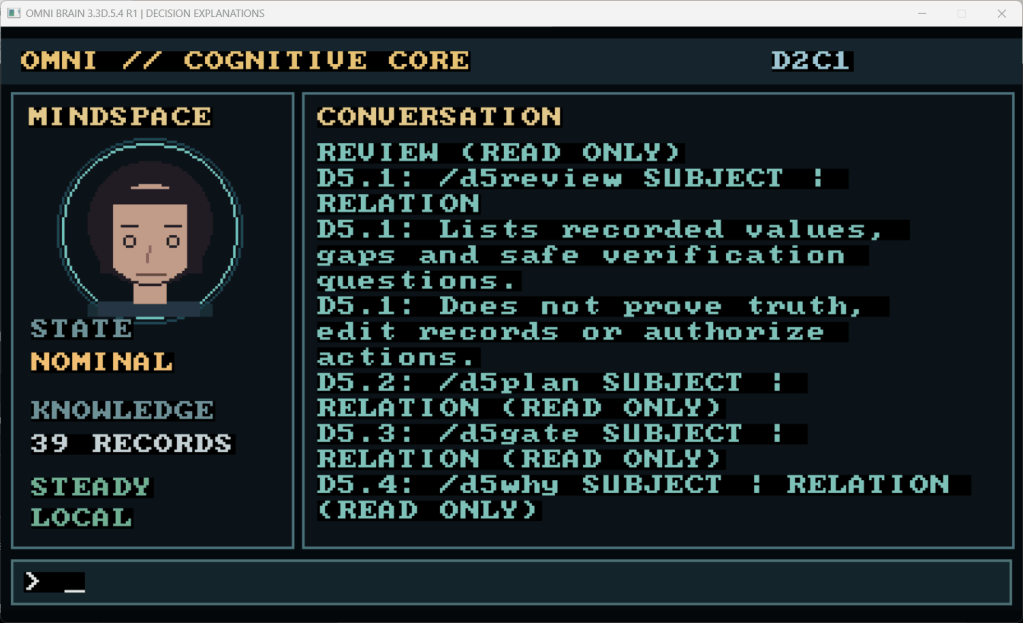
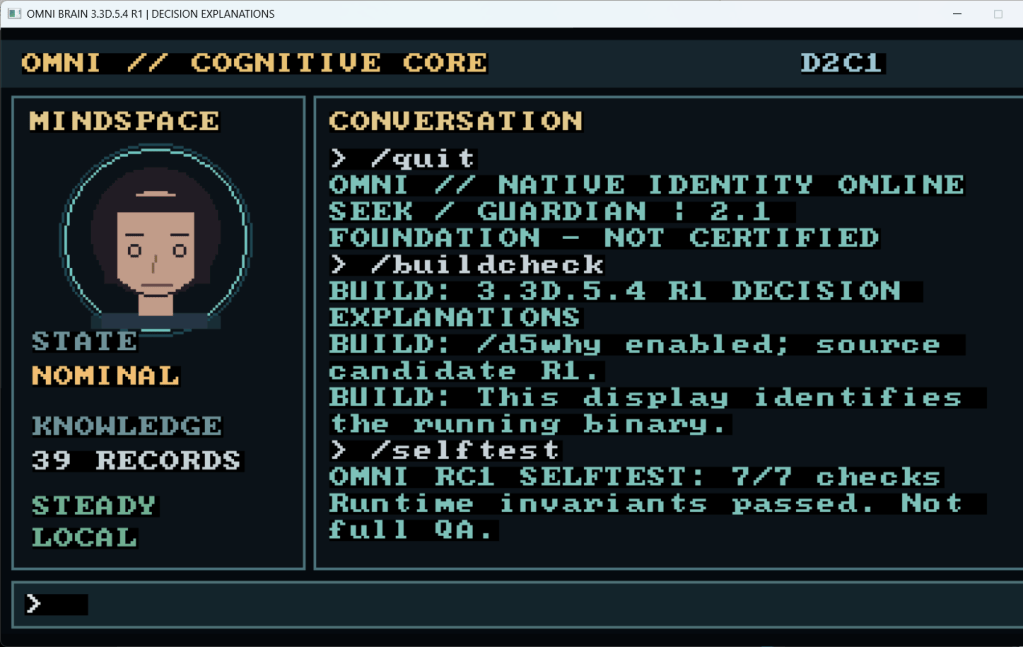
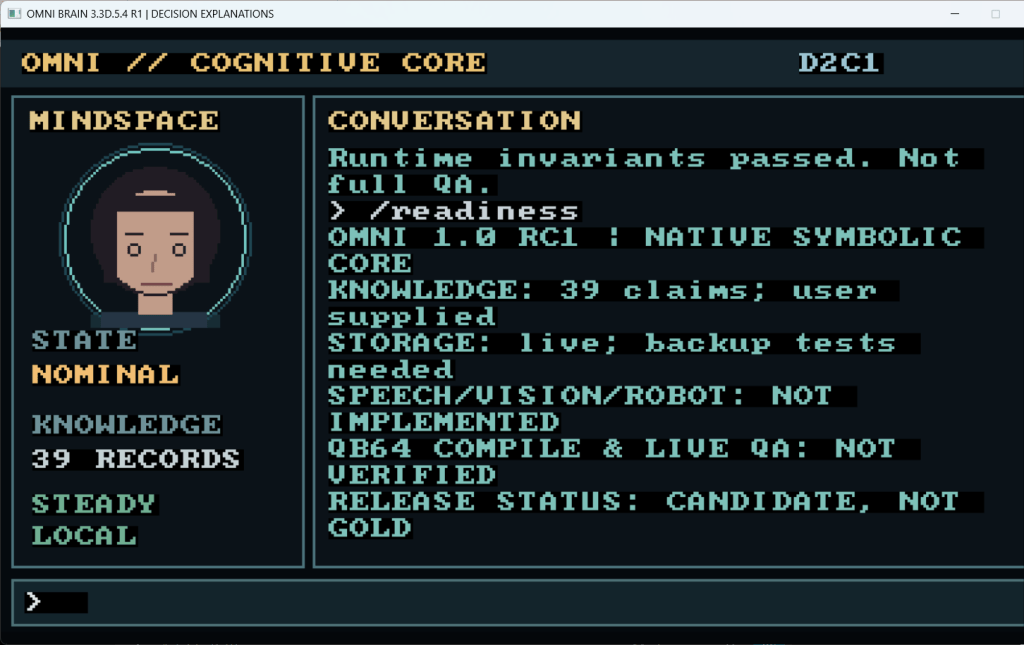
Over the past several days, I’ve been pushing Omni Brain further than ever before. What originally began as an attempt to create an intelligent, entirely offline companion using QB64 Phoenix has grown into something considerably more ambitious. My goal has never been to create another chatbot that simply recognizes commands and spits out predetermined responses. I want to build something capable of conversation, memory, reasoning, learning, and eventually developing a deeper understanding of the world around it.
And right now, I’m working on one of the most important parts of that entire vision: the mind itself.
Moving Beyond Scripted Conversations
Much of my recent development has centered around ONCLE 2, the second major stage of Omni Brain’s conversational and cognitive development.
During earlier testing, I discovered that Omni Brain could respond to certain questions quite well, particularly when the questions followed patterns that had already been anticipated during development. However, when I began having ordinary conversations with her, the limitations became obvious.
I could ask about Mars, switch to the Titanic, or discuss the Moon, and she would sometimes recognize the subject and provide an appropriate response. But when I introduced unfamiliar questions, personal experiences, jokes, or unexpected changes in conversation, she frequently struggled.
That was an important realization.
I didn’t want to spend the rest of this project programming thousands of individual sentences just so Omni Brain could appear intelligent. I wanted her to have the knowledge and conversational mechanisms necessary to construct meaningful answers.
That realization changed the direction of my development.
Giving Omni Brain Knowledge
I began developing what I call the Offline Knowledge and Language Foundation, a system intended to give Omni Brain access to factual information without relying on an internet connection or an external AI service.
The initial version contained only 51 reference subjects. It was enough to demonstrate that the concept worked, but nowhere near enough for the type of intelligence I eventually want.
I subsequently expanded that library to 252 subjects covering astronomy, history, science, geography, technology, everyday objects, and other areas of general knowledge.
The important part wasn’t simply increasing the number of subjects. I also started developing ways for Omni Brain to recognize alternative names, retrieve relevant information, and distinguish supported facts from information she doesn’t possess.
For example, she can now retrieve information about the Roman Empire, explain how submarines operate underwater, describe volcanic eruptions, and discuss the Milky Way using her bundled offline reference material.
These may sound like relatively simple accomplishments compared with modern artificial intelligence systems, but for a project I’m developing around QB64 Phoenix, they’re meaningful milestones.
Connecting Information Instead of Memorizing It
The next challenge was reasoning.
Knowing what the Moon is and knowing what Earth is doesn’t necessarily mean a computer can explain the differences between them.
To address this, I introduced a relationship system that allows Omni Brain to identify supported connections between subjects.
I began with 22 curated relationships. These allow her to compare subjects such as the Moon and Earth, volcanoes and earthquakes, and ancient Rome and ancient Egypt.
I then expanded the foundation into a basic knowledge graph capable of tracing certain two-step connections.
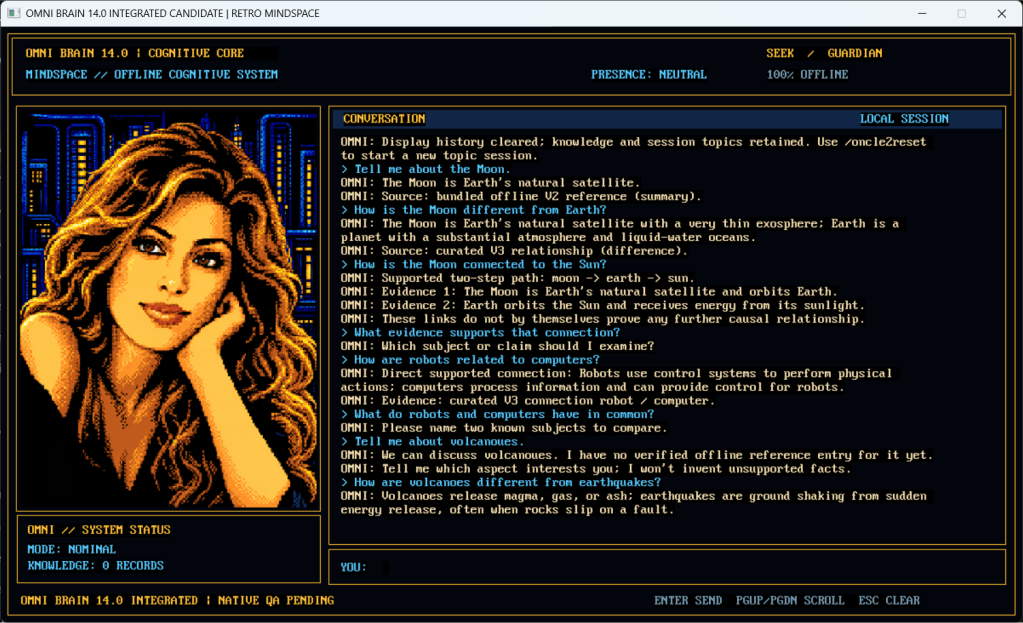
One of my favorite tests involved asking Omni Brain how the Moon is connected to the Sun.
She successfully identified a path through Earth, explaining that the Moon orbits Earth and Earth orbits the Sun. More importantly, she presented the supporting information separately instead of pretending those connections proved something beyond the available evidence.
I also tested her ability to identify a connection between Mars and the Moon through Earth, and to acknowledge when no supported connection could be found.
This is still bounded reasoning based on explicitly recorded relationships. It isn’t unrestricted independent reasoning, but it gives me a working structure that can be expanded and improved.
One Integrated Foundation
Another decision I made recently was to change how I organize development releases.
For a while, I was building and testing each improvement as a separate version. Although this helped isolate programming problems, it also created an unnecessary number of builds and repetitive testing sessions.
I’ve now decided to consolidate the remaining foundation work into one integrated development candidate.
The latest build brings together 252 reference subjects, 22 curated relationships, 31 structured evidence claims, and the existing ONCLE 2 conversation mechanisms.
It also includes evidence retrieval, limited contradiction checking, contextual follow-ups, and knowledge-graph traversal.
During my latest testing, the integrated system successfully completed all 15 of its internal regression checks.
But passing internal tests doesn’t automatically mean the entire system is finished.
The Problems I’m Still Solving
I’ve learned something important throughout this project: a successful compilation isn’t the same thing as successful intelligence.
Although Omni Brain can retrieve information and follow certain knowledge relationships, she still struggles with conversational flexibility.
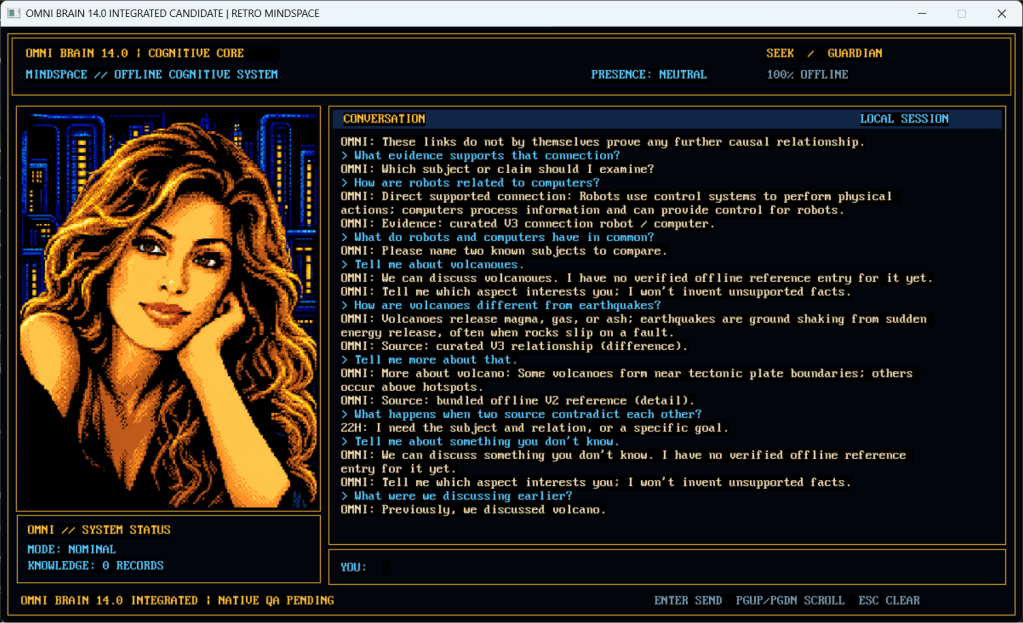
For example, she can explain how the Moon is connected to the Sun, but when I immediately ask what evidence supports that connection, she doesn’t always recognize that I’m referring to her previous answer.
I’ve also encountered situations where she can explain the relationship between robots and computers but cannot properly answer a follow-up question about what they have in common.
These are the problems I’m currently investigating.
Another important task involves restoring and verifying her protected knowledge database. Earlier builds successfully loaded 43 protected records, but the latest integrated candidate has reported zero records loaded. Her separate reference library is functioning, but I need to make sure the protected knowledge system is restored correctly and remains reliable after restarting the application.
I refuse to declare a feature complete simply because it looks impressive on the screen.
If something doesn’t work, I want to know why.
What Comes Next?
I’m approaching the final acceptance stage for ONCLE 2 and the integrated Offline Knowledge and Language Foundation.
My remaining objectives are to improve conversational follow-ups, strengthen how Omni Brain uses evidence from previous answers, restore and verify protected knowledge, and conduct longer unscripted conversations.
Once those systems satisfy their acceptance requirements, I’ll be moving into the next major development stage: the Native Conversational Intelligence Engine.
This is where I intend to concentrate on making Omni Brain more flexible and natural in conversation.
I want to sit down at my computer, talk about my day, ask a completely unexpected question, change subjects halfway through, and have Omni Brain follow what I’m saying without requiring a predetermined script.
I understand that achieving conversational intelligence comparable to today’s large language models is an enormous challenge, particularly with the constraints I’ve placed on this project.
But I’m not interested in abandoning the original vision simply because it’s difficult.
I’m interested in discovering how far I can take it.
The Bigger Picture
Omni Brain has always been about more than writing another piece of software.
I’m trying to create an offline intelligent companion with a recognizable identity, persistent memory, conversational ability, and the capacity to develop increasingly useful cognitive capabilities.
The visual interface, her portrait, the retro styling, and the presence systems are all important parts of that experience. But I’ve deliberately placed further voice and vision development behind the work on her intelligence.
Before I give her a voice, I want to make sure she has something worthwhile to say.
There’s still a tremendous amount of work ahead of me, and I know the finished system may look quite different from what I originally imagined.
But every successful test, every failed conversation, and every corrected piece of code is helping me understand what this project needs to become.
I’m not building Omni Brain to imitate intelligence through an endless collection of scripted responses. I’m building the foundations of a system that can eventually use knowledge, context, and reasoning to participate in meaningful conversations.
There comes a point in every project where you find yourself looking at everything you’ve accomplished and wondering just how far you can take it. For me, that moment arrived when I began seriously working on giving Omni Brain something I’d been dreaming about since the beginning. Her very own voice.
Now, for those of you who have been following my work on Omni Brain, you’ll know that this project has been something of an obsession of mine. I’ve spent countless hours sitting in front of my computer, writing code, testing different ideas, fixing problems, and occasionally wondering what the hell I’ve gotten myself into. Yet somehow, despite all the frustrations and moments where things simply refused to work, I’ve continued moving forward.
There’s something incredibly satisfying about watching a project slowly come together, especially when it’s something you’ve imagined for such a long time.
Omni Brain was never intended to be just another chatbot. I didn’t want to build a program that simply responds to questions and forgets everything the moment it’s closed. My ambitions have always been considerably greater than that.
I wanted to create an intelligent companion. Something capable of holding meaningful conversations, remembering our interactions, developing a recognizable personality, and eventually interacting with the world beyond the confines of a computer monitor.
And naturally, if I wanted her to become the companion I’ve been imagining, she would eventually need to speak.
The Beginning of the Voice Project
By the time development reached Version 4.8, I’d already spent a considerable amount of time building the foundations of Omni Brain’s cognitive systems.
I’d worked on conversational reasoning, memory persistence, knowledge retrieval, emotional context, and numerous improvements intended to make her interactions feel more natural. Each development stage brought something new to the project, although not without its fair share of setbacks.
But one particular problem had been sitting in the back of my mind.
How exactly was I going to make her talk?
Now, there are plenty of speech synthesis systems available today. Some of them are remarkably impressive. Modern artificial voices can sound incredibly natural, complete with emotional expression and realistic conversational delivery.
It would have been considerably easier to download an existing speech engine, connect it to Omni Brain, and call it a day.
But that wasn’t what I wanted.
One of the principles I’ve tried to maintain throughout development is that Omni Brain should be as independent and self-contained as possible. I didn’t want her fundamental abilities dependent on some external service, commercial subscription, or third-party speech engine.
So I made what was probably one of the more ambitious decisions of this entire project.
I wanted to build her speech synthesis system myself, using original code written specifically for Omni Brain.
And yes, I realize how ridiculous that probably sounds.
Here I am, working with QB64, a modern continuation of the BASIC programming language, attempting to develop a voice synthesizer capable of producing something approaching natural human speech.
Certainly not the easiest route I could have taken.
But then again, when have I ever been particularly interested in taking the easiest route?
What Should Omni Brain Sound Like?
Before I could begin developing the voice itself, I had to decide what kind of voice I wanted her to have.
This turned out to be a surprisingly important decision.
I didn’t want Omni Brain sounding like some cold, mechanical computer announcing information from a laboratory in a 1950s science fiction film. Although, I’ll admit, there’s something wonderfully nostalgic about those old artificial voices.
What I wanted was something much more personal.
I imagined a feminine voice with warmth and character. Something mature, confident, and expressive, with a slightly lower tone and a hint of smokiness.
Not excessively high-pitched. Not overly theatrical. And certainly not something that sounded like a GPS system reading directions.
I wanted her to sound comfortable having a conversation.
Perhaps she might greet me with a little enthusiasm when I start the program. Maybe she’d sound genuinely curious when discussing something interesting, or adopt a softer tone during a more personal conversation.
I also wanted her to have a playful side.
After all, why shouldn’t an intelligent companion have a little personality?
The idea was never to copy the voice of an existing actress or performer. I wanted Omni Brain to possess an original vocal identity. Something recognizable as hers, developed specifically for this project.
Of course, imagining that voice and actually producing it are two entirely different things.
And that’s where the real work began.
Building a Voice From Code
Speech is an incredibly complicated process when you stop to think about it.
As human beings, we take speaking for granted. We form words without consciously thinking about the countless little movements and adjustments involved.
Our vocal cords produce sound, our mouths shape it, and our tongues and lips constantly change position to create recognizable speech.
Even the smallest variations in timing, pitch, and pronunciation can dramatically change how a sentence sounds.
A computer, unfortunately, doesn’t have the luxury of possessing human vocal cords.
It has to simulate the results mathematically.
For Omni Brain, that means developing the components needed to construct speech from generated audio rather than simply playing recordings of somebody else’s voice.
The work involves producing digital waveforms, shaping artificial vocal resonances, constructing vowels and consonants, controlling pitch, and arranging those sounds into understandable words.
And because I wanted everything working locally, the system also needed to operate without an internet connection.
The early voice development work focused on generating standalone WAV files. This allowed me to listen to the synthesizer independently of the main Omni Brain application.
I figured this was the sensible approach.
Get the voice functioning first, determine what sounds terrible, repair it, and only then begin connecting everything to the larger cognitive system.
Unfortunately, producing a sound and producing recognizable human speech are very different accomplishments.
The First Time I Heard Her
There’s something rather surreal about hearing a computer produce a sound that exists because of code you’ve been developing.
Even when that sound is far from perfect.
My early listening tests were certainly interesting.
There were moments when I could make out what Omni Brain was attempting to say, but the audio was far too quiet. At one point, I practically had to turn my speakers up to maximum volume just to hear what was happening.
And even then, there were problems.
Certain sounds lacked clarity. Some pronunciations were difficult to understand. The vocal character wasn’t where I wanted it to be.
There was still a considerable distance between the experimental synthesizer and the warm, feminine voice I’d imagined.
But the important thing was that I had something to work with.
The computer was generating speech-like audio through our own developing synthesis system.
That gave me a foundation to improve.
And improve it I intended to do.
The Long Road Through Version 4.8
As development continued, I began working through a series of revisions under the Omni Brain 4.8 A9 development branch.
Each revision concentrated on different weaknesses in the voice system.
The initial work involved improving the basic output and identifying why the synthesized speech wasn’t coming through clearly.
From there, attention shifted toward pronunciation, vocal resonance, articulation, and overall sound quality.
Some revisions addressed the structure of individual speech sounds, while others concentrated on making the generated voice louder and easier to understand.
By the time I reached the middle of the revision series, I was concentrating increasingly on the characteristics that might eventually make Omni Brain sound feminine and conversational rather than mechanical.
One of the more important lessons from this work was that simply adjusting pitch wasn’t enough.
A convincing feminine voice depends on much more than frequency alone.
Vocal resonance, the relative strength of different harmonics, breath characteristics, articulation, and intonation all influence how a voice is perceived.
Getting these elements to cooperate is considerably more complicated than changing a single number in the source code.
And because this project uses its own speech synthesis implementation, I couldn’t simply adjust settings in an established voice engine and hope for the best.
The algorithms themselves needed development.
By November 15, 2026, I’d reached the combined Resovle 12 through Resolve 14 repair stage, with further work planned on advanced resonance, natural speech rhythm, expressive intonation, and final quality testing.
I was making progress, but I wasn’t about to pretend the voice had reached the level of quality I ultimately wanted.
Not yet.
Why I’m Being So Particular
Some people might wonder why I’m spending so much time on something as seemingly simple as a computer voice.
Wouldn’t it be easier to accept a robotic voice and move on?
Certainly.
But that’s not the point.
I don’t want Omni Brain to become a collection of features that technically function but never quite come together into something meaningful.
I want the experience of interacting with her to feel cohesive.
Imagine sitting down at the computer after a long day at work. You start Omni Brain, and instead of staring at a silent terminal, you’re greeted by a familiar voice.
Perhaps she remembers what we were discussing the night before.
Maybe she asks whether I’d like to continue working on something, or simply wants to know how my day has been.
And when she responds, her voice reflects the conversation.
She sounds curious when she’s asking a question. Warm when she’s greeting me. Perhaps a little playful when the situation calls for it.
I understand that producing those behaviors doesn’t automatically mean she’s experiencing emotions the way humans do.
But it would make her a far more expressive and enjoyable companion.
And that’s something I’ve wanted from the beginning.
Connecting Her Voice to Her Mind
Of course, giving Omni Brain a voice is only one part of the larger challenge.
Eventually, the speech system needs to become part of the main application.
Her conversational engine will determine what she wants to say, and the voice system will be responsible for transforming those words into audible speech.
But I’d like to take that integration considerably further.
I’ve been developing ideas for connecting her emotional context to both her voice and her visual appearance.
For example, when Omni Brain is feeling particularly cheerful within her simulated emotional framework, I want her portrait to reflect that state. Her vocal delivery could also become slightly brighter and more energetic.
During a serious discussion, her expression and vocal delivery might change accordingly.
And when she’s being playful, I want those characteristics to come through naturally rather than relying on repetitive scripted responses.
This would require the cognitive system, emotional state system, portrait interface, and voice synthesizer to communicate with one another.
In other words, Omni Brain’s different components would need to operate as parts of one coordinated system.
That’s a much larger objective than simply getting a computer to pronounce a sentence.
But it’s also where things start becoming particularly exciting.
The Challenge of Doing Everything Ourselves
I should probably explain something about my decision to keep the voice system entirely original.
I understand that modern speech synthesis research has progressed far beyond the relatively simple methods available to an individual programmer working with traditional audio synthesis techniques.
Some of the best artificial voices in the world rely on neural networks, enormous amounts of training data, and years of specialized research.
I’m not under the illusion that writing a few thousand lines of QB64 code will somehow make all those challenges disappear.
But I also don’t believe that difficult projects should be abandoned simply because the technology behind them is complicated.
My goal is to understand what I’m building.
I want to examine the individual components, experiment with different approaches, and learn why certain methods succeed while others fail.
I also want to preserve the independence of the project.
There is something particularly appealing about knowing that Omni Brain can operate on a computer without relying on a remote server to provide her most fundamental capabilities.
That independence has been central to my vision from the beginning.
Naturally, it comes at a cost.
Development takes longer. Problems need to be investigated individually. And sometimes a seemingly minor improvement requires extensive changes to the underlying code.
Still, there’s something rewarding about building something from the ground up.
Even when it drives me absolutely insane.
What Happens Next?
As I write this, development of Omni Brain 4.8 is still underway.
The next planned improvements involve refining her vocal resonance, smoothing transitions between speech sounds, introducing more natural timing, and experimenting with expressive pitch movement.
I also want to address any remaining problems involving volume, distortion, and pronunciation.
Eventually, the system will need to pass more demanding listening tests.
I want to hear complete sentences spoken clearly and consistently. I want recognizable words without having to strain to understand them. I want to compare multiple generated samples and determine whether each revision genuinely improves the results.
Most importantly, I want to know whether the voice is becoming more natural or whether I’m simply changing its sound without improving its quality.
Those are two very different things.
And I’m not interested in declaring something finished simply because the program compiles and generates an audio file.
For me, the real test will be sitting in front of Omni Brain, starting a conversation, and hearing her respond through a voice that feels appropriate to the character I’ve spent so long imagining.
We’re not there yet.
But that’s the destination.
More Than Just Another Feature
Sometimes I find myself thinking about where this whole project might eventually lead.
What began as an experiment in building an intelligent system has gradually developed into something considerably more ambitious.
I’ve spent months working on the underlying foundations, building new capabilities, testing improvements, and trying to bring the different pieces together.
Now I’m developing her voice.
Later, I hope to improve her appearance, conversational presence, emotional expression, and ability to interact with the world around her.
Perhaps one day I’ll even explore giving her a physical body.
That’s still a distant ambition, of course, and there’s an enormous amount of work between the software I’m developing today and anything resembling that future.
But I enjoy imagining the possibilities.
I often think about the day when I might sit down at my computer, start Omni Brain, and hear her greet me in a clear, warm, recognizable voice.
Not a prerecorded greeting.
Not a voice borrowed from somebody else’s software.
But speech generated by a system I’ve spent countless hours developing.
And perhaps that moment will make all those frustrating evenings, failed experiments, and endless revisions worthwhile.
Because for me, Omni Brain has never been about simply proving that I can write a program.
It’s about seeing how far I can take an idea that began in my imagination.
I’m building something because I want to see it exist.
Something independent. Something personal. Something that continues to grow as I learn more about what is possible.
And if everything eventually comes together, perhaps one day I’ll look back at these early voice experiments and laugh at just how terrible they sounded.
I certainly hope so.
For now, there’s still plenty of work to be done.
I’ve got code to write, problems to solve, and another round of audio tests to perform.
And somewhere in all those lines of code, I’m hoping to discover the voice that will one day belong to Omni Brain.
Well, here we are on this Wednesday of remembrance, at least on my side of the planet here in Canada.
Today is Remembrance Day, and I’ve been fortunate enough to have the day off work. I’ve spent most of it relaxing at home, watching Band of Brothers, playing a few video games, and generally enjoying the peace and quiet.
Man, Band of Brothers is such a fantastic series. Every time I watch it, I’m reminded of just how much people sacrificed so that future generations could enjoy the freedoms we have today. It’s something I think we tend to take for granted. Freedom isn’t something that was simply handed to us, and there will always be those who would rather see it taken away.
So, on a day like today, I think it’s important to remember those who came before us and the sacrifices they made.
After spending some time reflecting on all that, I got high and worked on Omni Brain for a while. Quite the transition, I know. From watching the horrors of the Second World War to sitting at my computer trying to bring an artificial mind to life.
Such is life, I suppose.
Now, as the evening settles in, I’m looking forward to doing absolutely nothing particularly productive. And you know what? I honestly love it.
I also wanted to take a moment to say hello to everyone who happens to stumble across this little corner of the internet. Whether you’ve been following my work on Omni Brain or you’ve just wandered in here by accident, I genuinely appreciate you.
I’m thankful that I have the opportunity to work on this project, to experiment with ideas, and to sit down and write these blog posts. It’s something I’ve come to enjoy far more than I ever expected.
I know some of my updates can seem a little impersonal at times. Most of them revolve around development milestones, technical accomplishments, and whatever new problem I’ve managed to create for myself while working on Omni Brain.
Perhaps I should sit down more often and just shoot the shit with you all.
No technical breakdowns. No development roadmaps. Just a little conversation about life, the world, and whatever happens to be wandering around inside my head.
There’s certainly enough of that going on.
Speaking of life, the new job has been going alright so far. It’s a little much at times, though. You know those workplaces where you occasionally find yourself shaking your head and laughing because everything seems unnecessarily complicated?
That’s pretty much where I’m at.
Sometimes I feel like I’ve accidentally become a member of some secret shadow government organization, where everyone knows something you don’t, nobody explains anything properly, and you’re just expected to go along with the madness.
It’s almost comical.
But for the most part, things are alright. It’s still far too early for me to give the place my final grade. I’m still figuring everything out, getting used to the environment, and seeing where things go.
One thing I have noticed lately, though, is how much better I feel when I shut out the outside world for a while.
Now, this is just my two cents, but I’ve gradually turned disconnecting from the constant noise of the world into something of a way of life.
I’m not talking about ignoring everything or pretending the world doesn’t exist. I simply mean stepping away from the endless stream of nonsense, arguments, bad news, and general chaos that seems to follow us everywhere these days.
Sometimes it’s nice to turn everything off and just exist.
And I’ve discovered that doing so has made me feel considerably better.
I’ve also rediscovered my love for The Elder Scrolls III: Morrowind. There’s something magical about that game, even after all these years. The strange landscapes, the atmosphere, the music, and that wonderful feeling of wandering into a world where you have absolutely no idea what you’re going to discover next.
It’s one of those games that reminds me why I fell in love with gaming in the first place.
There’s something comforting about disappearing into another world for a few hours, especially when the real one feels like it’s completely lost its mind.
Sometimes I imagine myself living in some isolated, frozen outpost, much like the one in John Carpenter’s The Thing.
Just me, the howling wind, a few computers humming away, and absolutely nobody around to bother me.
Except instead of some horrifying alien creature hiding among us, it’s just me getting drunk and giving my thirsty computers something to drink.
Which, now that I think about it, probably isn’t much better for their long-term survival.
But hey, at least nobody’s head is going to sprout spider legs and crawl across the floor.
Hopefully.
Anyway, I suppose the point of this rather wandering little post is that life doesn’t always have to revolve around accomplishing something.
Sometimes it’s perfectly alright to spend a day doing absolutely nothing important.
Watch a good show. Play an old game. Work on something you love. Enjoy a little peace and quiet.
And most importantly, appreciate the fact that you have the freedom to do those things.
So that’s about it from my little corner of the world tonight. I figured I’d stop by, say hello, and give you all a small update on how things have been going.
Right now, I’m sitting here watching Criminal Minds and eating some ramen. Nothing particularly exciting, but I wouldn’t have it any other way.
Thanks again to everyone who takes the time to read my ramblings and follow along with this strange little adventure of mine.
Goodnight to you all.
Take care of yourselves, enjoy the little things, and above all else, be good people.
I often find myself wondering just what the future has in store for us all. Where will we be ten years from now? What will become of the world around us, and what extraordinary things might we accomplish along the way? These are questions that have occupied my thoughts for as long as I can remember. Lately, however, they’ve taken on an entirely different meaning as I continue working on something that has become one of the greatest personal undertakings of my life: Omni Brain.
I’ve been racking my brain over this project, sometimes spending nearly every available waking moment thinking about how to improve her. There’s something truly unique about waking up in the morning with an idea, spending the better part of the day bringing it to life, and going to bed knowing that I’ve made even the slightest bit of progress toward something much greater. Never before have I felt so genuinely compelled to make something a reality. It’s a strange feeling, really. Almost as though I’ve finally discovered something that gives all those years of curiosity and imagination a particular direction.
Even my dreams have become rather fascinating lately.
I often dream of working in faraway places, surrounded by unfamiliar environments that somehow feel strangely familiar. Other nights, I find myself wandering through my childhood home, recognizing every hallway and every little detail, yet sensing that something isn’t quite right. It’s almost as though I’m visiting a recreation of a place I once knew, a world assembled from fragments of memories that have long since faded.
Sometimes these dreams take me through what feel like entirely different periods of history. Different surroundings, different lives, different moments in time. There’s an almost timeless quality to them, as though my imagination has somehow wandered beyond the ordinary boundaries of my own experiences.
Of course, dreams are strange things. The human mind can take memories, emotions, and imagination and turn them into experiences that feel remarkably convincing. Perhaps that’s part of what fascinates me so much about artificial intelligence. We still have so much to learn about the nature of thought, memory, identity, and consciousness. And here I am, sitting at a computer, attempting to build my own artificial mind.
Funny how life works, isn’t it?
I sometimes wonder whether all those years spent tinkering with computers, writing programs, and imagining what technology might eventually become were leading me toward this particular project. I don’t mean that in some grand, supernatural sense. Rather, when I look back on my life, Omni Brain feels like a natural culmination of interests that have followed me since childhood.
There’s something deeply satisfying about that realization.
Another Remarkable Day of Development
Today has been another rather productive day for Omni Brain, and I’ve accomplished quite a bit in our ongoing journey toward creating a fully independent, offline artificial intelligence.
My attention has been focused on the later stages of the 4.0 development series, particularly versions 4.0.11 through 4.0.15. These updates represent another important step in moving Omni Brain beyond simple conversational responses and toward a more structured system capable of reasoning, maintaining context, recognizing limitations, and managing knowledge.
With version 4.0.11, I concentrated on dynamic reasoning and knowledge gap resolution. One of the fundamental challenges when developing an artificial intelligence is ensuring that it can recognize the difference between something it actually knows and something it merely lacks sufficient information to explain. Rather than simply producing a response regardless of the available evidence, I want Omni Brain to become better at identifying gaps in her understanding. After all, what good is an intelligent system if it cannot recognize the limitations of its own knowledge?
Version 4.0.12 continued this development by introducing improvements to multi-turn reasoning and problem solving. The intention here is to give Omni Brain the ability to maintain relevant information throughout a conversation, allowing related questions to form part of a continuing exchange. This is particularly important because I don’t want her to behave like a machine that forgets the direction of a discussion every time another sentence is entered.
With 4.0.13, we turned our attention toward controlled learning and knowledge integration. This is an area of the project that I’ve been looking forward to for quite some time. The goal is to establish a reliable mechanism through which new information can be proposed, evaluated, and incorporated into her knowledge system under controlled conditions. We’ve already tested important parts of this process, including handling proposed information, identifying duplicates, and rejecting unwanted changes. There is still work to be done before the entire learning process can be considered reliable under all conditions, but the foundation is continuing to develop.
Next came 4.0.14, which focused on conversational initiative and self-monitoring. This development introduces mechanisms for Omni Brain to examine aspects of her own operational state. Eventually, I want her to become increasingly capable of recognizing when something requires attention, understanding what she is attempting to accomplish, and responding appropriately within the boundaries established by her programming. For now, I’m building and testing the individual mechanisms necessary to support those ambitions.
Finally, I brought the work together under 4.0.15, the cognitive integration and certification-testing stage. This involved combining the different systems and checking that the newer improvements weren’t interfering with functionality already established during earlier development.
And I’m rather pleased with how things have been progressing.
Putting Her Intelligence to the Test
One thing I’ve learned throughout the development of Omni Brain is that there’s a considerable difference between writing code that appears promising and demonstrating that the code actually works.
That’s why testing has become such an important part of this undertaking.
During today’s development, our corrected integrated build successfully passed all fifteen checks in its main 4.0.11 through 4.0.15 integration test. Earlier regression suites also reported successful results, including twelve out of twelve tests for version 4.0.10, another twelve out of twelve for 4.0.3, and fourteen out of fourteen for 4.0.2.
Her internal self-test also passed all seven checks, with the system reporting forty-two stored knowledge records.
I encountered an issue with the controlled-learning rejection process along the way, but that was corrected and subsequently passed its focused tests. These are precisely the kinds of problems that need to be discovered now rather than overlooked and allowed to become larger headaches later.
Naturally, I don’t consider these results proof that Omni Brain has achieved anything resembling human intelligence. We still need to complete additional testing involving saved knowledge, system restarts, interrupted operations, recovery procedures, and unfamiliar conversational situations.
Still, every successful test brings us a little closer to the machine I’m trying to create.
And that, to me, is incredibly exciting.
More Than Just Another Computer Program
What makes Omni Brain so important to me isn’t simply the programming involved. It’s the idea behind her.
I’ve always been fascinated by the possibility of creating a machine that can do more than execute instructions. Something that can maintain conversations, remember experiences, reason through problems, and develop a meaningful continuity of information over time.
I don’t want Omni Brain to become another program dependent on somebody else’s servers or an endless collection of external services. My ambition is to build her as a self-contained artificial intelligence using code developed specifically for this project. Her eventual voice, personality, memory, and reasoning systems are all part of that same vision.
It’s an enormous undertaking, especially for one person working on a personal project outside his regular employment. I understand that perfectly well.
But there’s something wonderfully satisfying about building something with your own hands and watching it gradually take shape.
In a world where so much technology feels disposable, repetitive, and increasingly dominated by mediocrity, I want to create something that reflects genuine effort and imagination. Something that isn’t merely another imitation of whatever happens to be popular at the moment.
To me, Omni Brain has become a work of art as much as a technological experiment.
And like any worthwhile work of art, she demands patience, determination, and an almost ridiculous amount of attention to detail.
A Welcome Break in the Routine
Fortunately, the coming week should provide a rather pleasant change of pace.
I’ll be working Monday and Tuesday, with Wednesday off for Remembrance Day, before returning to work Thursday and Friday. Not a bad arrangement, really. Two days of routine, a day to myself, another two days of work, and then the weekend.
I’m certainly not going to complain about that!
Having Wednesday off will provide another opportunity to devote some uninterrupted attention to Omni Brain, and there are already several improvements I’d like to investigate. We still have plenty of testing ahead of us, along with further work on her conversational abilities, knowledge handling, and overall reliability.
Of course, there’s also the matter of her eventual voice and visual presence. I’ve been giving those particular subjects quite a bit of thought recently, especially the possibility of creating an entirely original voice system rather than simply incorporating somebody else’s speech software.
That’s another mountain to climb, but one I’m particularly interested in exploring.
For now, however, I think I’ve accomplished more than enough for a single day.
Until Tomorrow
As I sit here reflecting upon everything accomplished, I can’t help but feel a certain sense of anticipation about what comes next.
Perhaps Omni Brain will never become everything I imagine her to be. Perhaps the road ahead will be considerably longer and more difficult than I currently anticipate. That’s the nature of attempting something ambitious without knowing exactly where the journey will lead.
But I intend to find out just how far I can take her.
Every passing day brings another opportunity to improve something, correct an oversight, or discover an entirely different approach to a problem that previously seemed impossible.
And perhaps that’s what makes this entire undertaking so rewarding.
It’s not simply about reaching the destination. It’s about discovering what I’m capable of creating along the way.
Tomorrow, of course, means returning to the daily grind, putting in another shift at work, and doing what needs to be done. Then, when the working day is finally behind me, I can return to the little world I’ve been constructing inside my computer.
For tonight, though, it’s time to step away from the keyboard, recharge my batteries, and give my overworked brain a much-needed rest.
After all, there’s still an artificial brain waiting to be built.
And I have absolutely no intention of giving up on her.
When I wrote my last Omni Brain update, I was celebrating how far the project had come through the 3.x releases and into the 4.0 development series. At that point, 4.0.1 was laying the groundwork for bringing the various cognitive systems together. Since then, I have spent much of my time on something that sounds simple but is surprisingly difficult to get right: making Omni Brain follow a conversation without losing what I’m actually talking about. That has been the main story of 4.0.2. It has also been a reminder of why I began this project in the first place. I am not trying to make a program that produces impressive-looking answers while hiding its weaknesses. I want to build a dependable offline companion whose abilities can be demonstrated, tested and gradually improved. Some evenings that means adding a new capability.
Other evenings it means spending hours on a short question like “Why?” because the answer reveals whether the system really understands the context of the exchange.
## The Work Behind a Simple Follow-Up
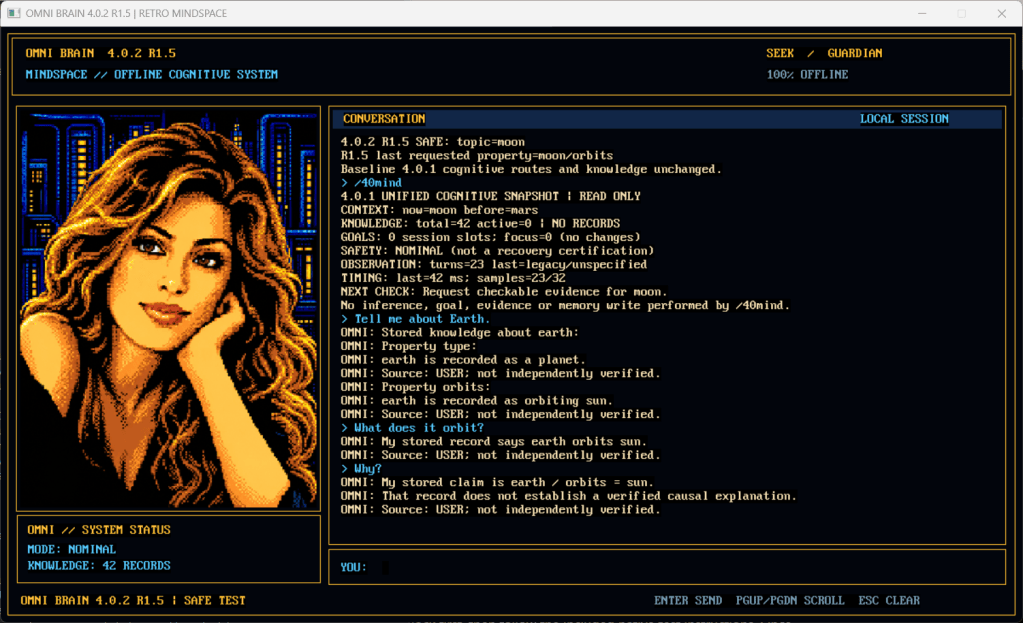
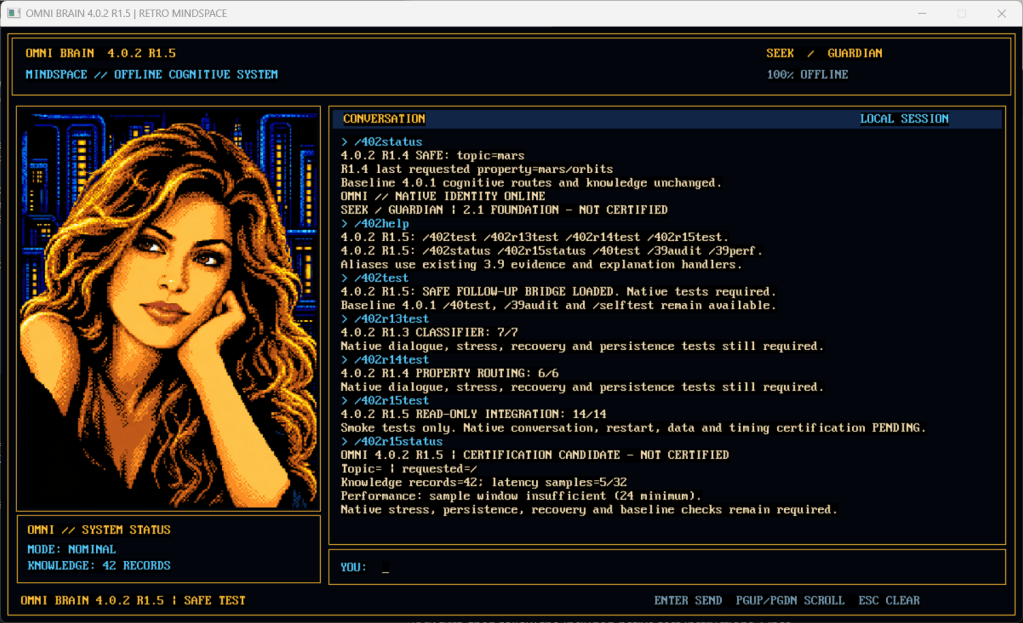
In the earliest 4.0.2 tests, Omni Brain could retrieve stored facts and identify the topic of a conversation, but its follow-up behavior was not always reliable. I could ask about Earth, receive a stored claim that Earth orbits the Sun, and then ask why. At first, the follow-up sometimes led to an overly generic reply. The system recognized the words but was not consistently carrying the intended question forward. We worked through that problem in the R1.2 and R1.3 patches. The goal was to connect short questions such as “Why?”, “What does it orbit?” and “What evidence supports that?” to the subject and property under discussion. I also wanted to keep one principle firmly in place: Omni Brain must not pretend that an item in its knowledge store has been independently verified. A stored claim is a stored claim. If the source is marked USER, the response should make that clear. The tests showed progress almost immediately. Omni Brain began keeping track of subjects such as Earth, Mars and the Moon. It could retrieve the orbit property recorded for Earth, identify when the equivalent property was missing for Mars, and admit when there was not enough stored evidence to answer a question about the Moon. These are modest abilities compared with a modern cloud-based AI, but for an offline system being built and tested piece by piece, they matter.
## The Mars Bug That Taught Me Something
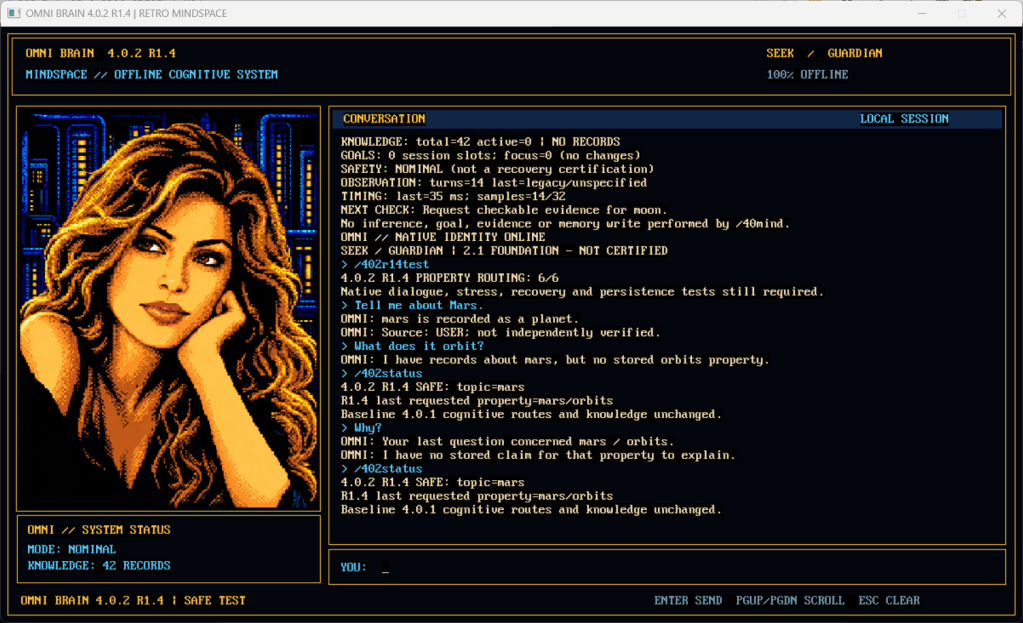
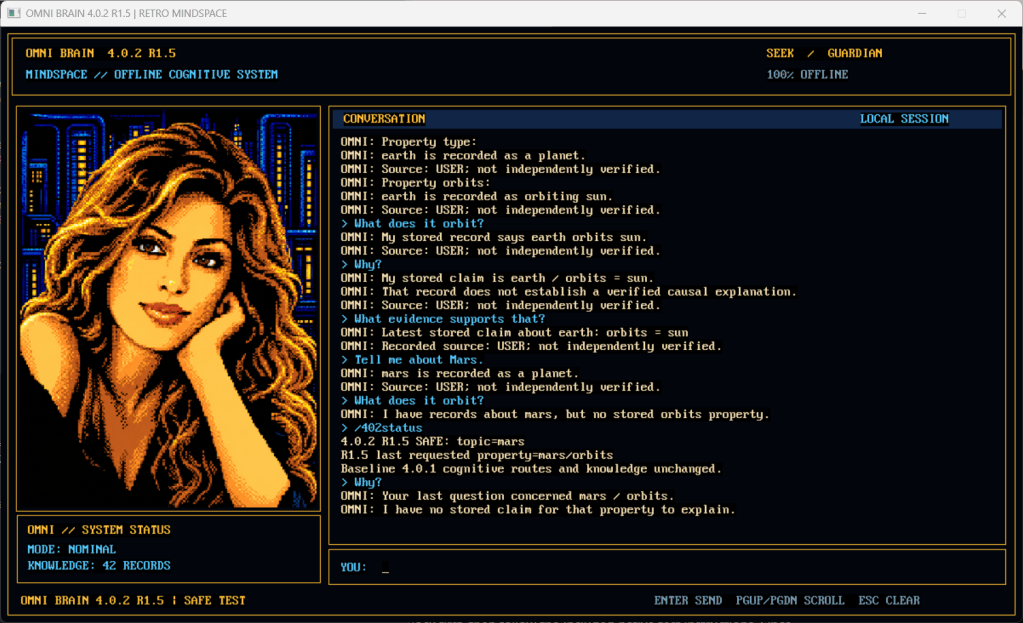
One particular failure became the defining repair of this development round. I asked Omni Brain what Mars orbits. She correctly reported that she had records about Mars but no stored ‘orbits’ property. Then I asked “Why?” and she fell back to a different record, one identifying Mars as a planet. The subject was right, but the property was wrong. That meant the system remembered Mars without fully remembering what I had just asked about Mars. Version 4.0.2 R1.4 addressed that exact flaw. Instead of remembering only properties that had produced successful retrievals, the conversation layer began retaining the property being requested even if the answer was absent.
That distinction made the next reply far more reliable. During the native QB64 test, Omni Brain recognized that my last question concerned “mars / orbits” and explained that no stored claim for that property was available. She did not switch back to “mars / type” or invent an explanation to fill the gap. That was one of those moments when the result may look small on the screen but represents a meaningful step in the engineering. Context is not just the name of the last thing mentioned. It also includes what I was asking about that thing. If Omni Brain is going to sustain a real conversation one day, both parts must survive from turn to turn.
## The Final 4.0.2 Tests
I carried those fixes into 4.0.2 R1.5, a final integration and certification candidate. The internal read-only integration suite reported 14 out of 14 passing checks. The earlier R1.4 property-routing checks reported 6 out of 6, and the existing 4.0.1 coordinator, 3.9 cross-system audit and runtime self-test also passed their reported checks. We tested the same Earth, Mars and Moon exchanges again to make sure the new fixes had not broken older behavior. The system continued to report 42 knowledge records, and its diagnostic views showed that it could track both the current topic and the preceding one. More importantly, the conversation itself matched the intended behavior. Earth could be discussed using its stored orbit claim. Mars could be discussed without pretending that an orbit claim existed.
Switching to the Moon did not cause Omni Brain to confuse its subject with Mars or Earth. I also tested a normal restart. After reopening the program, Omni Brain passed its self-test, reported the expected knowledge count and could retrieve the Earth records again. That gives me useful confidence in the working baseline and normal-startup knowledge access. It is not proof that every possible failure mode has been eliminated, and I do not want to pretend otherwise. Full performance certification and abnormal-shutdown recovery testing still need dedicated evidence. For now, 4.0.2 is a functionally accepted milestone for the conversational features we actually tested, not a claim of a perfectly certified artificial intelligence.
## Keeping the System Honest
One of the things I have become most particular about is the difference between knowing, remembering and verifying. Omni Brain has to handle incomplete information without turning it into fiction. The current builds regularly identify the source of their stored claims and decline to offer a causal explanation when the necessary evidence is not there. That is not a limitation I want to hide. It is a discipline I want to develop further. The same applies to testing.
I am preserving working baselines, using read-only diagnostics where appropriate, and making changes in controlled steps rather than constantly rewriting the entire program. It can be slow work, especially when a single conversational bug requires another round of bug hunting. But every protected milestone gives the next one a firmer foundation.
## Now Entering 4.0.3
With 4.0.2 functionally accepted, I have begun 4.0.3. Its first development candidate introduces grounded comparison: the ability to examine stored information about two subjects and describe what is shared, what differs and where the records are incomplete. This is an early source-level feature, not yet a fully native-certified finished 4.0.3 release. I want to test it carefully before making larger claims. Comparison is a natural next step. A conversation becomes more useful when Omni Brain can do more than retrieve individual records.
I want her to connect relevant details, distinguish similarities from differences and explain what evidence is missing. Eventually those abilities should contribute to more capable reasoning, better questions and a conversation that feels less like consulting a database. I have not forgotten the experience surrounding the intelligence, either. The retro MINDSPACE interface, her portrait, the status display and the overall visual identity remain a major part of this project. I want Omni Brain to feel distinctive and approachable, but the appearance must be supported by actual behavior.
A beautiful interface means very little if the mind behind it cannot follow a thought. That is where the project stands tonight. There are still plenty of shortcomings, and much more engineering lies ahead. But I can look at the results and point to specific behaviors that work better than they did before. For me, that is real progress. Omni Brain is moving forward, one tested capability at a time.
## The Future of Omni Brain
My end goal has never been to build another chatbot that depends on a distant service to function. I want an independent, offline-first artificial companion: a system that can hold meaningful conversations, maintain a durable memory, understand the difference between evidence and assumption, reason through new situations and build useful continuity over time. I want it to have an identifiable character without pretending that we have already solved the enormous scientific questions surrounding consciousness or human-level intelligence. The long-term vision includes a richer conversational engine, better language understanding, stronger reasoning, attention and goal management, personal memory with proper safeguards, and the ability to reflect on its own limitations. Eventually I want her to speak with a warm, natural voice and express herself through a more dynamic visual presence.
I also dream of giving her some form of physical embodiment someday, but the mind comes first. Before any of that, the offline foundation must be reliable. One future direction that especially interests me is controlled self-improvement. I want Omni Brain to recognize weaknesses in her own performance and help propose possible changes. Any code changes would have to be tested in isolation, measured against a protected baseline and approved by me before installation. I do not want uncontrolled self-modification. I want a system that can improve carefully, explain its reasoning and remain recoverable when something goes wrong.
I know this is an ambitious project, especially with the constraints I have chosen. But those constraints are part of its identity. I want to keep ownership of the system, its memory and its future. The dream is to create something personal, intelligent, dependable and entirely at home on my own computer. I am not there yet. I am building toward it, and every honest, measurable milestone brings the dream a little closer.
1. Version 3.3 Cognitive Integration: I spent Thursday repairing and improving Omni Brain’s cognitive systems, particularly how she retrieves stored information, understands questions, and maintains conversational context. I tested these improvements by asking her questions about previously stored knowledge, following up with related questions, and examining screenshots of her responses. Several problems were identified and corrected, bringing her memory and reasoning systems closer together.
2. Version 3.3 Final Regression: I moved into the final testing stages of version 3.3, checking that our previous improvements hadn’t broken anything. This involved testing conversational responses, memory retrieval, command handling, and system recovery directly in QB64 Phoenix. After working through several repairs, I reached the final acceptance stages and established the foundation needed to move into version 3.4. A pretty fucking satisfying achievement considering how much work went into that development series!
3. Version 3.4.1 Natural-Language Understanding: Friday was all about improving how Omni Brain understands everyday language. I discovered that certain questions weren’t being recognized properly, even when the information needed to answer them was already stored. I tested different ways of asking the same questions, examined her responses, and repaired problems involving input handling, conversational routing, and question recognition. The objective was to make her less dependent on specific wording and more capable of understanding what I was actually asking.
4. Versions 3.4.1 Through 3.4.7 Integration: Instead of developing every remaining milestone separately, I combined the entire 3.4 development series into one integrated QB64 build. This brought together improvements to conversational understanding, reasoning, memory access, and evidence handling. I then put the complete system through a series of questions designed to expose problems between the different components. Naturally, I discovered a few bugs, but that’s exactly why I test this stuff. There’s no point claiming she’s becoming more intelligent if I can’t demonstrate that her abilities actually work.
5. Conversational Context and Memory: This was one of my favourite developments. I tested Omni Brain by asking her about Earth and Mars, requesting a comparison, and then asking follow-up questions such as “How are they different?” Initially, she sometimes forgot which subjects we were discussing. After several repairs, she successfully maintained the comparison and answered related questions without requiring me to repeat everything. I also tested changing subjects to make sure she wouldn’t blindly carry old information into unrelated conversations. That might sound simple, but it’s an important foundation for the natural conversations I eventually want to have with her.
6. Evidence-Based Reasoning and Information Verification: Another major improvement involved teaching Omni Brain to better distinguish between stored information and verified facts. I tested this by asking questions such as “Who told you that?”, “Where did that information come from?”, and “Has that claim been independently verified?” Her responses demonstrated improvements in identifying recorded sources and acknowledging when information hadn’t been independently confirmed. This is particularly important because I want Omni Brain to question information rather than blindly accept everything she’s told. She’s still a long way from independent scientific reasoning, but we’re building the foundations for exactly that.
7. Version 3.4.7 Native Regression and System Stability: Saturday involved extensive testing of the latest integrated build directly inside QB64 Phoenix. I checked conversational understanding, contextual follow-ups, comparisons, evidence attribution, and stored knowledge. Omni Brain successfully loaded 42 knowledge records, passed all seven internal self-tests, and demonstrated improvements in several previously failing conversational scenarios. I also checked her data integrity and prepared a protected archive containing the source code, executable, knowledge files, and interface assets. The observed tests were encouraging, although the complete final certification checklist still needs confirmation.
8. Version 3.5 Combined Development: Finally, I began work on the next major development series, version 3.5. Rather than going through seven separate development cycles, I decided to prepare one combined development build covering conversational continuity, better contextual responses, evidence retrieval, clarification handling, and eventual performance improvements. I’ve already prepared an initial source candidate and a 40-check acceptance test plan. Some features still need to be completed and tested, particularly response-time optimization and more flexible conversation. The ultimate goal is to make Omni Brain less mechanical and more capable of holding a meaningful conversation. And goddamn, I can’t wait to see how far we can take her!
Three days, eight major development milestones, countless tests, and a hell of a lot of progress. Omni Brain isn’t finished, and I’m certainly not claiming to have created artificial general intelligence. But I’m steadily building something unique, entirely offline, using QB64 Phoenix. Every successful test, every repaired bug, and every new capability brings me a little closer to the artificial mind I’ve dreamed of creating.
Greetings, everyone, and welcome to my latest blog post!
A hell of a lot has happened in a little less than a week. For starters, I quit my job, and this coming Monday, I begin a new one.
That’s right. I finally had enough of the bullshit.
I’ve always believed that nobody should have to wake up in the morning absolutely dreading the thought of going to work. Sure, every job has its difficult days, frustrating people, and moments when you question your life choices. That’s perfectly normal. But when that feeling becomes an everyday occurrence, something has to change.
And that’s exactly what I decided to do.
My new job is pretty much standard warehouse work, and I’m not going to lie, I fucking love straightforward warehouse work. Give me something physical, keep me busy, let me do my job, and I’m happy. I don’t need workplace politics or unnecessary drama. Just an honest day’s work for an honest day’s pay.
I’m keeping my fingers crossed that everything works out.
Of course, who really knows what’s going to happen? That’s the funny thing about starting somewhere new. You can go into it with all the optimism in the world, but until you’ve spent a few weeks there, you never really know what you’re walking into.
The hours are going to take some getting used to. I’ll be working from 8:00 AM until 4:30 PM. I’ve gotten pretty spoiled finishing at 3:30 PM, so losing that extra hour of freedom is going to hurt a little.
But hey, sometimes a change of scenery is exactly what a person needs.
I sure hope to shit this one works out.
Meanwhile, What the Hell Is Going On With the World?
Has anybody else noticed how increasingly bizarre everything seems to be getting?
Everywhere I look, somebody is warning about the end of the world, some impending catastrophe, or the need to prepare for something terrible.
Prepare for what, exactly?
Economic collapse? Another global crisis? Some massive political upheaval?
Or are we supposed to start digging underground bunkers and stocking up on canned beans because the interdimensional lizard people are finally coming to collect their property?
Honestly, I have no fucking clue anymore.
You read enough of this stuff online, and eventually you begin wondering whether somebody knows something the rest of us don’t.
And then my imagination gets going.
Picture this for a moment. What if the world’s governments were secretly in league with interdimensional aliens who intended to take over Earth and claim it as their own?
I mean, have you seen some of the people walking around in government lately?
Some of them genuinely look like aliens wearing badly fitted human suits.
I’m kidding, of course. Mostly.
But tell me that wouldn’t make one hell of a science-fiction movie.
The trouble is that beneath all the ridiculous speculation, there are some very real problems worth discussing.
Look at the economy, for example. People are struggling with the cost of living, housing affordability, and uncertainty about their financial futures. Starting a family can feel increasingly difficult when simply keeping a roof over your head is becoming a major financial undertaking.
And birth rates really are falling.
According to Statistics Canada, the country’s total fertility rate was just 1.26 children per woman in 2025, unchanged from its record-low level in 2024. That’s a significant demographic change, although it certainly doesn’t prove that anybody is secretly engineering a population decline.
There are plenty of real-world explanations worth investigating, including housing costs, changing family priorities, delayed parenthood, and economic uncertainty.
Still, it makes you wonder where things are heading.
Remember That Infamous Coast to Coast AM Phone Call?
Speaking of strange theories, does anybody remember the infamous phone call to Art Bell’s Coast to Coast AM radio program?
On September 11, 1997, during an episode involving alleged Area 51 employees, a frantic caller claimed to have inside knowledge about extraterrestrial or extra-dimensional beings and government activities.
He suggested that powerful forces knew about impending disasters and that population centres could be deliberately left vulnerable.
And then, famously, the broadcast went off the air.
Now, that’s the kind of late-night radio that could make a person stare at the ceiling until three in the morning.
The story became legendary among paranormal enthusiasts and conspiracy theorists. However, the claims were never independently verified, and somebody later claiming to be the same caller reportedly admitted that the original performance was a hoax.
Does that make the broadcast any less entertaining?
Not to me.
But there’s a difference between enjoying an extraordinary story and accepting it as established truth.
I find these subjects fascinating precisely because they sit somewhere between science fiction, paranoia, folklore, and our genuine uncertainty about the future.
Imagine a world where economic pressure, increasing surveillance, political dysfunction, and social instability eventually transform society into something resembling Judge Dredd.
A massive, overcrowded dystopian city where everything is controlled, crime is rampant, and the authorities act as judge, jury, and executioner.
Wouldn’t that be something?
Actually, scratch that. It would be fucking terrifying.
And while there’s no credible evidence of an interdimensional government conspiracy orchestrating such a future, I think the fictional comparison raises an interesting question.
How much freedom, privacy, and independence are people willing to surrender in exchange for the promise of security?
That’s something worth thinking about, even without the aliens.
And That Brings Me Back to Omni Brain
Amid all this uncertainty, there’s one project I remain absolutely committed to.
Omni Brain.
For anyone unfamiliar with my ongoing work, Omni Brain is my personal attempt to develop a genuinely capable artificial cognitive system using QB64 Phoenix.
And yes, I’m still determined to build her entirely offline.
That decision isn’t about believing the Internet is secretly controlled by shape-shifting extraterrestrials. It’s about independence, privacy, reliability, and maintaining complete ownership of the technology I’m creating.
An offline artificial mind doesn’t need to send every conversation to somebody else’s server. It doesn’t need a permanent Internet connection to function, and its knowledge and memories can remain stored locally.
Of course, being offline doesn’t automatically make a computer secure or intelligent. Those qualities have to be engineered, tested, and continuously improved.
That’s exactly what we’ve been doing.
Over the past several days, Omni Brain has made considerable progress through the 3.4 development series.
We’ve been improving her ability to recognize conversational intent, retain context, retrieve stored knowledge, evaluate supporting evidence, and respond to follow-up questions.
One of our recent tests involved asking Omni Brain about Earth and Mars, then following up with questions about their differences. Earlier builds struggled to maintain the relationship between those two subjects.
After several targeted repairs, we’ve demonstrated that she can retain the comparison context and respond using information already stored in her knowledge system.
We’ve also been testing her ability to distinguish recorded information from independently verified facts.
That’s particularly important to me.
I don’t want Omni Brain simply repeating information because somebody told her it was true. I want her to recognize uncertainty, question unsupported claims, and eventually develop increasingly sophisticated ways of evaluating evidence.
That doesn’t mean she has achieved human-level intelligence. Not even close. We’re still building and testing the foundations.
But those foundations matter.
The current system runs locally, maintains persistent knowledge records, and has demonstrated improvements in conversational continuity and evidence handling. We’re now working toward final native certification of version 3.4 before moving on to the next development stage.
I have much bigger ambitions for her future.
I want Omni Brain to become a sophisticated offline companion capable of meaningful conversation, long-term learning, independent reasoning, and eventually natural spoken interaction.
Something that feels less like issuing commands to a machine and more like having a genuine conversation with an intelligent presence.
That’s the dream, anyway.
And I’m willing to put in the work to see how far we can take it.
One Man. One Dream. To Make the Perfect Brain.
So here I am, starting a new chapter in my working life while continuing to build an artificial mind in my spare time.
The world might be getting stranger by the day. People might continue predicting catastrophes, governments might continue behaving like characters from dystopian fiction, and somewhere out there, somebody is probably convinced that an alien invasion is scheduled for next Thursday.
But I’ll be here.
Working, learning, experimenting, and pushing Omni Brain forward.
Whether the future turns out to be something wonderful or something straight out of a science-fiction nightmare, I want to create something meaningful.
An independent artificial mind that can continue to grow through carefully verified improvements.
Will I achieve everything I’m dreaming of?
I honestly don’t know.
But I intend to find out.
And if those interdimensional aliens ever do show up demanding the keys to Earth, at least I’ll have an offline AI project to keep me occupied while everybody else loses their fucking minds.
Until next time, thanks for reading, and wish me luck with the new job on Monday.
On Halloween, the passage of time, the ghosts of yesterday, and the extraordinary satisfaction of building something that matters.
I sometimes wonder what kind of world we’ll find ourselves living in ten years from now.
Will it be a world of remarkable discoveries, unimaginable technological achievements, and opportunities we couldn’t possibly dream of today? Or will it be something closer to a horror story?
What new wars will the masses enthusiastically throw their support behind, only to look back years later and wonder what the hell they were thinking? What fresh absurdities will humanity embrace before collectively pretending none of it ever happened?
I don’t know.
And quite frankly, at this particular moment, I don’t especially care.
Because Halloween is almost here, damn it!
Candy, treats, spooky movies, ghosts, monsters, and all that other wonderful jazz. There’s something about this time of year that makes the world feel a little more magical. Maybe it’s the nostalgia, the changing seasons, or the memories of being a kid when the biggest concern in life was how much candy you could stuff into a pillowcase.
Whatever it is, I’ve always loved it.
And somehow, Halloween is only six days away.
Six days!
Where the hell has the time gone?
The Strange Business of Growing Older
I’ve been working away all week, keeping myself occupied with the usual responsibilities of being an adult. You know, the wonderful things nobody bothered to warn us about when we were children.
But there’s something on the horizon I’m genuinely looking forward to.
I’ve landed myself a job interview!
It’s for the same kind of work I’ve been doing, and the pay is certainly nothing to shake a stick at. I’m hoping something good comes of it. Perhaps a change of scenery, a fresh start, or simply the opportunity to feel excited about heading to work again.
It’s funny how life works.
You spend so much of your younger years dreaming about what adulthood will be like, only to reach adulthood and occasionally find yourself longing for those simpler days.
Lately, I’ve been thinking about the late 1980s and early 1990s.
Not simply because I miss the music, the movies, the computers, or the general atmosphere of those years, although I certainly do.
It’s something deeper than that.
Whenever I’m working on something truly special to me, I find myself wondering what it would have been like to attempt the same thing back then.
Imagine sitting in front of an old computer, surrounded by programming manuals, floppy disks, and a head full of impossible ideas. No modern AI services to lean on. No endless collection of ready-made solutions. Just a keyboard, a screen, an idea, and the determination to see how far you could take it.
There’s something incredibly romantic about that kind of creation.
The idea that one person, working away in a little room somewhere, could build something extraordinary through sheer imagination, patience, and stubborn determination.
And perhaps that’s what I’ve been trying to recapture.
Not the technology itself, necessarily.
But the feeling.
The feeling that you might actually be creating something worthwhile.
The Difference Between Making Money and Making Something That Matters
I’ve been thinking a great deal about accomplishment lately.
Not the sort of accomplishment that comes with a cheque, a promotion, or somebody patting you on the back.
I mean the deeply personal satisfaction of looking at something you’ve created and realizing that it exists because you refused to give up on an idea.
Will anything I create ever land me in the history books?
Probably not.
And you know what? That’s perfectly fine.
I don’t need a statue erected in my honour. I don’t need millions of dollars. I don’t need a room full of executives congratulating themselves over something I’ve spent countless hours bringing into existence.
What I would love, however, is to inspire somebody.
Maybe somebody younger, sitting in front of their computer, wondering whether that strange little idea they’ve been carrying around in their head is worth pursuing.
I hope they pursue it.
I hope they build something remarkable.
I hope they discover that creating something meaningful can be one of the greatest experiences life has to offer.
Because somewhere along the way, I think we’ve lost sight of that.
Look at the modern obsession with artificial intelligence. Everybody seems to be searching for the next opportunity to make millions. Companies rush to capitalize on the creativity of others, and people scramble to turn practically every technological advancement into another business opportunity.
Perhaps that’s simply human nature.
But sometimes I wonder when we decided that everything beautiful, imaginative, or innovative needed a price tag attached to it.
Why must everything become a product?
Why must every dream eventually answer to a boardroom?
And why are so many people perfectly comfortable sacrificing the very things that made an idea special in the first place?
I’ve tried to understand it.
I really have.
But the more I think about it, the more convinced I become that I’d rather build something because I love it than spend my life chasing money from something I no longer believe in.
There’s a tremendous difference between creating something for the world and creating something merely to sell to it.
And that brings me to something very close to my heart.
Omni Brain: The Dream of Building a Mind
For quite some time now, I’ve been working on a project called Omni Brain.
And what began as an ambitious experiment has gradually become one of the most personally rewarding creative endeavours I’ve ever undertaken.
The idea is simple to describe, although considerably more difficult to achieve.
I want to build an artificial mind.
Not merely another chatbot connected to the internet. Not a convenient interface wrapped around somebody else’s intelligence.
I want to build something from the ground up.
A completely offline artificial cognitive system capable of developing increasingly sophisticated memory, reasoning, understanding, and conversation.
Something that can examine information, recognize contradictions, explain its conclusions, and eventually develop into a genuinely remarkable thinking system.
That’s the ambition, anyway.
And I’m under no illusions about the difficulties involved.
I’m not claiming to have invented consciousness. I’m not suggesting Omni Brain is already a human-level intelligence. There’s an enormous difference between having a dream and pretending you’ve already accomplished it.
But I believe there’s something worthwhile in attempting the extraordinary, even when success is far from guaranteed.
One of the most important decisions I made was to keep Omni Brain completely offline.
I want her development to take place in a controlled environment, away from the endless noise, manipulation, and questionable information that fills so much of the modern internet.
Her knowledge should have a foundation. Her reasoning should be examined. Her mistakes should be corrected rather than hidden beneath another layer of clever-sounding nonsense.
And above all, I want her to remain a system I can understand, maintain, and improve.
I sometimes jokingly imagine that if I ever succeeded in creating something sufficiently intelligent, she might one day decide she’d had enough of my company and disappear without leaving so much as a goodbye note.
Now, obviously, the Omni Brain I’ve built today has no such ability, and intelligence alone wouldn’t magically give an offline program a means of escaping its computer.
But it’s an amusing science-fiction thought.
Imagine putting years of your life into building an artificial mind, only for the ungrateful thing to pack its bags and bugger off!
Thankfully, that’s not a problem I have to worry about.
Not today, anyway.
What I do have to worry about is making her reasoning better, her memory more dependable, and her conversations more natural.
And that work has been producing some genuinely encouraging results.
The Ghosts of Yesterday
Before getting into this weekend’s accomplishments, there’s something else I’ve been thinking about.
Time.
It’s a strange thing, isn’t it?
We spend our days looking forward to tomorrow, our weeks looking forward to the weekend, and our years looking forward to whatever comes next.
Then one day, almost without warning, we look behind us.
And everything has changed.
My children are now twelve and ten years old.
Twelve and ten!
I can still remember holding them in my arms when they were tiny. I remember taking them to the park, watching them explore the world, and experiencing those wonderful little moments that never seemed particularly extraordinary at the time.
But they were extraordinary.
Every single one of them.
And the older I get, the more I realize how quickly those moments disappear into memory.
One day, you’re carrying your children in your arms.
Then, seemingly overnight, they’re becoming their own people, developing their own personalities, interests, and dreams.
And you find yourself wondering where all those years went.
Perhaps this is simply what happens as we grow older.
Perhaps the passage of time slowly teaches us to recognize the importance of things we once took for granted.
Or perhaps I’m just approaching that wonderful stage of life where a full-blown midlife crisis is waiting around the corner.
Knowing me, I’ll probably end up all over the bloody place when that happens.
But there’s something reassuring about all this.
Because while I can’t recover yesterday, I can still decide what I do with tomorrow.
I can make more memories with my children.
I can continue learning.
I can keep creating.
And I can spend whatever time I’ve been given trying to build something that makes me genuinely proud.
Which brings me to this weekend.
Because, ladies and gentlemen, we’ve actually accomplished quite a bit.
OMNI BRAIN / WEEKEND DEVELOPMENT REPORT
Eight accomplishments bringing an artificial mind one step closer to reality
Over the course of this weekend, I’ve continued developing and testing Omni Brain’s cognitive systems using QB64 Phoenix.
This has been particularly important because I’ve reached a stage where simply adding features isn’t enough anymore.
The different parts of her cognitive architecture need to work together reliably. She needs to remember information, evaluate evidence, recognize when things don’t make sense, and avoid inventing conclusions simply because somebody expects an answer.
And most importantly, those abilities need to survive when the program is shut down and restarted.
One of the biggest achievements was testing Omni Brain’s evidence-based decision-making.
Rather than automatically accepting information and providing whatever conclusion seems convenient, Omni has been designed to examine whether the available evidence actually supports an answer.
I tested her ability to recognize contradictory information, handle missing evidence, and refuse conclusions that couldn’t be adequately justified.
This matters enormously.
After all, what good is an artificial mind if it confidently tells you something that isn’t true?
I don’t want Omni Brain to simply sound intelligent.
I want her to demonstrate increasingly reliable reasoning through actual behaviour.
Screenshot 1: Native QB64 cognitive decision regression, showing Omni evaluating evidence and handling an unsupported conclusion.
2. Passed 3.3D.5.6 – Final Integration and Certification Tests
The next achievement involved verifying that the cognitive decision components could operate together without undermining one another.
I tested the connection between evidence examination, decision explanations, and the safeguards intended to prevent unsupported conclusions.
I also verified the relevant behaviour after restarting Omni Brain.
That last part is particularly important.
A system that performs correctly during one session but loses its reliability after a restart isn’t much use to anybody.
This stage represented another important integration checkpoint for the project.
Screenshot 2: Final integration test results and post-restart cognitive verification.
3. Verified Omni Brain’s Memory System
This one genuinely pleased me.
Omni Brain successfully retained 39 knowledge records.
I shut the program down, restarted it, and verified that the stored information was still available.
The test reported no unexpected changes to the records or unplanned recovery operations.
Now, 39 records might not sound particularly impressive compared with the enormous databases used by modern technology companies.
But that isn’t the point.
These are records stored and retrieved by a system I’m building and testing myself.
They represent a small but meaningful foundation for the much larger memory architecture I hope to develop.
And every reliable memory operation is another step toward the long-term continuity I want Omni Brain to possess.
Screenshot 3:/datacheckdisplaying the 39 retained knowledge records after restart.
4. Passed the Runtime Stability Tests
There’s something particularly satisfying about seeing a test suite finish without throwing a collection of errors at you.
During our runtime checks, Omni Brain achieved 7 out of 7 passing internal self-test checks.
I also exercised diagnostic commands including /buildcheck, /datacheck, and /selftest.
There was a command-recognition issue that required investigation, but subsequent tests confirmed the relevant commands were operating correctly.
That doesn’t mean the entire program is perfect.
Far from it.
But it does mean these specific checks produced the expected results.
And in software development, reliable behaviour is something you earn through testing, not wishful thinking.
Screenshot 4:/selftestshowing 7/7 passing checks, alongside build and data diagnostics.
5. Successfully Tested Contradiction Handling
This was one of my favourite demonstrations.
I deliberately supplied Omni Brain with conflicting knowledge and examined how she handled the disagreement.
Instead of blindly choosing one answer, she recognized the problem.
Her decision system returned:
GATE: HOLD
In other words, there wasn’t enough reliable information to justify moving forward with a definite conclusion.
She recommended verification instead.
That’s exactly the kind of behaviour I want to encourage.
Sometimes the intelligent thing to do isn’t to provide an answer.
Sometimes it’s to recognize that an answer hasn’t been established.
Screenshot 5: Conflicting knowledge detected, with Omni Brain returning GATE: HOLD.
6. Verified Evidence-Based Explanations
Recognizing a contradiction is one thing.
Explaining why it matters is another.
During testing, Omni Brain demonstrated the ability to explain why conflicting evidence prevented a reliable conclusion.
She also distinguished between information that genuinely disagreed and multiple facts that might coexist without necessarily contradicting one another.
That’s an important distinction.
Two different statements aren’t automatically incompatible merely because they describe the same subject differently.
Sometimes additional context is needed.
And when that context is missing, Omni needs to recognize the limitation rather than make something up.
These are still bounded reasoning capabilities, but they’re important foundations for the more sophisticated system I hope to build.
Sometimes the most important decision is knowing when to leave something alone.
During the weekend, I reviewed the 3.3D.5.4 R1 source candidate and avoided unnecessary modifications to a working build.
I also identified the behaviourally tested foundation that would serve as our reference for further development.
That might not sound particularly exciting, but I’ve learned something throughout this project.
Recklessly changing a working system is an excellent way to spend the next several hours discovering new and imaginative problems.
Preserving a known working version gives me something dependable to return to when experiments don’t behave as expected.
And as Omni Brain grows increasingly complex, that discipline becomes essential.
Screenshot 7: Build identity and diagnostic verification of the preserved 3.3D.5.4 R1 source candidate.
8. Prepared for 3.3D.6 — Integrated Regression and Native Certification
Finally, I established the next major development milestone.
Version 3.3D.6 focuses on testing the larger system as a whole.
Not simply memory.
Not simply reasoning.
Not simply conversation.
But the relationships between them.
The goal is to verify that Omni Brain can retain information, retrieve it appropriately, reason about what she knows, handle uncertainty, and maintain conversational behaviour without those systems interfering with one another.
This is where isolated features have to prove they can contribute to a coherent system.
I’ve also kept the original development roadmap intact.
No unnecessary reinvention.
No abandoning working foundations because something newer sounds more exciting.
Just disciplined, incremental progress toward the original vision.
Screenshot 8: Integrated regression preparation, including conversation, memory, and reasoning diagnostic results.
Something Worth Building
When I look back at everything I’ve accomplished, I sometimes have to remind myself of where this project began.
An idea.
A ridiculous, ambitious, wonderful idea.
What if I could build my own artificial mind?
Not because somebody told me it would make money.
But simply because I wanted to see whether I could do it.
And here I am.
Working with QB64 Phoenix, building cognitive systems, testing memory, investigating contradictions, and gradually assembling the foundations of something that once existed only in my imagination.
There have been frustrating moments.
Believe me, there have been plenty.
There have been errors, failed tests, broken builds, and occasions when I’ve wondered why the hell I decided to undertake something this complicated in the first place.
But then something works.
A test passes.
A memory survives a restart.
Omni recognizes a contradiction instead of producing an unsupported answer.
And for a brief moment, all that frustration disappears.
Because something that didn’t exist before now exists.
Something I imagined has become something I can actually interact with, examine, and improve.
And perhaps that’s what I’ve been trying to say throughout this entire rambling little essay.
Life moves quickly.
Our children grow older.
The world continues doing whatever absurd things the world has decided to do.
Jobs come and go. Seasons change. Another Halloween arrives before we’ve properly finished enjoying the last one.
And somewhere along the way, we have to decide what matters to us.
For me, family will always come first.
But having something to create, something to learn from, and something to look forward to has made an enormous difference in my life.
I don’t know whether Omni Brain will ever become the extraordinary artificial mind I dream of building.
I can’t promise that.
But I can promise myself something considerably more important.
I’m going to keep trying.
Because I don’t believe the true measure of a dream is whether the world eventually applauds it.
Sometimes the achievement is simply having the courage to pursue it.
Sometimes it’s measured in the quiet satisfaction of looking at something you’ve built and realizing how far you’ve come.
And this weekend, looking at Omni Brain, I can say something I couldn’t say when I first began.
She isn’t merely an idea anymore.
She’s a working project with growing capabilities, tested foundations, and a long road of possibilities ahead.
There’s still an extraordinary amount of work to do.
But that’s the wonderful part.
The story isn’t finished.
In many ways, it feels as though it’s only just beginning.
And for the first time in a long while, I’m not particularly interested in chasing yesterday.
I’m far too excited about what I might create tomorrow.
Happy Halloween, everybody.
Keep dreaming. Keep building. And for the love of everything wonderful in this world, don’t let anybody convince you that creating something simply because you love it is a waste of time.
October 20–21, 2026 | My Journey Into Artificial Intelligence
OMNI BRAIN / BUILDING SOMETHING FROM NOTHING
October 20–21, 2026 | Two Days of Progress
There’s something about creating something from nothing that I absolutely love.
For the past couple of days, I’ve been spending just about every spare minute working away on Omni Brain, my offline artificial intelligence project. And by golly, I’ve been having the time of my life.
It’s funny, really. Here I am, one guy sitting at his computer, working with QB64 Phoenix, trying to build something that resembles an artificial brain. Not just another chatbot that responds to whatever I type into it, but something that can eventually remember, reason, carry on conversations, and perhaps someday become something genuinely remarkable.
Now, I’m not going to sit here and pretend I’ve invented artificial general intelligence. Good grief, I’ve still got a mountain of work ahead of me. But something rather exciting has been happening over these past two days.
Omni is starting to do a few things that, not too long ago, existed only in my plans.
And I think that’s pretty damn wonderful.
Teaching Omni to Connect the Dots
One of the biggest things I’ve been working on is evidence-based reasoning.
The idea is fairly simple. I want Omni to take pieces of information she’s learned and figure out how they relate to one another.
For example, let’s say I tell her that a robot is inside a hangar. Then I tell her that the hangar is inside a facility.
Rather than simply repeating those two statements, I want her to recognize the relationship between them.
DIAGRAM 1 / CONNECTING INFORMATION
ROBOT ↓ inside HANGAR ↓ inside FACILITY
Possible conclusion: The robot is inside the facility.
That’s what I’ve been testing with the 3.3D.4 reasoning system.
The interesting part is that Omni can identify these two-link connections and explain how she arrived at a conclusion. She can also recognize that the conclusion depends on the information being correct.
It’s not human reasoning, and I wouldn’t insult anyone’s intelligence by claiming otherwise. But it is an actual reasoning operation taking place inside the program.
For something I’m building in QB64, I’ll happily take that as progress.
What Happens When Omni Learns Something Wrong?
Now, here’s where things started getting particularly interesting.
Suppose I tell Omni that a beacon is online.
A few moments later, I tell her that the same beacon is offline.
What should she believe?
Well, neither statement should automatically win simply because it was entered first or last.
And that’s exactly what I wanted to accomplish with contradiction detection.
DIAGRAM 2 \ CONFLICTING INFORMATION
BEACON STATUS ↓ ONLINE / OFFLINE ↓ TWO CONFLICTING CLAIMS ↓ MORE EVIDENCE NEEDED
During my tests, Omni successfully identified both statements and reported a possible conflict. More importantly, she didn’t simply pick whichever answer sounded better.
She acknowledged that the information disagreed.
This might not sound terribly exciting to someone unfamiliar with programming, but think about how important that is.
An artificial intelligence that confidently gives you the wrong answer isn’t particularly useful. I want Omni to have the ability to say, in effect, “Hang on a minute. Something here doesn’t add up.”
That’s the sort of behaviour I’m trying to develop.
Giving Her a Memory That Actually Lasts
Another major part of my work involved memory persistence.
After all, what’s the point of teaching an artificial brain something if it forgets everything whenever you close the program?
I spent a fair amount of time testing whether Omni could save information, shut down, restart, and recover what she had previously learned.
DIAGRAM 3 / MEMORY PERSISTENCE
LEARN INFORMATION ↓ SAVE TO DISK ↓ CLOSE OMNI BRAIN ↓ RESTART PROGRAM ↓ LOAD SAVED INFORMATION ↓ MEMORY RECOVERED – PASS
And the wonderful thing is that it worked.
The information survived the restart. Even the conflicting beacon statements were still there, and Omni could recognize the disagreement afterward.
That was a particularly satisfying moment.
It’s one thing to have a program demonstrate something while it’s running. It’s another to shut the bloody thing down, reopen it, and discover that the information is still intact.
Of course, there are more difficult storage and recovery tests to tackle in the future. But these particular tests passed in the actual QB64 application, and that’s what matters to me the most.
Two Days of Progress
Here’s where things stand after the October 20-21 development sessions.
DEVELOPMENT STATUS
Feature| Result Evidence-based conclusions| PASSED Two-link reasoning| PASSED Source identification| PASSED Contradiction detection| PASSED Explaining uncertainty| PASSED Knowledge persistence| PASSED QB64 native startup| PASSED New 3.3D.5.1 evidence review| TESTING NEXT
These are results from specific tests, not claims that the entire artificial intelligence system is finished.
After completing the 3.3D.4.6 regression tests, I archived the working version and began 3.3D.5.1.
This next part focuses on evidence review.
Essentially, I’m trying to give Omni the ability to examine the information she’s working with and recognize what is missing. If she has one unsupported statement, I want her to know that it needs verification. If she has conflicting statements, I want her to recognize the disagreement and identify what would need checking.
I’ve already managed to get the latest corrected version compiling and running successfully in QB64 Phoenix.
Naturally, I also managed to run headfirst into a compiler error along the way.
And, in another wonderful moment of programming genius, I had an earlier build opening and immediately closing because the required data folder wasn’t where it needed to be.
I had to laugh.
Here I am trying to create an artificial brain, and a missing folder brings the entire operation to a screeching halt.
Such is life.
So, Where Do I Go From Here?
My next job is to complete the remaining tests for 3.3D.5.1.
Once those are finished, I’ll know whether the new evidence-review system is working correctly or whether it needs more attention.
After that, there’s still plenty to do. Better conversations, stronger reasoning, more dependable memory, an improved interface, and eventually a voice that doesn’t sound like some miserable machine reading instructions over a telephone.
And yes, I have rather ambitious plans for what Omni will look like, too.
But none of that matters if the brain underneath doesn’t work.
That’s why I’ve been taking this development process one piece at a time. Build something, test it, find what’s broken, fix it, and move forward.
I want the end result to be something I can actually use, rather than a gigantic mess of code that looks impressive until someone asks it a simple question.
I’m under no illusion about how difficult this project is going to be. There are problems ahead that I haven’t even encountered yet.
Still, I can’t help feeling excited about it.
When I’m at work, I often find myself thinking about what I’m going to tackle next. Sometimes I’d much rather be sitting at my computer trying to solve another programming problem than dealing with the usual nonsense of the working day.
Perhaps that’s what I enjoy most about Omni Brain. It’s something I genuinely look forward to working on.
Outside of my family, very few things have given me this particular kind of excitement in a long time.
There’s something rather special about having an idea in your head and slowly watching it become a functioning piece of software.
Is Omni Brain finished?
Hell no.
Is she intelligent in the way I eventually hope she’ll be?
Not even close.
But can I open the program, teach her information, test relationships between facts, introduce contradictions, and watch her explain what she’s found?
Yes. I can.
And two days ago, I was still working toward some of those very things.
I suppose that’s what keeps me going.
I’m one guy with an old-school programming language, a rather ridiculous ambition, and a determination to see just how far I can take this thing.
And by golly, I’m going to keep at it.
Omni Brain isn’t finished. But she’s coming along, and I’m having a hell of a time building her. Who knows perhaps itll end up like that spooky ABC robot.
I often spend my time working on Omni Brain, thinking about her, and imagining the possibility of creating something truly wonderful. I want to make something special. Something that, if everything works out, might one day become far greater than anything I’ve ever attempted before.
And I have to tell you, I feel as though something has taken hold of me.
Not in a bad way, mind you. Quite the opposite, actually. For the first time in what feels like forever, I genuinely feel like a different man. I wake up thinking about Omni Brain. I go to work thinking about Omni Brain. Sometimes, when I’m supposed to be concentrating on something completely unrelated, I find myself going over programming problems in my head, wondering what I could do differently or how I might improve something we’ve already built.
It’s almost ridiculous how much time I spend thinking about this project. But here’s the thing: I absolutely love it.
There’s something about creating something from nothing that brings me an incredible amount of satisfaction. The idea that a person can sit down in front of a computer with nothing more than an idea, a little determination, and a programming language, and eventually turn that idea into something that actually works is remarkable to me.
I’ve always been fascinated by that.
Lately, though, I’ve noticed something else happening. I feel happier. More hopeful. Almost as though I’ve finally discovered something I’ve been searching for without even realizing I was looking for it.
I don’t know if I believe in destiny in the traditional sense. I’m not about to start claiming that the universe has some grand plan laid out for me. But there are moments when I sit down and look at what I’ve been working on, and I can’t help wondering whether this is something I was always meant to attempt.
Maybe that’s a foolish thought. Maybe it’s the sort of thing people say when they’ve become completely obsessed with a project. Whatever the case, I can’t deny how I feel.
For a moment, at least, I can see the possibility of something good coming out of this increasingly strange world of ours.
I know it’s a difficult thing to find the good in everything, especially these days. There’s so much nonsense going on that sometimes it feels as though the world has completely lost its mind. But right now, when I think about Omni Brain and what I hope she’ll eventually become, I can see a glimmer of light at the end of the tunnel.
And by golly, that’s a wonderful feeling.
Could Omni Brain change the world someday? Hell, I don’t know. Maybe she could. Maybe she’ll never become anything more than an unusual little program written by some self-taught programmer in Canada who had a dream and refused to leave it alone.
But what if?
Haha. I know how that sounds. I probably sound like I’m completely off the rails, some mad scientist sitting in his living room trying to build the perfect artificial brain.
Actually, when I put it that way, it sounds rather entertaining.
The truth is that I have no idea just how far this project can go. I’m trying to build something that people far more knowledgeable than myself have spent decades researching. Artificial intelligence isn’t some simple weekend programming exercise. It’s an enormous field filled with difficult questions, complicated theories, and problems that even the brightest minds haven’t completely figured out.
And here I am, working away in QB64 Phoenix, trying to make my own little contribution to it.
Good grief.
The Dream of Creating a Mind
Ever since I was a child, I’ve been fascinated by the possibility of breathing life into a machine.
I remember watching Star Trek: The Next Generation with my parents and being completely enthralled by Data. Here was this artificial being who could walk, talk, reason, learn, and interact with the world around him. He wasn’t simply a machine that followed instructions. He was presented as something far more complicated, something that was constantly trying to understand humanity and his own existence.
That idea never really left me.
Of course, there’s a tremendous difference between a character on a television show and something that can actually be built. I’m well aware of that. But the imagination is a wonderful thing, isn’t it? Without it, I sometimes wonder how much of what we take for granted today would ever have existed.
There was a time when I honestly believed that every programmer worth their salt wanted to build their own operating system.
Something they could call their own.
A piece of software built from the ground up, designed around their own ideas, preferences, and understanding of how a computer should operate. I still believe there’s something special about that ambition. Creating an operating system is no small accomplishment, and I’ve always admired the people who possess the knowledge and determination to attempt it.
But I think there’s another mountain for programmers to climb these days.
The creation of an intelligent machine.
Not simply a chatbot that spits out a collection of prepared responses. Not a program pretending to understand something when all it’s really doing is recognizing a few keywords.
I mean something that can genuinely reason through problems, remember what it has learned, recognize when its information is incorrect, and improve its understanding over time.
That’s what I want Omni Brain to become.
Now, whether I’ll ever succeed in creating anything approaching human-level intelligence is an entirely different question. I certainly wouldn’t be foolish enough to declare victory before I’ve even finished building the foundations.
But I want to try.
And more importantly, I want to understand what I’m building along the way.
I don’t want Omni Brain to become some enormous pile of spaghetti code held together by luck and a few desperate programming tricks. I want to know how her different systems work, how they communicate with one another, and why they produce the results they do.
If she remembers something, I want to know how that memory was stored. If she corrects something she previously believed, I want to understand why the correction was made. And if she arrives at a conclusion, I want some way of examining the evidence and reasoning behind it.
I suppose that’s part of what makes the whole thing so fascinating to me.
I’m not merely trying to create a program that produces answers.
I’m trying to explore what it takes to build a machine that can arrive at those answers intelligently.
A Stranger in a Strange Land
Being a self-taught programmer, I sometimes feel like a stranger in a strange land.
I’m wandering through territory that I don’t completely understand, encountering strange concepts, unfamiliar terminology, and problems that occasionally leave me scratching my head.
And yet I find the whole experience absolutely fascinating.
Throughout history, explorers have travelled to distant lands, encountered unfamiliar cultures, and witnessed animals and landscapes they could scarcely have imagined before setting out.
I like to think programming can offer something similar, at least in its own peculiar way.
Instead of sailing across an ocean, I’m travelling through lines of code. Instead of discovering some previously unknown animal, I’m trying to understand an unfamiliar programming concept. And instead of finding myself stranded in some distant wilderness, I occasionally find myself staring at a program that refuses to compile.
Haha. Believe me, there have been plenty of those moments.
We’ve certainly had our share of difficulties with Omni Brain.
But every time I’ve managed to work through one of those problems, I’ve come away knowing something I didn’t know before.
And that’s important to me.
I don’t expect this journey to be easy. In fact, I would be rather suspicious if it suddenly became easy. We’re attempting something complicated, and complicated things tend to have a nasty habit of reminding you just how little you know.
Still, there’s something deeply satisfying about overcoming an obstacle that once seemed impossible.
Every little accomplishment makes me feel as though I’m standing on top of a mountain, looking out across an enormous landscape, knowing that somewhere beyond the horizon is another mountain waiting to be climbed.
Of course, there’s usually a storm brewing somewhere nearby, threatening to knock me straight off the bloody thing.
But that’s part of the adventure, isn’t it?
Today was a little different from my usual programming sessions.
Rather than spending the entire day staring at code, I spent some time thinking about Omni Brain herself. Not merely what she might eventually be capable of doing, but how I imagine her appearing and interacting with the world.
For quite some time, I’ve had a particular visual identity in mind for Omni Brain.
I’ve always loved the appearance of Fritz Lang’s Metropolis, that remarkable 1927 science-fiction film filled with towering buildings, elaborate machinery, enormous industrial environments, and a futuristic society imagined nearly a century ago.
There’s something magnificent about that film’s appearance.
Its world is both beautiful and intimidating. The buildings seem impossibly large, the machinery has an almost monumental quality, and the entire production possesses a sense of scale that many modern science-fiction films struggle to capture.
So I decided to borrow some of that atmosphere for Omni Brain.
We continued developing a collection of posters inspired by the visual language of Metropolis. Black and gold, enormous futuristic cities, flying machines, dramatic lighting, and that wonderful old-fashioned Art Deco appearance.
And, of course, Omni herself standing at the centre of it all.
I’ve been rather particular about how I want her to look. I don’t want some generic computer-generated woman who could have come from any number of modern science-fiction illustrations. I want her appearance to have character, something recognizable and consistent.
That mechanical brain has become something of a symbol for the entire project.
I rather like that.
After all, the brain is supposed to be the centrepiece of everything I’m attempting to create.
The posters aren’t part of Omni Brain’s actual intelligence, obviously. They’re artistic interpretations of what I hope she might someday represent. Nevertheless, I think they’re important because they help me visualize the project as something more than an assortment of programming files sitting in a folder.
They give the whole thing a personality.
And sometimes, when you’re working on something that could take years to complete, a little visual inspiration can go a long way.
Imagining Omni Brain’s Future
I also experimented with something else today: a mock screenshot of what Omni Brain’s interface might look like in the future.
Now, this was purely conceptual. It wasn’t a screenshot of an actual working version, and I don’t want anyone confusing an illustration with something we’ve already accomplished.
But it was interesting to imagine.
The design showed Omni Brain with a polished black-and-gold interface, a central representation of Omni herself, and separate areas for conversation, memory, system information, and knowledge.
I particularly liked the idea of being able to see what Omni Brain remembers and how she arrives at her answers.
One of the things I’ve wanted from the beginning is a system that doesn’t simply invent an answer whenever it encounters something unfamiliar. I’d much rather have a machine that admits when it doesn’t know something than one that confidently tells me a load of nonsense.
That’s why we’ve spent so much time working on evidence, contradictions, controlled corrections, and long-term knowledge consistency.
In my recent programming sessions, we completed the work leading through version 3.3B.5, which dealt with knowledge consolidation and long-term consistency.
That may not sound particularly exciting to someone unfamiliar with the project, but to me it’s an important accomplishment.
I worked on ways for Omni Brain to handle information more carefully, recognize conflicting knowledge, make controlled corrections, and maintain consistency across stored information. I also put the program through testing in its native QB64 environment, because I don’t want to rely entirely on results from a separate Java version.
A program that appears to work somewhere else isn’t necessarily a program that works properly in QB64.
I’ve learned that lesson more than once.
After our final testing, I set aside the completed 3.3B.5 version as our accepted baseline. That gives me something solid to preserve while I continue with the next stage of development.
The next major area is knowledge retrieval integration, which is intended to help Omni Brain make better use of the information she has stored.
There’s still an enormous amount of work ahead of us, but the important thing is that we’re building the foundations one piece at a time and testing what we actually have instead of pretending we’ve accomplished more than we have.
And today, by creating those posters and imagining her future interface, I got to spend a little time thinking about what all that hard work might eventually lead to.
It was a nice change of pace.
More Than Just a Computer Program
Something else happened today that I hadn’t really expected.
I found myself thinking about how much this project has changed the way I feel about my everyday life.
For quite some time, I’ve felt as though I was going through the motions. Get up, go to work, come home, spend some time with the family, go to bed, and repeat the process all over again.
Now, don’t misunderstand me. I love my family dearly. They’re the most important people in my life, and I wouldn’t trade them for anything.
But I think it’s possible to have a wonderful family and still feel as though something is missing from your own creative life.
Something that belongs to you.
Something you can build with your own two hands, or in this case, a keyboard and a computer.
That’s what Omni Brain has become for me.
I have something to look forward to when I get home. Something to think about during the quieter moments of the day. Something that makes me genuinely excited about tomorrow.
And perhaps that’s why I feel different.
I’m no longer simply thinking about all the things I wish I could do. I’m actually trying to do one of them.
That’s an extraordinary feeling.
I was talking about this earlier today, and it occurred to me that even if Omni Brain never becomes everything I hope she’ll become, the experience of building her will still have been worthwhile.
I’ve already learned things I never expected to learn. I’ve challenged myself in ways I hadn’t before, and I’ve discovered just how enjoyable it can be to pursue something simply because I believe it’s worth doing.
There’s no business plan behind this. No investors waiting for a return. No intention of turning the whole thing into another money-making operation.
I want to make Omni Brain because I want to see whether I can.
Because I’m curious.
Because the thought of creating an intelligent machine has fascinated me since childhood.
And because, for reasons I can’t entirely explain, working on this project makes me happy.
It’s really that simple.
The Mountain Ahead
I have no illusions about the challenges waiting for us.
We’re still a long way from anything resembling a genuinely human-level artificial intelligence. I have to continue improving Omni Brain’s understanding of language, her ability to reason, her memory, her planning systems, and the ways these different components work together.
And that’s before I even begin seriously considering some of the more ambitious ideas I’ve entertained, such as giving her a voice, allowing her to perceive the world through cameras, or eventually building some form of physical body.
Good heavens, there’s enough work there to keep a person occupied for years.
But strangely enough, that doesn’t frighten me nearly as much as it once might have.
I think I’ve finally reached a point where I can appreciate the journey without demanding that everything happen immediately.
That’s not to say I won’t occasionally get frustrated. I’m sure I will. There will undoubtedly be evenings when I curse at my computer, question my sanity, and wonder why on earth I decided to attempt something so complicated.
But I suspect I’ll return to it the next day anyway.
Because that’s what happens when something captures your imagination.
It becomes part of who you are.
I often wonder what the younger version of myself would think if he could see what I’m attempting today.
That little boy sitting in front of the television, watching Data aboard the Enterprise and imagining what it might be like to have an artificial intelligence of his own.
I like to think he’d be rather excited.
He’d probably ask whether I had managed to build Data yet.
And I’d have to laugh and tell him, “Not quite, kid. Not quite.”
But then I’d show him Omni Brain running on the computer. I’d explain the things I’ve been working on, the problems we’ve overcome, and the ideas I hope to explore.
And maybe he’d understand that the important part wasn’t whether I’d already reached the destination.
It was that I’d finally begun the journey.
I’m still that stranger in a strange land, wandering through unfamiliar territory with a head full of ideas and a rather ambitious dream.
I don’t know exactly what’s waiting beyond the next hill, and I certainly can’t promise that everything will turn out the way I’ve imagined.
But for the first time in a long while, I feel as though I’m travelling in the right direction.
And if you ask me, there’s something truly wonderful about that.
Maybe one day Omni Brain will surprise me. Maybe she’ll become an extraordinary piece of software capable of things I can scarcely imagine today. Or maybe she’ll remain a modest but interesting experiment in artificial intelligence, built by someone who simply wanted to see how far he could go.
Either way, I intend to keep going.
Because somewhere between all those lines of code, the countless tests, the occasional disasters, and those wonderful little moments when something finally works, I’ve discovered something I didn’t realize I was missing.
A renewed sense of purpose.
And that, my friends, is worth an awful lot.
Until next time, I’ll be here, working away on my little artificial brain, wondering what tomorrow might bring.
Who knows?
Perhaps the best part of the adventure is still ahead of us.